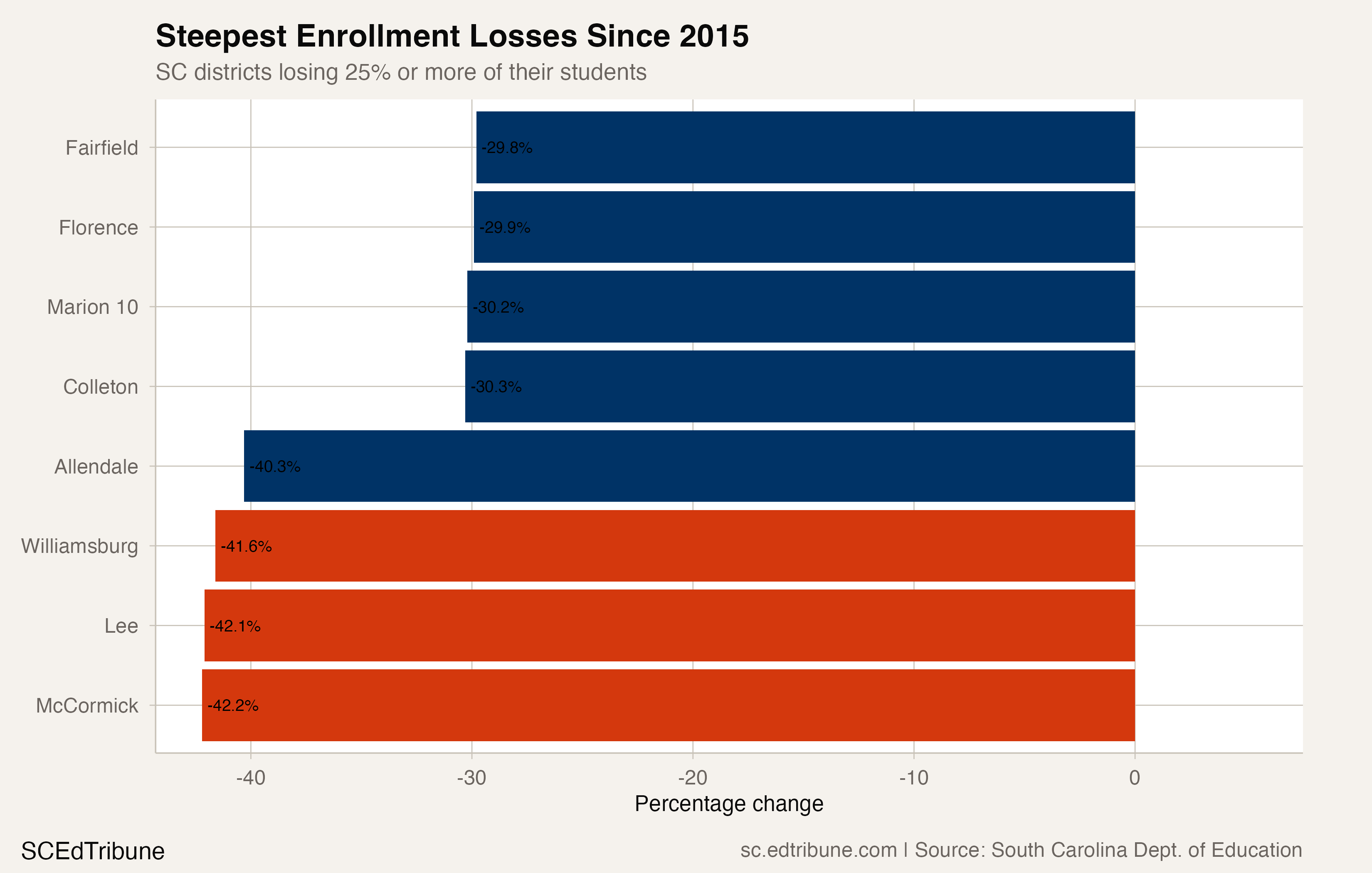
South Carolina added 32,220 students between 2015 and 2026, a 4.3% gain. McCormick↗ET lost 42.2% of its enrollment over the same period. Lee↗ET lost 42.1%. Williamsburg↗ET lost 41.6%. A fourth district, Allendale↗ET, lost 40.3%.
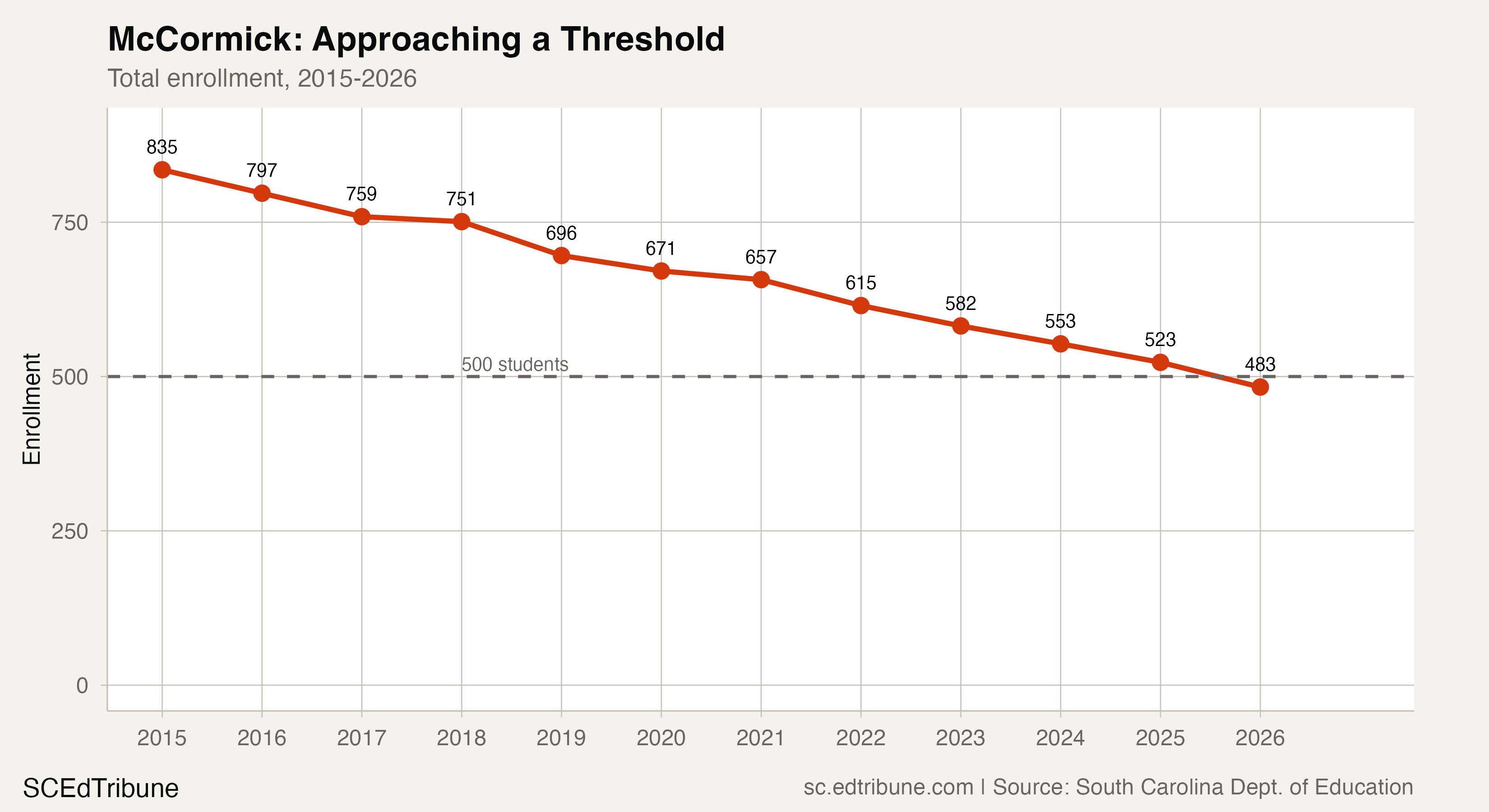
These are not large districts absorbing a bad year. McCormick enrolled 483 students in 2025-26. It has declined every single year for 11 consecutive years. Williamsburg has done the same. Lee declined in 10 of 11 years.
While the state was growing, these districts were emptying.
The trajectory has no floor
The three focal districts, McCormick, Lee, and Williamsburg, enrolled a combined 7,412 students in 2014-15. By 2025-26, that number is 4,312: a loss of 3,100 students, or 41.8%.
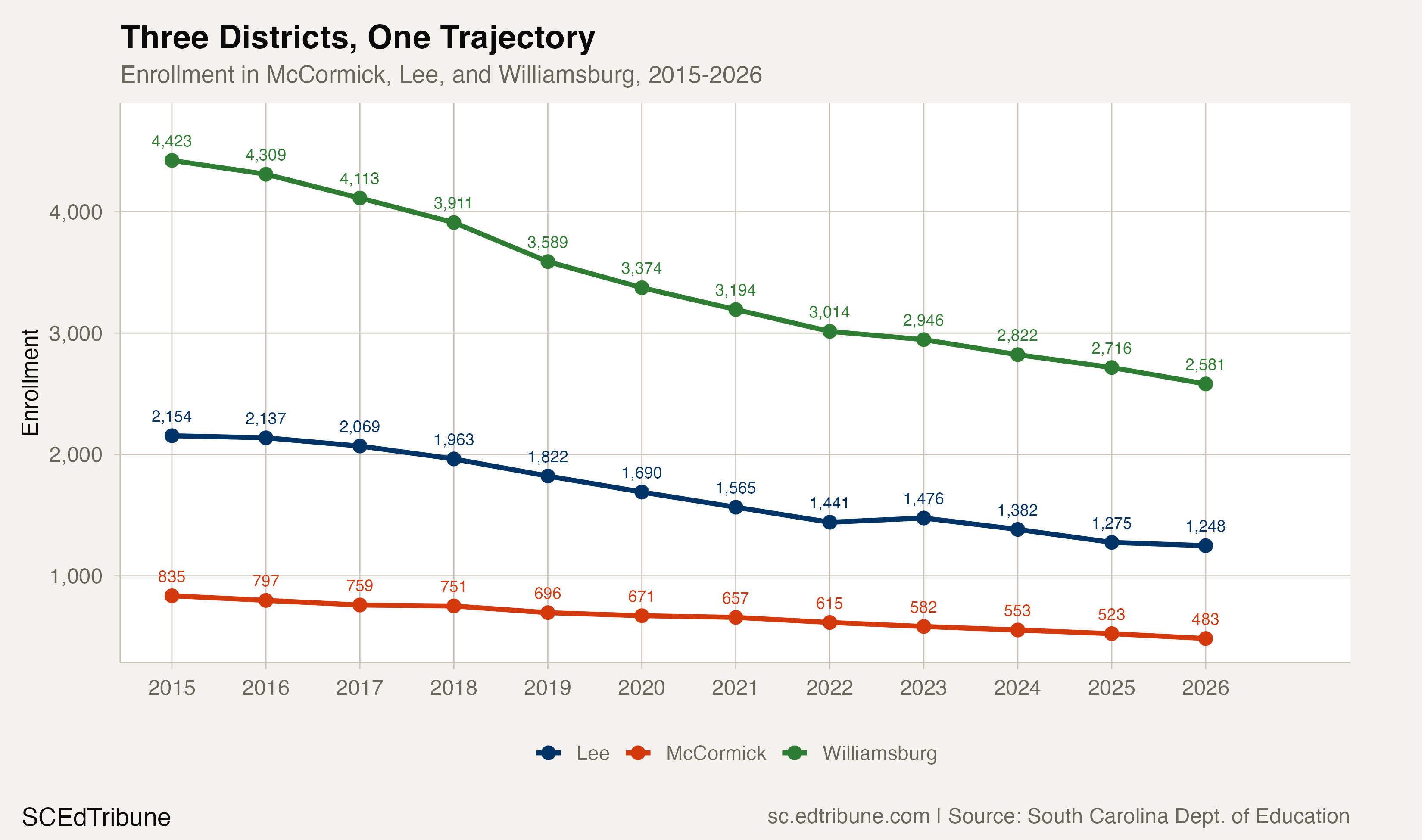
The decline is not slowing. McCormick lost 40 students in 2025-26, a 7.6% drop, its steepest percentage loss in the data window. Lee lost 27 after losing 107 the previous year. Williamsburg lost 135, accelerating from 106 the year before.
McCormick's enrollment, 835 in 2015, has fallen below 500. At its average pace of 32 students lost per year over the past 11 years, simple arithmetic puts the district below 400 by 2030. Williamsburg, the largest of the three, has lost an average of 168 students per year. Lee averages 82.
These are not isolated cases. Six South Carolina districts have lost more than 30% of their enrollment since 2015. Four have lost more than 40%. Among all districts present in both years, 28 have lost more than 10%.
The gap between these districts and the state is widening
Indexed to 2015 enrollment, South Carolina as a whole sits at 104.3. McCormick sits at 57.8. Lee at 57.9. Williamsburg at 58.4.
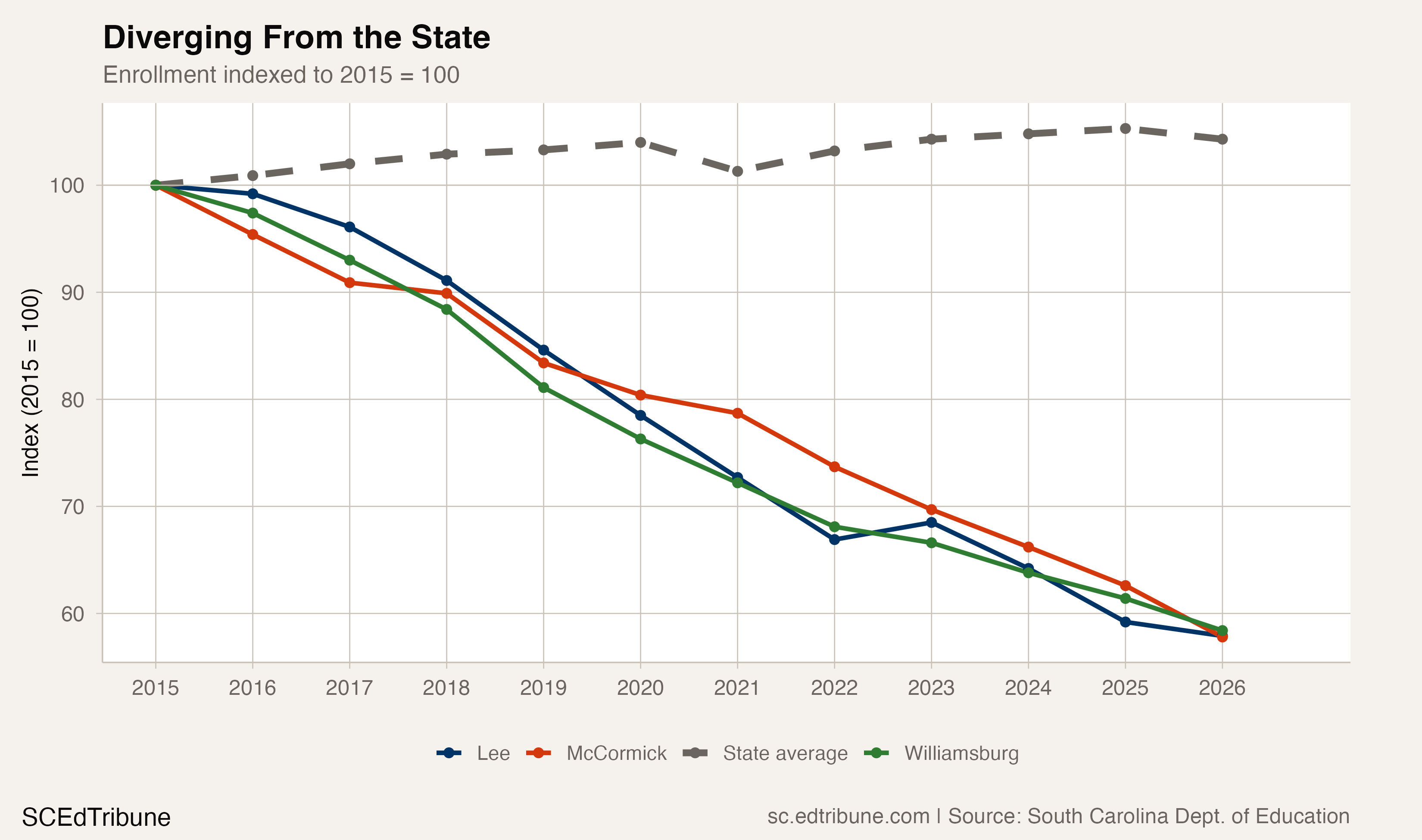
The divergence accelerated around 2019, when the state was still growing and all three districts were losing 5% to 8% of their enrollment annually. COVID hit the state hard, dropping statewide enrollment by 20,250 students in 2020-21. But these districts had already posted several annual losses in that range before the pandemic. Williamsburg's worst single year was 2018-19, when it lost 322 students, an 8.2% decline, two years before the pandemic.
Williamsburg: 11 years without a single gain
There is no year in the data window when Williamsburg's enrollment rose. Every bar on the year-over-year chart points down.
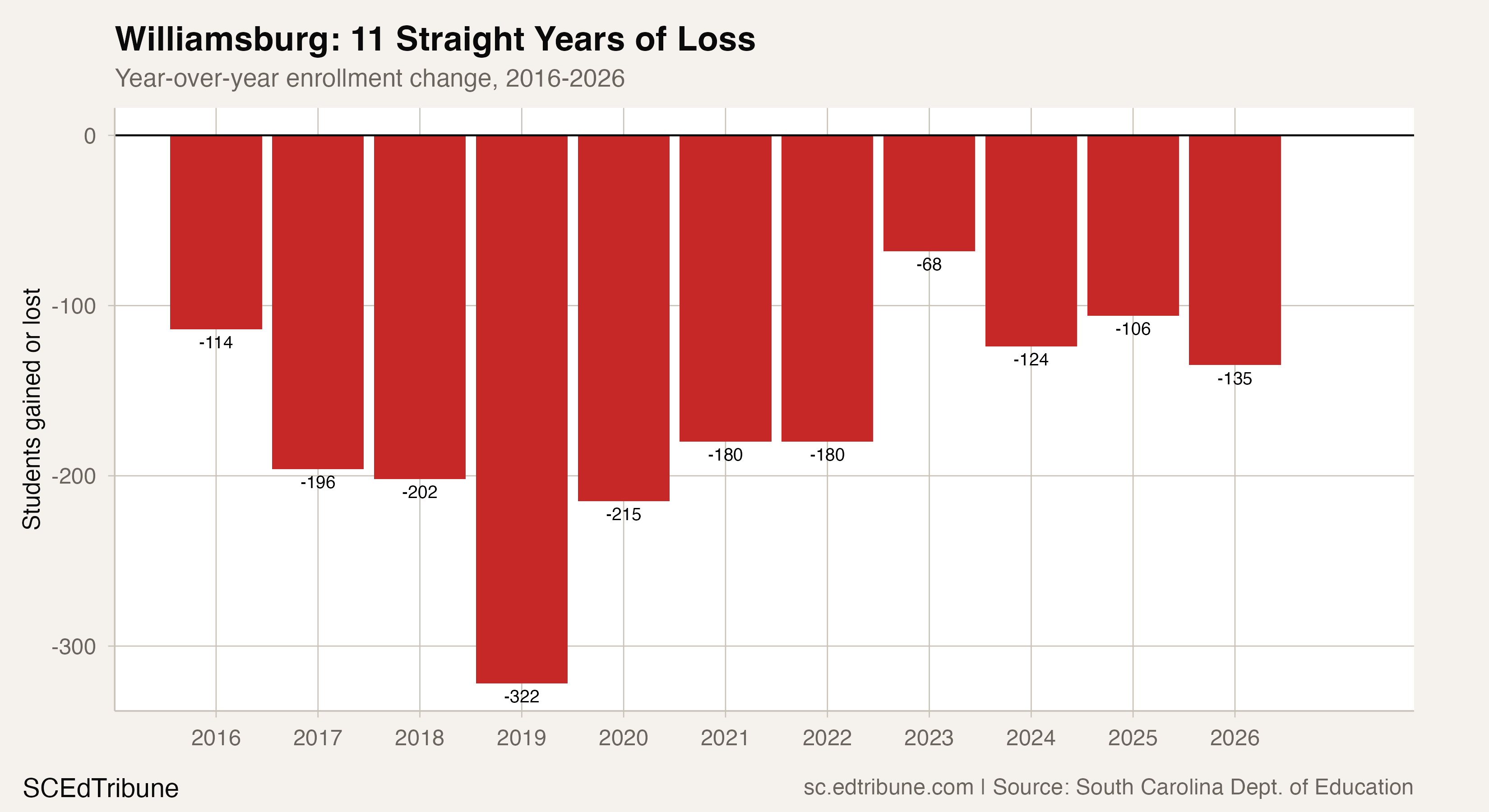
The governance record is direct evidence for oversight, not for enrollment causation: the district has been under state control since 2018, and the South Carolina Department of Education said in 2024 that it would begin transitioning more governance responsibilities to the local board. Enrollment has continued to fall through that period, from 3,911 when the state took over to 2,581 in 2025-26, a further 34% decline.
Williamsburg County's population was 30,810 in the 2020 Census, down from 34,423 in 2010. The district is shrinking in a county that had already been shrinking.
The I-95 corridor that a court called unconstitutional
McCormick, Lee, and Williamsburg are all part of the I-95 Corridor, a stretch of rural counties running through eastern South Carolina that the 2007 documentary Corridor of Shame brought to national attention. In 1993, 34 districts in the Abbeville litigation argued that the state was failing to provide a minimally adequate education.
In 2014, the South Carolina Supreme Court ruled 3-2 that the state had indeed failed its constitutional obligation. Chief Justice Jean Toal wrote that "it is the Defendants who must take the principal initiative... and have failed in their constitutional duty." Twenty-one of the 34 plaintiff districts had more than 90% of students enrolled in the free and reduced lunch program.
Three years later, the court reversed itself. In 2017, the South Carolina Supreme Court vacated its own ruling, holding that the previous decision violated separation of powers.
The enrollment data shows what happened next. Between 2015 and 2026, McCormick lost 352 students, Lee lost 906, Williamsburg lost 1,842. That is the enrollment backdrop for the consolidation debate.
What is driving the losses
Suggestive context: county population trends line up with the district enrollment losses, though they do not prove causation. McCormick County counted 9,526 residents in the 2020 Census, down from 10,233 in 2010. Lee County's Census Reporter profile lists a 25% poverty rate, per capita income of $23,949, and 11.6% of residents with a bachelor's degree or higher, compared with 32.1% statewide.
Suggestive context: South Carolina as a whole grew by 1.7% in 2024, driven by migration to Charleston, the Upstate, and the Grand Strand. But the enrollment data cannot identify individual family motives, and statewide growth has not prevented these rural districts from shrinking.
Suggestive context: charter school expansion may also play a role, though it is difficult to quantify. South Carolina's charter sector has grown substantially since 2019, with the Charter Institute at Erskine alone growing from 8,450 to 28,376 students. Whether charter schools draw enrollment from these specific rural districts, or whether the families leaving would have left regardless, is not clear from enrollment data alone.
McCormick below 500
McCormick crossed below 500 students in 2025-26, enrolling 483. For context, Wando High School in Charleston County lists 2,593 students, more than five times McCormick's entire district. McCormick's district website lists elementary, middle, and high school report-card links.
A proposed consolidation bill shows where part of the policy debate is headed. House Bill 3470, introduced in the 2025-26 session, would require every county to consolidate into a single countywide district by July 2027, and then merge into regional districts by 2032. Under that bill, McCormick would join a seven-county regional district with Abbeville, Edgefield, Greenwood, Laurens, Newberry, and Saluda.
As of 2021, 11 school districts were consolidating, aided by $50 million in state incentive funding. The Palmetto Promise Institute has estimated that consolidation of the smallest districts could save $338 million over five years through reduced administrative duplication.
The question nobody answers
Suggestive context: districts this small face a structural bind. Fixed costs, a superintendent, a bus fleet, building maintenance, do not scale down proportionally. McCormick spends roughly $19,191 per student, well above the state average, not because it is lavish but because it cannot spread overhead across enough students.
The consolidation debate frames this as an efficiency problem. The enrollment data frames it differently: these are districts posting recurring 5% to 8% annual losses, with no sign of a floor in the 2015-2026 data window.
The 2025-26 data does not answer whether McCormick, Lee, or Williamsburg can sustain standalone districts at their current trajectories. It does make clear that the question can no longer be deferred. McCormick lost 40 students this year. It has 483 left.
Detailed code that reproduces the analysis and figures in this article is available exclusively to EdTribune subscribers.
Discussion
Sign in to join the discussion.
Loading comments...