For four straight years, South Carolina's three largest coastal districts grew in lockstep. Berkeley↗ET added students as housing developments spread through the I-26 corridor. Horry↗ET rode the Myrtle Beach construction boom. Charleston↗ET absorbed corporate relocations and an influx of young families. Together, the three districts accounted for 17.4% of the state's public school enrollment, and their growth was a big reason South Carolina fully recovered from its COVID losses by 2024-25.
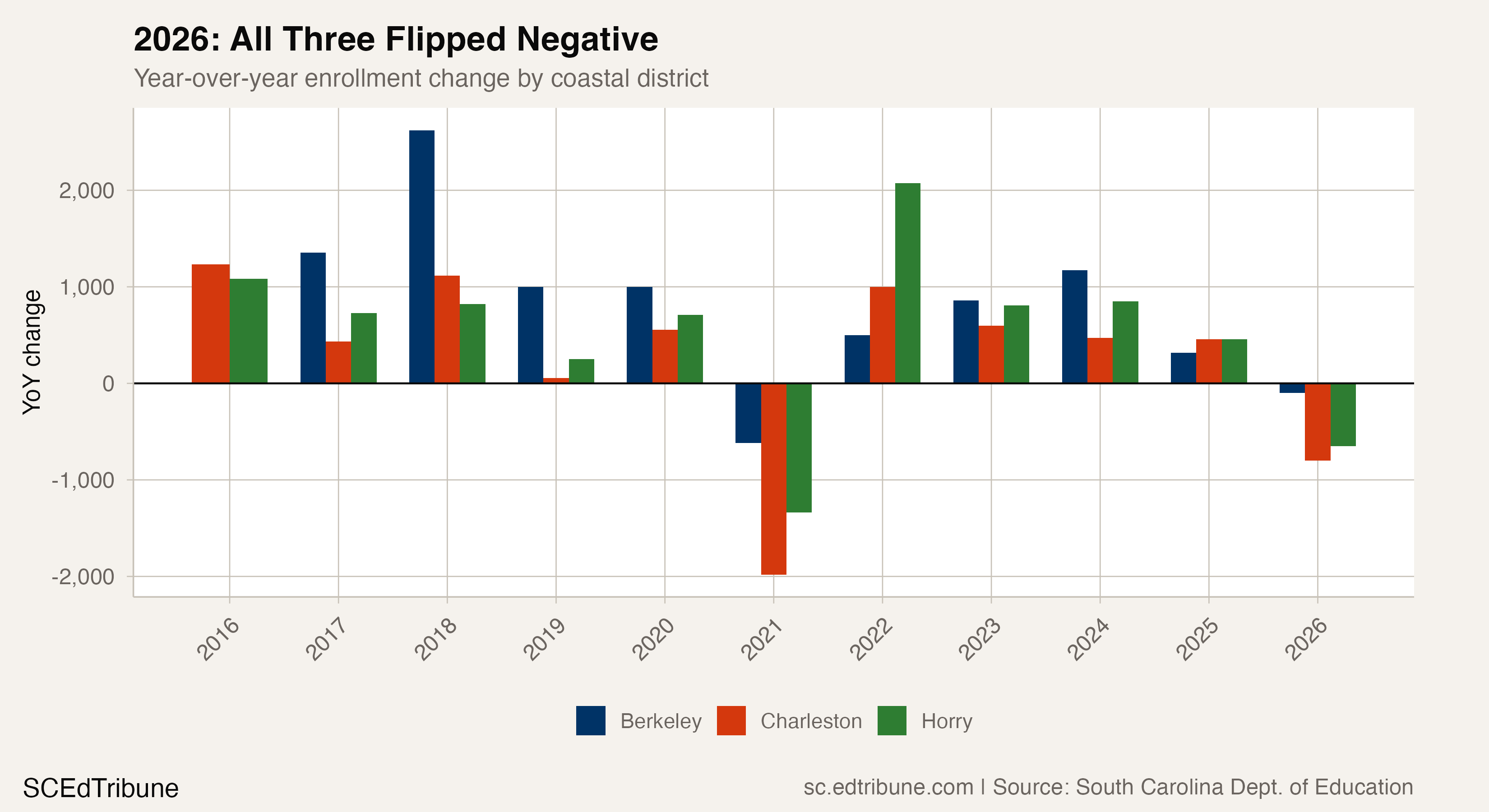
Then all three reversed at once. In 2025-26, Berkeley lost 97 students, Horry lost 649, and Charleston lost 800. The combined 1,546-student decline is modest in percentage terms, but the synchronization is not: this is the first time all three coastal districts have declined in the same non-COVID year in 12 years of data.
Four years of growth, gone in one
The trajectory of these three districts followed a remarkably similar arc. Each grew steadily from 2015, dipped during the pandemic in 2020-21, bounced back sharply in 2021-22, and then posted four consecutive years of growth through 2024-25. Berkeley's 2024 gain of 1,172 students was its largest since 2017. Horry added 848 that same year. Charleston reached its all-time high of 50,856 in 2025.
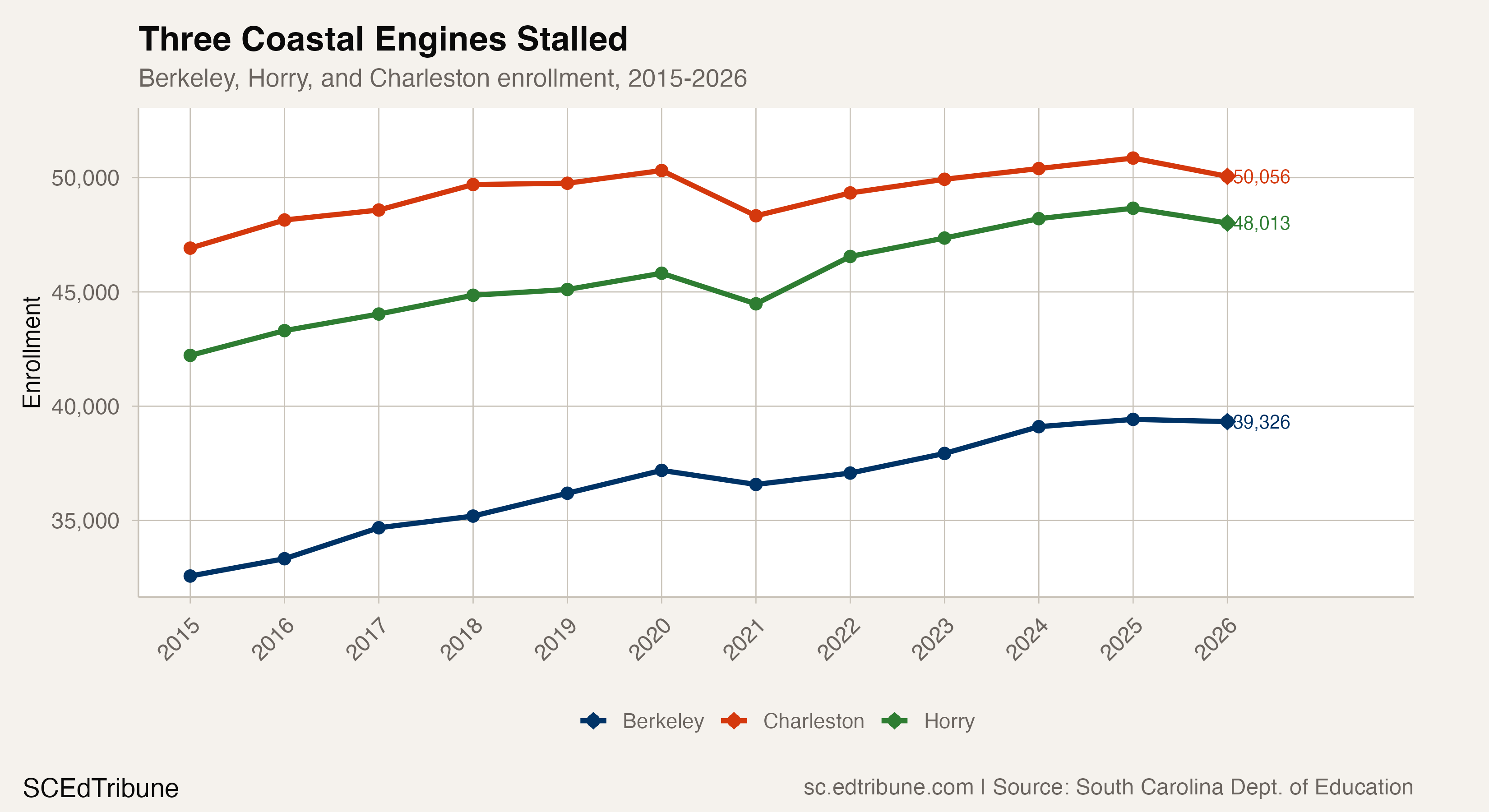
The reversal is sharpest in Charleston, where the 800-student loss (-1.6%) wiped out more than a full year of gains. Horry's 649-student decline (-1.3%) is the district's worst non-COVID year on record. Berkeley's 97-student dip (-0.2%) is the smallest of the three but still represents a break from a growth pattern that had delivered 6,757 new students over 12 years, a 20.7% gain.
The combined loss of 1,546 students accounts for 20.1% of the state's total 7,694-student decline in 2026, a year that erased South Carolina's entire post-COVID recovery surplus.
They were not alone
The coastal reversal was part of a broader pattern. Seventeen districts that grew in 2024-25 flipped to decline in 2025-26. Together, these 17 districts lost 3,311 students, accounting for 43% of the statewide drop.
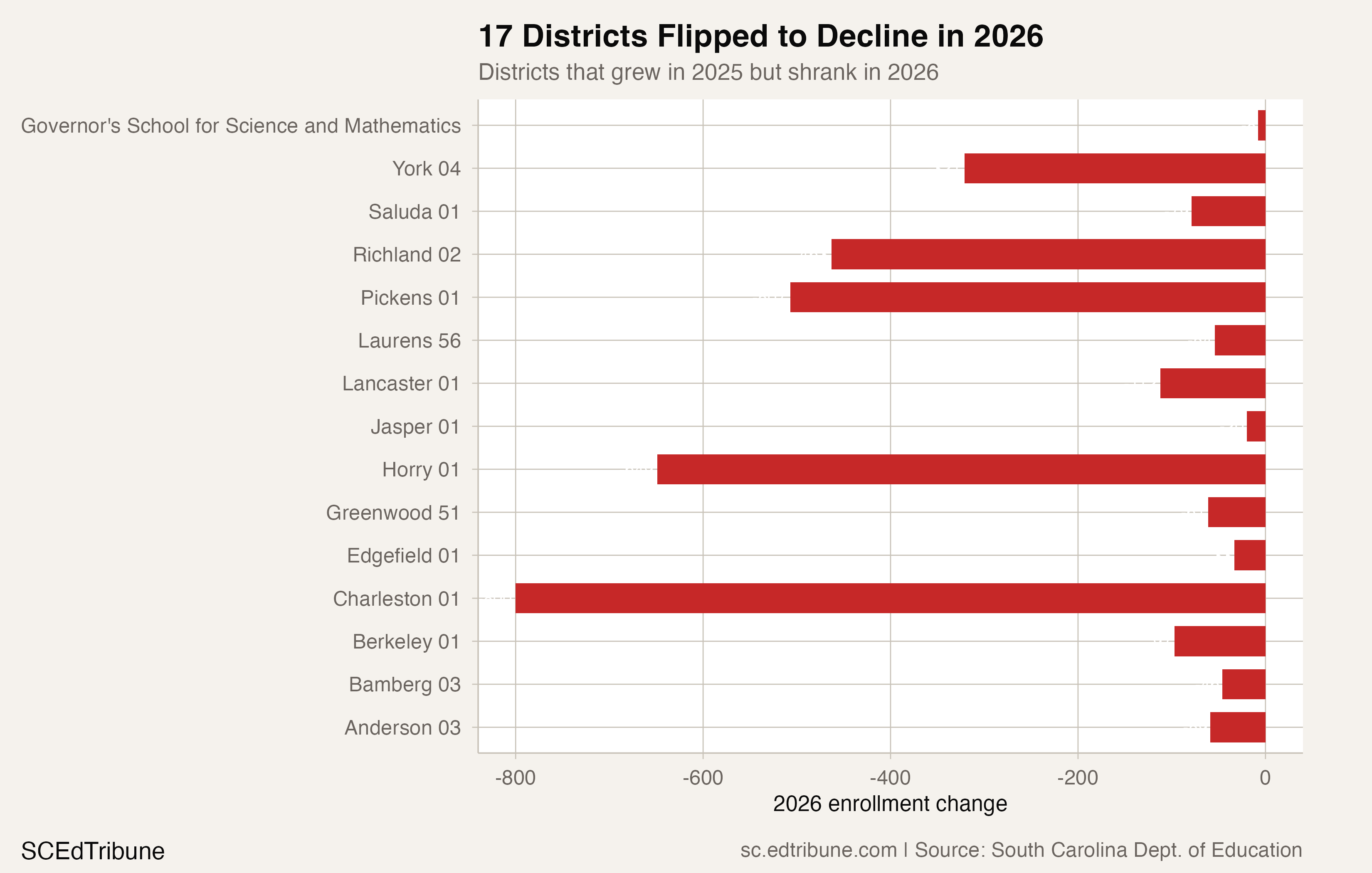
The list includes York 04↗ET (Fort Mill), which lost 321 students after years as one of SC's fastest-growing Charlotte-area suburbs. Richland 02↗ET, the Columbia metro's growth district, shed 463 students. Pickens 01↗ET in the Upstate lost 507. These are not struggling rural districts. They are the places that were supposed to be immune to decline.
Dorchester 02↗ET, the fourth member of the Lowcountry's tri-county metro area, has been declining since 2025 and lost another 212 students in 2026. Adding Dorchester to the coastal count brings the Lowcountry's combined loss to 1,758 students.
What building plans reveal about expectations
The most striking feature of this reversal is that it caught districts mid-expansion. Berkeley County is building two new schools, Bee Tree Elementary and Midtown Middle, set to open in August 2026 to address overcrowding. The district had been adding roughly 400 students per year for six or seven years. Students from more than 10 schools face redistricting for 2026-27.
Horry County still has 20 of its 58 schools operating above 95% capacity, with Carolina Forest High School projected at 120% next year. All five North Myrtle Beach schools remain overcrowded. The district purchased property in Little River for future school construction.
"We don't want to make an overcrowded school even more overcrowded." -- WMBF News, Feb. 2026
That quote was about managing student transfers into packed schools. It captures the paradox: these districts are still planning for the growth wave they expected, even as the enrollment data turns against them.
The pipeline and the charter question
Two structural forces are working against coastal districts.
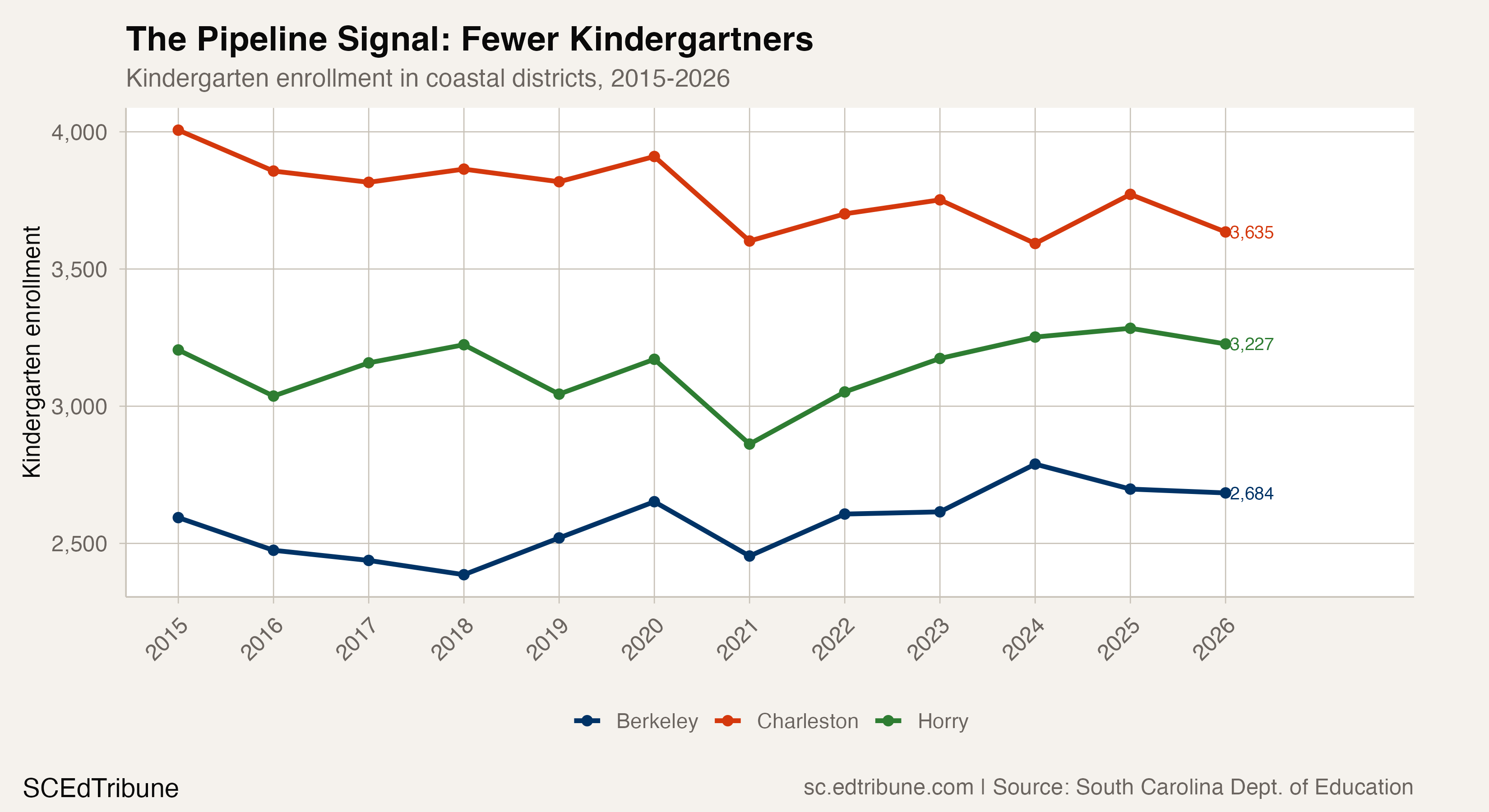
The first is the kindergarten pipeline. Charleston's kindergarten enrollment has dropped 9.3% since 2015 (from 4,006 to 3,635), tracking the statewide K decline of 9.2%. Horry's kindergarten class is essentially flat over 12 years, and Berkeley's has grown only 3.5%. The students entering the front door are fewer than the seniors walking out the back.
The second is charter growth. South Carolina's three charter operators, the Charter Institute at Erskine, SC Public Charter School District, and Limestone Charter Association, have collectively grown from 28,763 students in 2019 to 59,141 in 2026, more than doubling. In 2026 alone, they added 4,357 students while the coastal traditional districts lost 1,546.
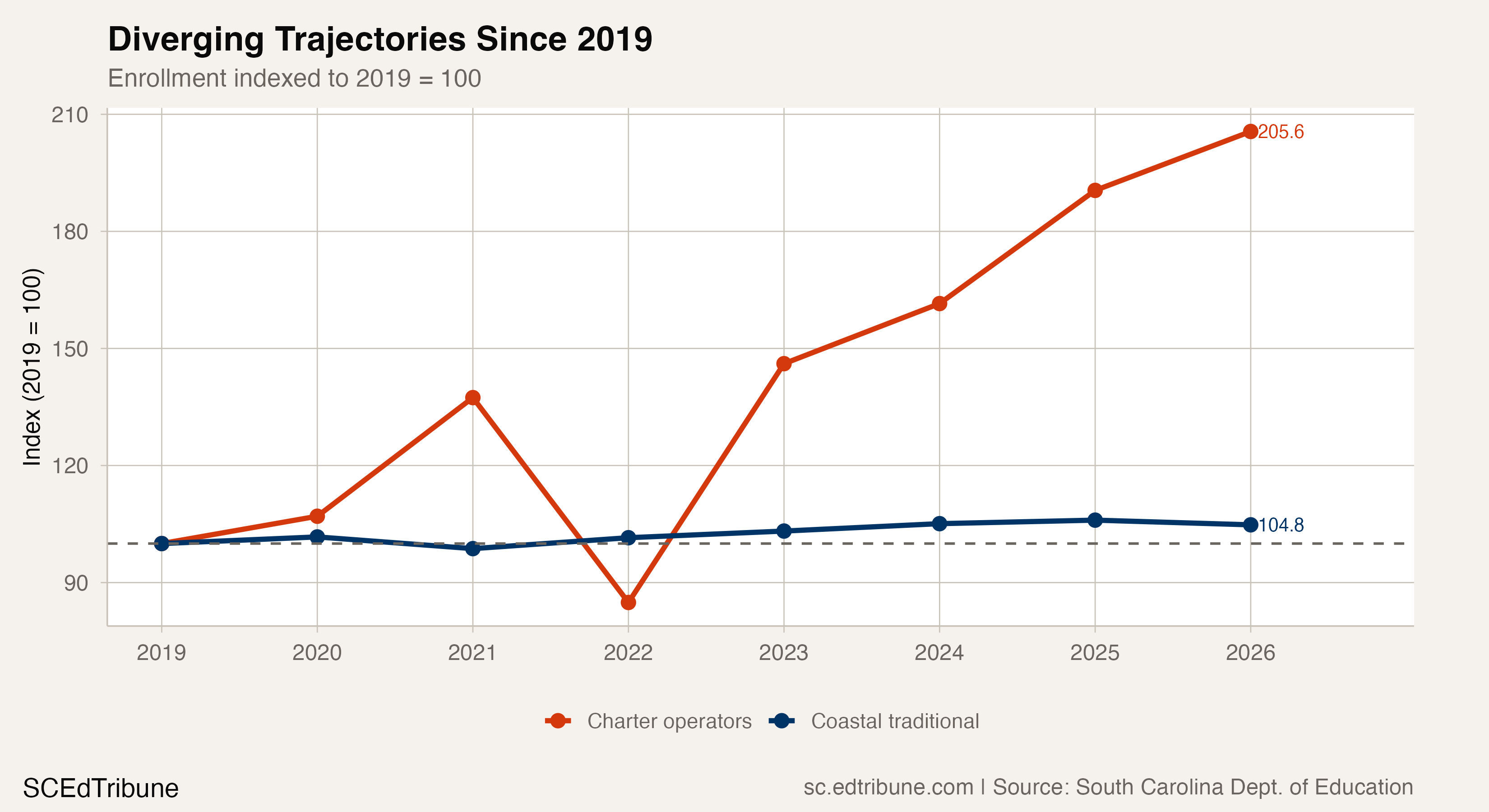
The Charter Institute at Erskine, now the state's sixth-largest district with 28,376 students, currently operates 31 schools with 13 more approved and in the pipeline. The enrollment data cannot isolate how many coastal students shifted to charters versus left the public system entirely. But the timing of charter acceleration and traditional deceleration is hard to ignore.
Sorting out causes
No single explanation accounts for a synchronized reversal across three geographically distinct districts. Several forces are plausible.
South Carolina's housing market is normalizing after years of pandemic-era frenzy. Statewide inventory is up 11.5% year-over-year and the list-to-sales price ratio has dropped to 98.4%, signaling that buyers have gained negotiating power. A cooler housing market means fewer families relocating into coastal school zones each year, and the enrollment data is consistent with that slowdown.
Demographic aging is a longer-term factor. State population projections show Berkeley County growing from 232,400 residents in 2020 to 326,615 by 2035 and Horry County nearly doubling from 370,075 to 603,675. But population growth increasingly skews older. A state that attracts retirees does not necessarily attract school-age families at the same rate, and the kindergarten data in all three coastal districts reflects this.
Charter expansion is the one factor with direct evidence in the enrollment data: charter operators added 4,357 students statewide in 2026. Some portion of those students previously attended traditional coastal schools, though the data does not specify transfers by origin district.
What a one-year reversal means, and what it does not
One year of decline does not erase 12 years of growth. Berkeley is still 20.7% larger than it was in 2015. Horry is up 13.7%. Charleston has added 3,140 students. These remain large, well-resourced districts with populations that far exceed their pre-pandemic baselines.
But Berkeley is building two new schools for August 2026, Horry has 20 buildings above 95% capacity, and Charleston just broke ground on a middle school. All three districts are spending bond money on construction designed for growth trajectories that the 2026 data no longer supports. Population growth and school enrollment growth are not the same thing, especially when charter options are expanding and the state attracts more retirees than young families.
For three decades, the South Carolina coast was the growth story. Building plans still say it is. The enrollment data has started to disagree.
Detailed code that reproduces the analysis and figures in this article is available exclusively to EdTribune subscribers.
Discussion
Sign in to join the discussion.
Loading comments...