In Saluda, a small town west of Columbia where the school district has added 242 students over the past decade, nearly half the 2,600 enrolled children are Hispanic or Latino. Six bilingual graduates from the Class of 2023 have returned to teach in the district where they grew up. This is not an isolated curiosity. It is the leading edge of the largest demographic transformation in South Carolina's public school history.
Hispanic enrollment has grown from 60,023 students in 2014-15 to 116,754 in 2025-26, a 94.5% increase that makes it the only major racial group adding students at scale. The growth has been unbroken: 11 consecutive years of gains, through recessions, a pandemic, and a statewide enrollment reversal. Without Hispanic enrollment growth, South Carolina would have lost 24,511 students over this period instead of gaining 32,220.
From 8% to nearly 15%
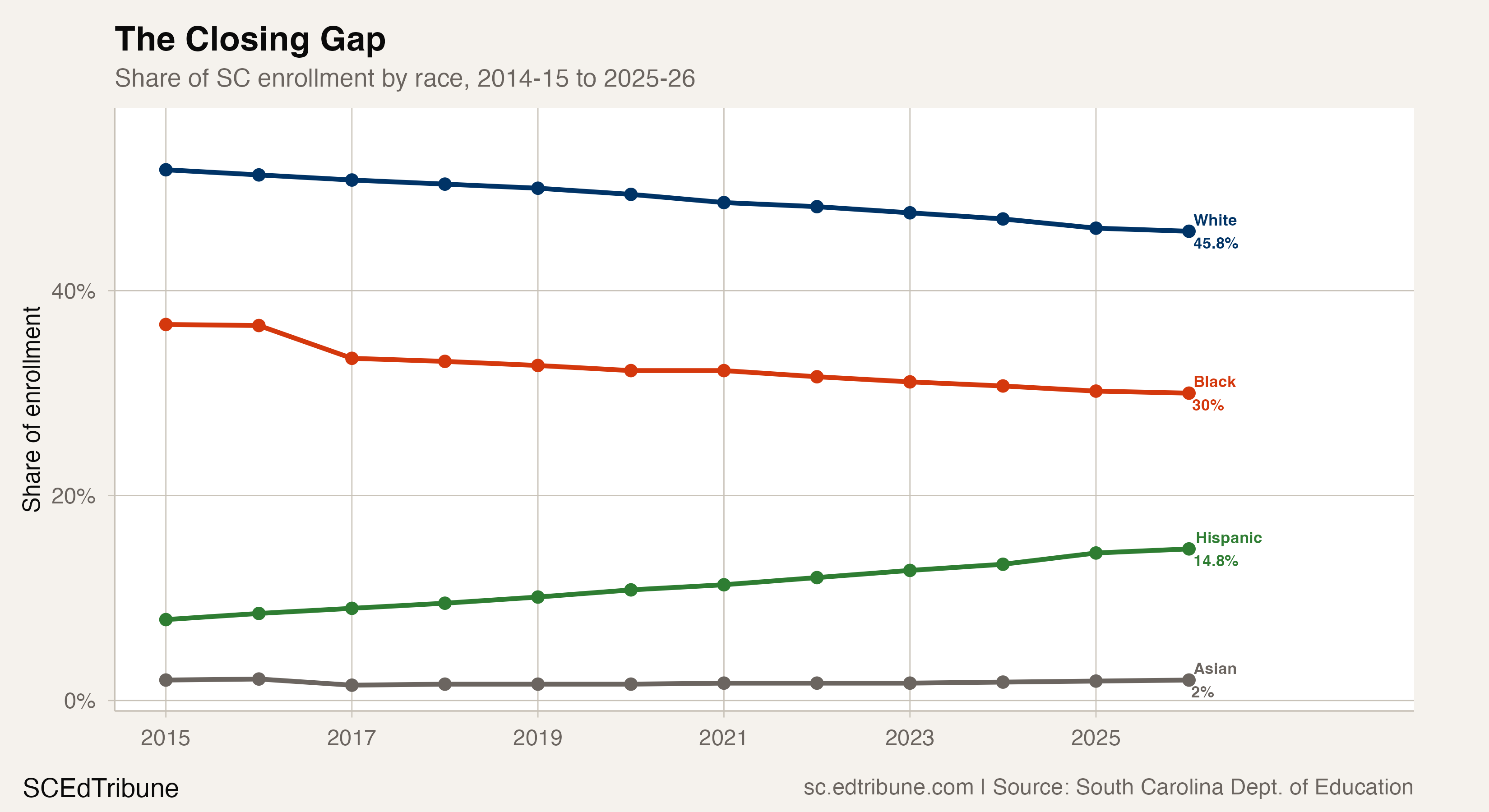
Hispanic students represented 7.9% of South Carolina's enrollment in 2014-15. By 2025-26, that share has reached 14.8%, nearly one in seven students statewide. The growth is accelerating: the first half of the data window (2015 to 2020) added 2.9 percentage points of share, while the second half (2020 to 2026) added 4.0 points.
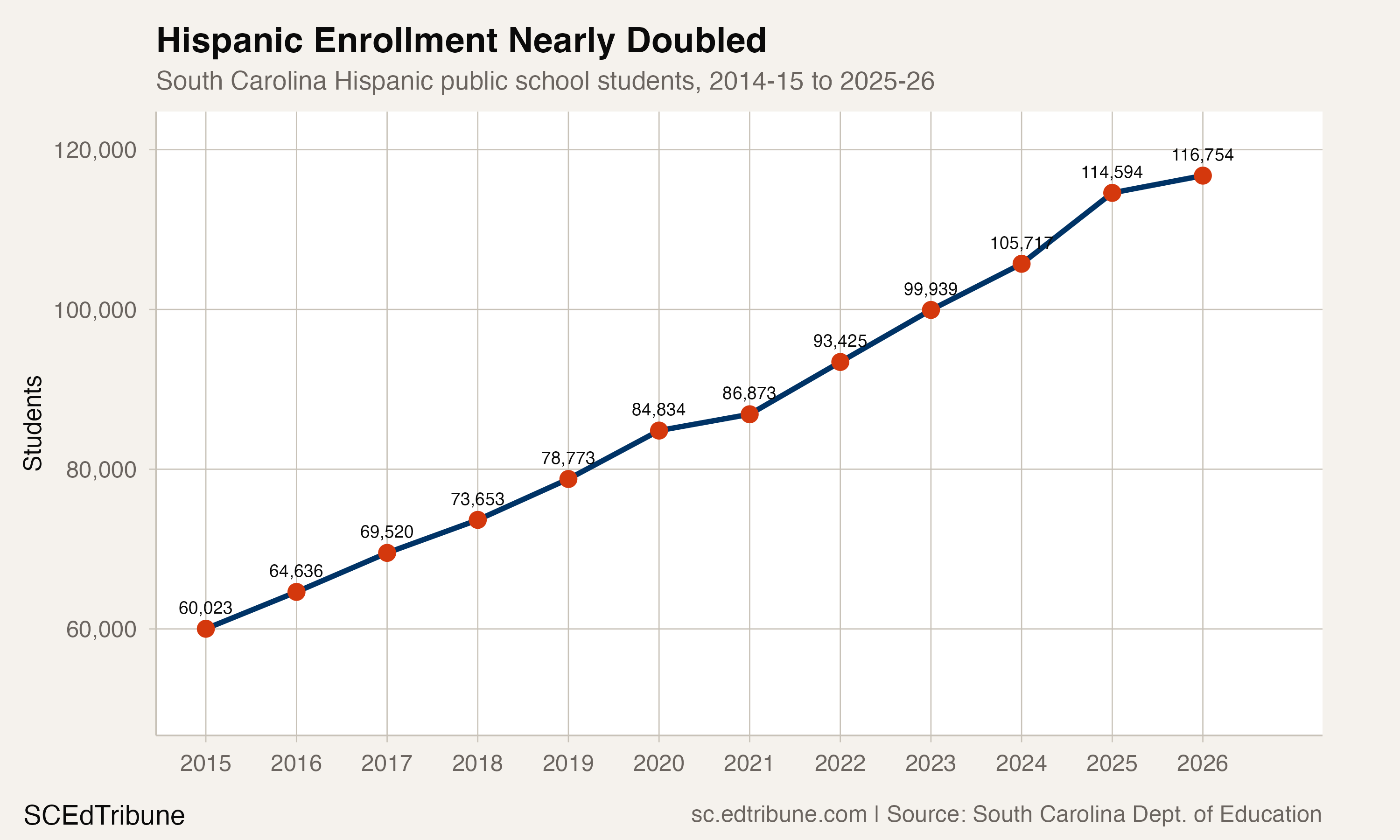
The scale of the shift becomes clearer in context. Over the same 11 years, white enrollment fell by 30,633 students (-7.8%) and Black enrollment fell by 41,256 (-14.9%). Asian enrollment was essentially flat at around 15,400. Multiracial students, tracked since 2017, grew 73.2%. But no group comes close to matching the Hispanic trajectory in either absolute numbers or growth rate.
The number of districts where Hispanic students make up more than 10% of enrollment has jumped from 10 in 2015 to 38 in 2026. Four districts now have Hispanic shares above 30%.
Poultry plants, construction sites, resort towns
The growth is not evenly distributed. It follows three economic corridors that have drawn Latino workers and families to South Carolina over the past two decades.
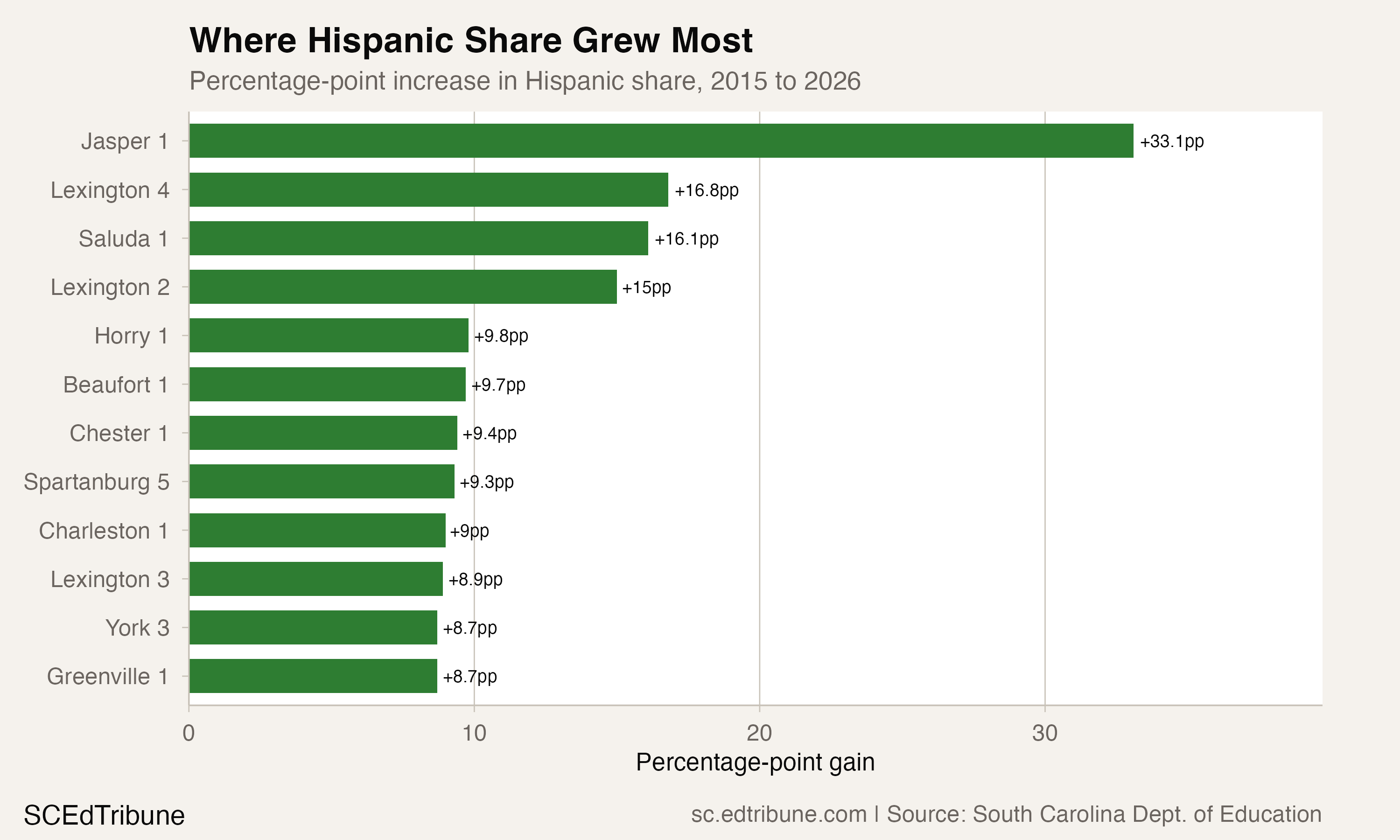
In Jasper 01↗ET, a small Lowcountry district near the Georgia border, Hispanic share jumped from 25.3% to 58.4%, a 33-percentage-point gain that makes it the most heavily Hispanic public school district in the state. Jasper County was the third-fastest-growing county in the nation in 2024, with 5.9% population growth driven largely by construction and hospitality employment tied to the Lowcountry's building boom.
Saluda 01↗ET, where Hispanic share climbed from 31.9% to 48.0%, is a different story. Mexican and Guatemalan immigrants began arriving in the late 1990s for jobs at poultry processing plants and produce farms. A PBS Frontline investigation documented how the town of Saluda itself is now majority Hispanic, with the school district spending $600,000 over five years on multilingual teaching staff and $285,000 on translators. Voters approved a $49 million bond referendum in 2022 to expand and renovate schools that were bursting at capacity.
"We welcome all kids." -- Harvey Livingston, Saluda County Schools superintendent, PBS Frontline
The coastal tourism corridor tells a third version. Horry 01↗ET, home to Myrtle Beach, saw its Hispanic enrollment jump from 4,064 to 9,305, a 129% increase that pushed Hispanic share from 9.6% to 19.4%. Beaufort 01↗ET, anchored by Hilton Head Island's resort economy, holds the largest Hispanic share among major districts at 33.2%.
The big districts are transforming too
The geographic concentration in small agricultural and tourism communities is well documented. Less discussed is the scale of change in South Carolina's largest school systems.
Greenville 01↗ET, the state's largest district, added 6,764 Hispanic students since 2015, more than any other district in absolute terms. Hispanic share there rose from 14.0% to 22.7%. Charleston 01↗ET added 4,748 Hispanic students (+124.3%), pushing its share from 8.1% to 17.1%. Berkeley 01 added 3,851 (+132.5%).
Across these three coastal and Upstate metro districts alone, Hispanic enrollment grew by 15,363 students. That is more than the entire Hispanic enrollment of 40 of the state's 82 traditional districts.
The gap that keeps closing
In 2014-15, Black students outnumbered Hispanic students by 217,762. That gap has narrowed to 119,775, a 45% reduction in 11 years. The convergence is driven from both directions: Black enrollment declined by 41,256 while Hispanic enrollment rose by 56,731.
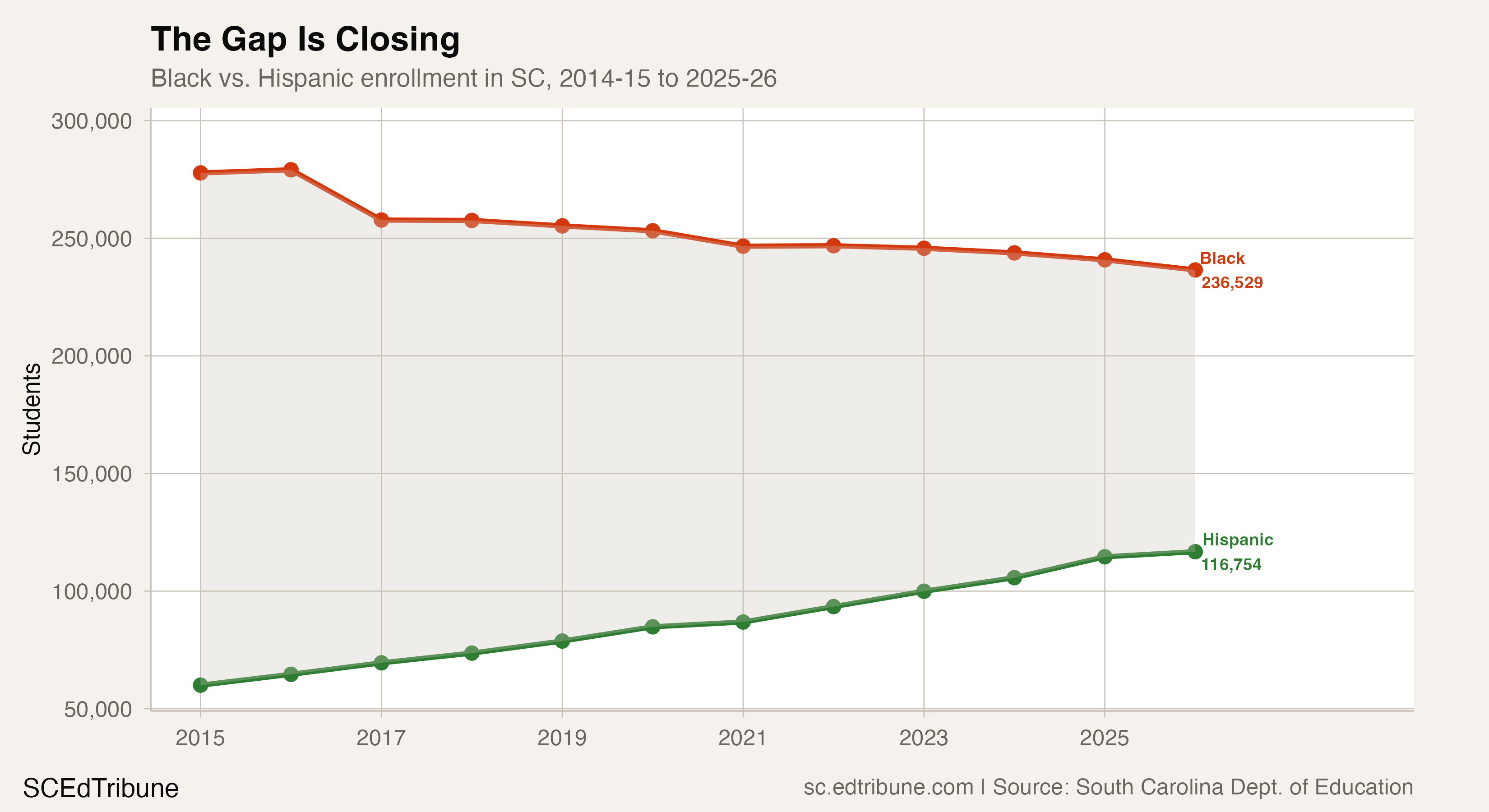
At the current trajectory, where Hispanic enrollment gains roughly 5,200 students per year and Black enrollment loses about 3,800, the two lines would cross sometime around 2035. That projection is crude. But the direction is unambiguous: Hispanic students are on a path to become South Carolina's second-largest racial group within the next decade, a reordering of the state's demographic hierarchy that has no precedent in its school data.
Growth slowed sharply in 2026
The year-over-year data introduces a caveat to the acceleration narrative. After adding 8,877 Hispanic students in 2024-25, the largest single-year gain in the data, growth dropped to 2,160 in 2025-26. That is the smallest gain since the COVID-disrupted year of 2020-21, when the increase was 2,039.
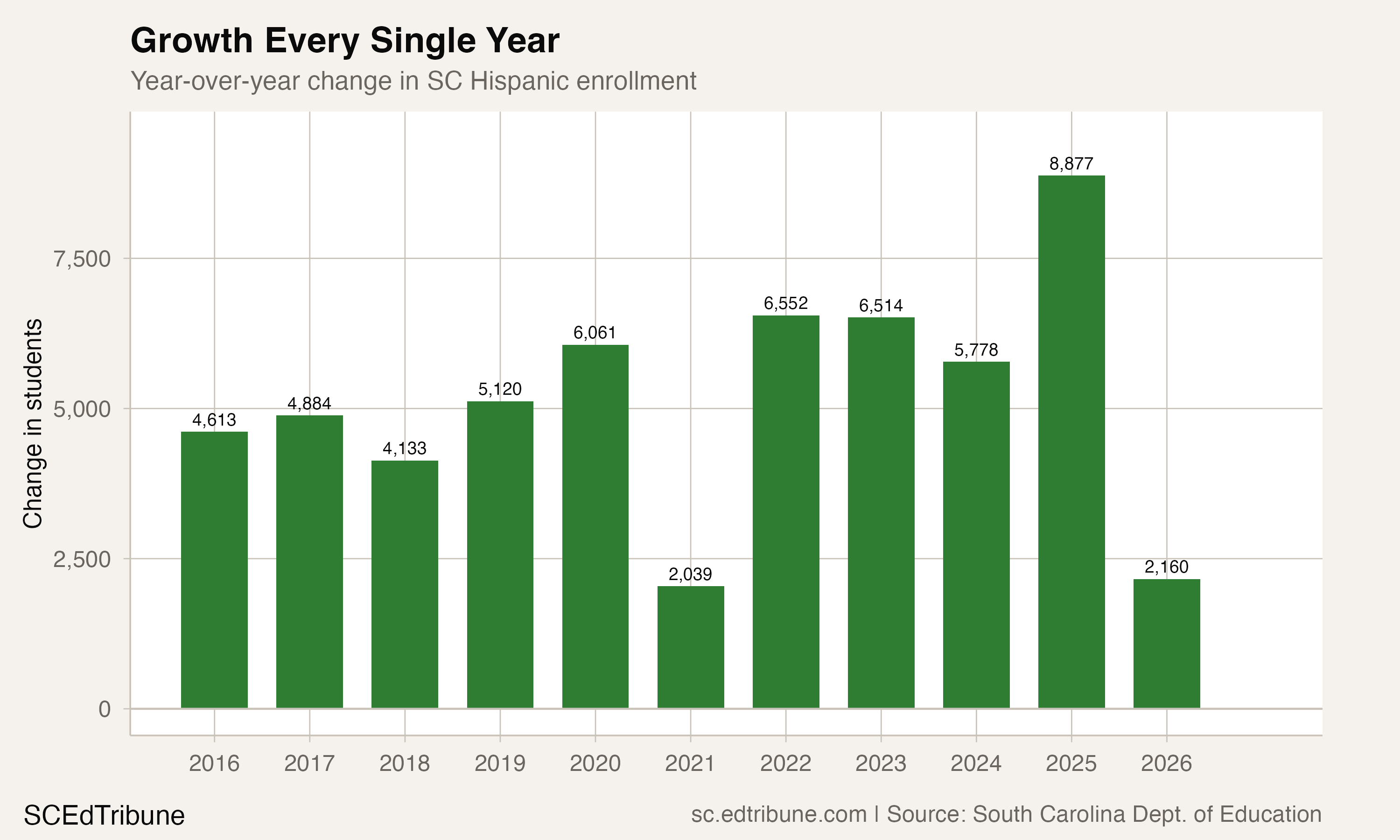
The 2025-26 slowdown coincides with South Carolina's broader enrollment cliff: the state lost 7,694 students overall, its first non-COVID decline in the data window. Smaller kindergarten cohorts born during the pandemic may have begun to temper Hispanic growth. Federal immigration enforcement in 2025 may have depressed enrollment among families uncertain of their status. Both forces are plausible. Both could be acting simultaneously.
What it means for classrooms
The instructional implications are substantial. South Carolina was home to nearly 66,719 English language learners in 2022, and the overlap between Hispanic enrollment and EL identification is significant. The state's EL data, available only through 2024-25, shows the need for multilingual instruction growing faster than the teaching workforce can supply it.
The Saluda model, where districts invest in bilingual staff and grow their own teachers from the community, represents one approach. But Saluda is a district of 2,600 students. Greenville, with 17,348 Hispanic students and growing, faces the same challenge at an entirely different scale.
South Carolina has considered policy in this direction. Legislation introduced for the 2025-26 session would establish educational standards for Spanish instruction beginning with the 2026-27 school year if enacted. Whether that translates into staffing capacity quickly enough to keep pace with enrollment growth is the open question.
The 56,731 additional Hispanic students who entered South Carolina's public schools over the past 11 years represent the single largest source of enrollment growth in the state. Without them, South Carolina's student population would have been smaller in 2025-26 than it was in 2015. The next decade will test whether the school systems that absorbed this growth can serve these students as well as they counted them.
Detailed code that reproduces the analysis and figures in this article is available exclusively to EdTribune subscribers.
Discussion
Sign in to join the discussion.
Loading comments...