Correction (August 16, 2026): An earlier draft counted a Charleston charter outside the district in its school comparison. The corrected count is five of South Carolina's 16 majority-absent schools in Charleston County School District.
The premise is straightforward and a little uncomfortable: pay families $25 per week if their child attends school every day. Charleston County School District↗ET, South Carolina's second-largest at 50,814 students, is testing this idea at 10 pilot schools from March through May 2025, funded through its Weighted Student Funding program. Early reports say the pilot produced "significant increases" in perfect attendance within 2.5 weeks.
The experiment arrives alongside a data story that is both encouraging and incomplete. Charleston County's chronic absenteeism rate improved from 24.4% in 2023-24 to 20.5% in 2024-25, a 3.9 percentage point drop that outpaced the state's overall improvement. But the current rate is still 2.7 points above where the district started in 2021-22, when it measured 17.8%.
The trajectory that prompted the experiment
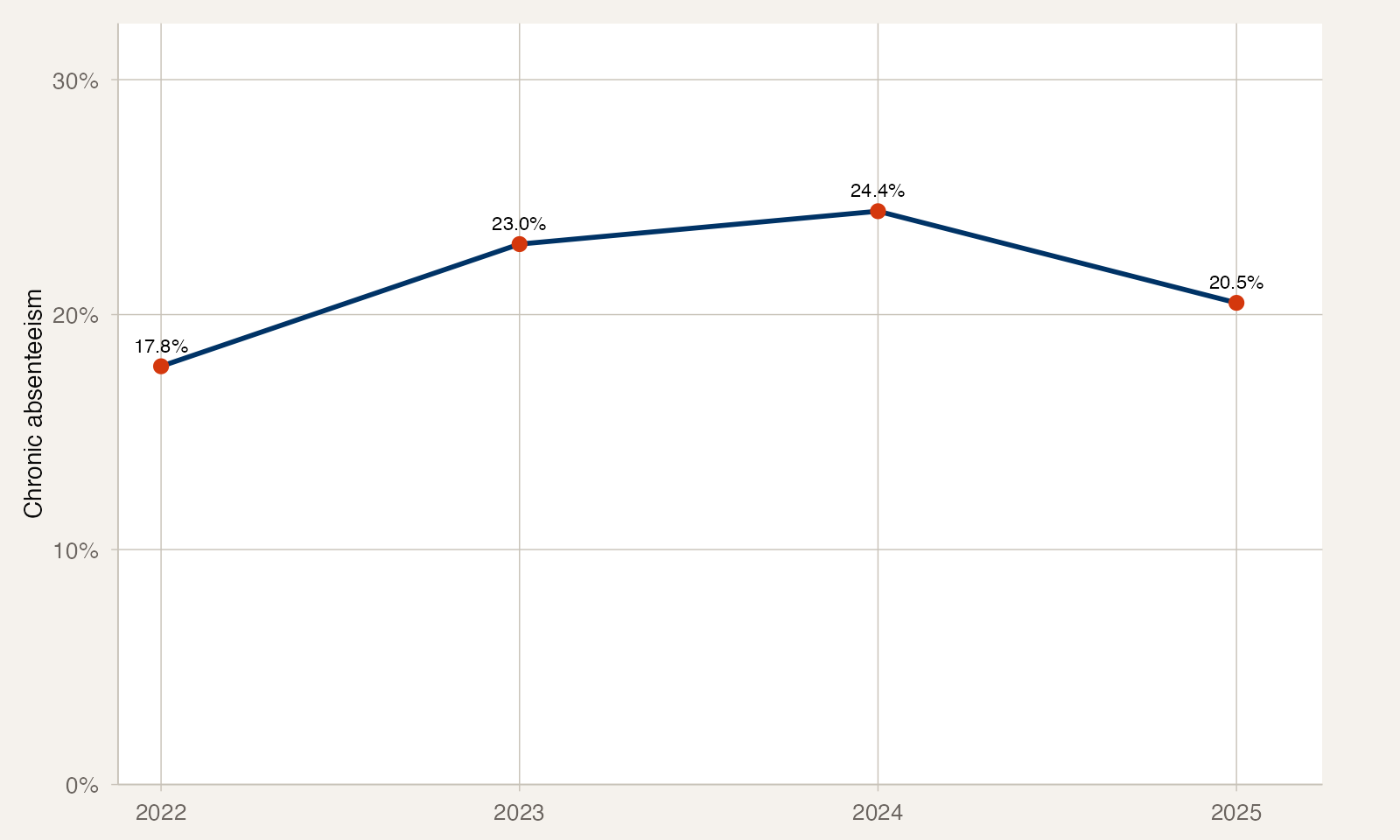
Charleston's four-year arc follows a pattern shared by many South Carolina districts: a relatively manageable rate in 2021-22 (17.8%), a sharp increase to 23.0% in 2022-23, a further worsening to 24.4% in 2023-24, and then a partial recovery to 20.5% in 2024-25. The notable detail is the timing. The statewide average peaked in 2022-23 and edged down the following year, but Charleston's rate kept climbing into 2023-24 before it turned. The district was roughly a year behind the statewide recovery curve.
The 3.9-point improvement in 2024-25 caught up some of that lost ground. In absolute terms, 10,420 Charleston students were chronically absent in 2024-25, down from 12,980 the previous year. That is 2,560 fewer students missing a month of school, a number that translates into thousands of additional instructional days across the district.
What $25 buys
The incentive pilot targets schools with the highest chronic absence rates, concentrating in North Charleston, where several schools have rates above 50%. Learn4Life High School in Charleston, a charter school, has a 90.1% chronic rate. North Charleston High is at 63.4%. R.B. Stall High is at 53.9%. These are not schools where traditional interventions, attendance letters, phone calls, mentoring programs, have produced sufficient results.
The $25 weekly payment is modest by design. It is roughly the cost of gas, bus fare, or a shift of child care, the kinds of concrete barriers that keep students home. The idea is borrowed from conditional cash transfer programs that have shown success in developing countries, where small payments tied to school attendance produced substantial enrollment gains.
Whether a program designed for communities with extreme poverty in Latin America or sub-Saharan Africa translates to North Charleston is an open question. The cultural and economic contexts are different. But the underlying logic, that attendance barriers are often financial and that removing small financial friction can change behavior, applies across settings.
The debate
Paying families for attendance is not universally popular. Critics argue it sends the message that education is only worth attending if you are compensated, that it rewards behavior that should be expected, and that the money would be better spent on addressing root causes: transportation, housing, health care. Supporters counter that the root causes are expensive, slow to address, and that children are falling behind right now. A $25 payment that gets a child in a classroom this week produces an immediate educational benefit, even if it does not solve the underlying problem.
Charleston is not the first district in the country to try this approach. Districts in Dallas, Washington DC, and other cities have experimented with financial incentives for attendance, with mixed but generally positive short-term results. The longer-term question, whether attendance persists after payments stop, is harder to answer.
The broader context
Charleston County is a district of extremes. Affluent coastal suburbs sit on one end, schools with majority chronic absenteeism on the other. The 20.5% overall rate masks enormous variation within the district: some schools are under 10% chronic, while five of the state's 16 majority-absent schools are Charleston County School District schools.
South Carolina's funding model uses Average Daily Membership at the 45th and 135th days, meaning chronically absent students still generate funding as long as they are enrolled and present on count days. The fiscal incentive for the district to improve attendance is indirect. The educational incentive is not.
Ten schools, two months, $25 a week. The pilot is small enough that its results will not move Charleston's overall rate. But if the early numbers hold, Charleston will have demonstrated something that matters beyond a single district: that some of the children counted in the chronic absent column are reachable with a bus pass worth of money. The harder question is what it means that a public school system had to reach for cash payments to do something as basic as getting children through the door.
Data source: Chronic absenteeism figures come from the South Carolina Department of Education report card data covering the 2021-22 through 2024-25 school years. South Carolina defines chronic absenteeism as a student missing 10 percent or more of enrolled days. Details of the $25-per-week pilot, the conditional cash transfer research, and incentive programs in other cities are drawn from the linked news and policy sources and are not part of the state enrollment or attendance data.
Detailed code that reproduces the analysis and figures in this article is available exclusively to EdTribune subscribers.
Discussion
Sign in to join the discussion.
Loading comments...