McCormick 01↗ET enrolled 483 students in 2025-26. That is roughly 37 per grade. The district has lost students every single year for 11 consecutive years, shedding 42.2% of its enrollment since 2014-15. It is not alone.
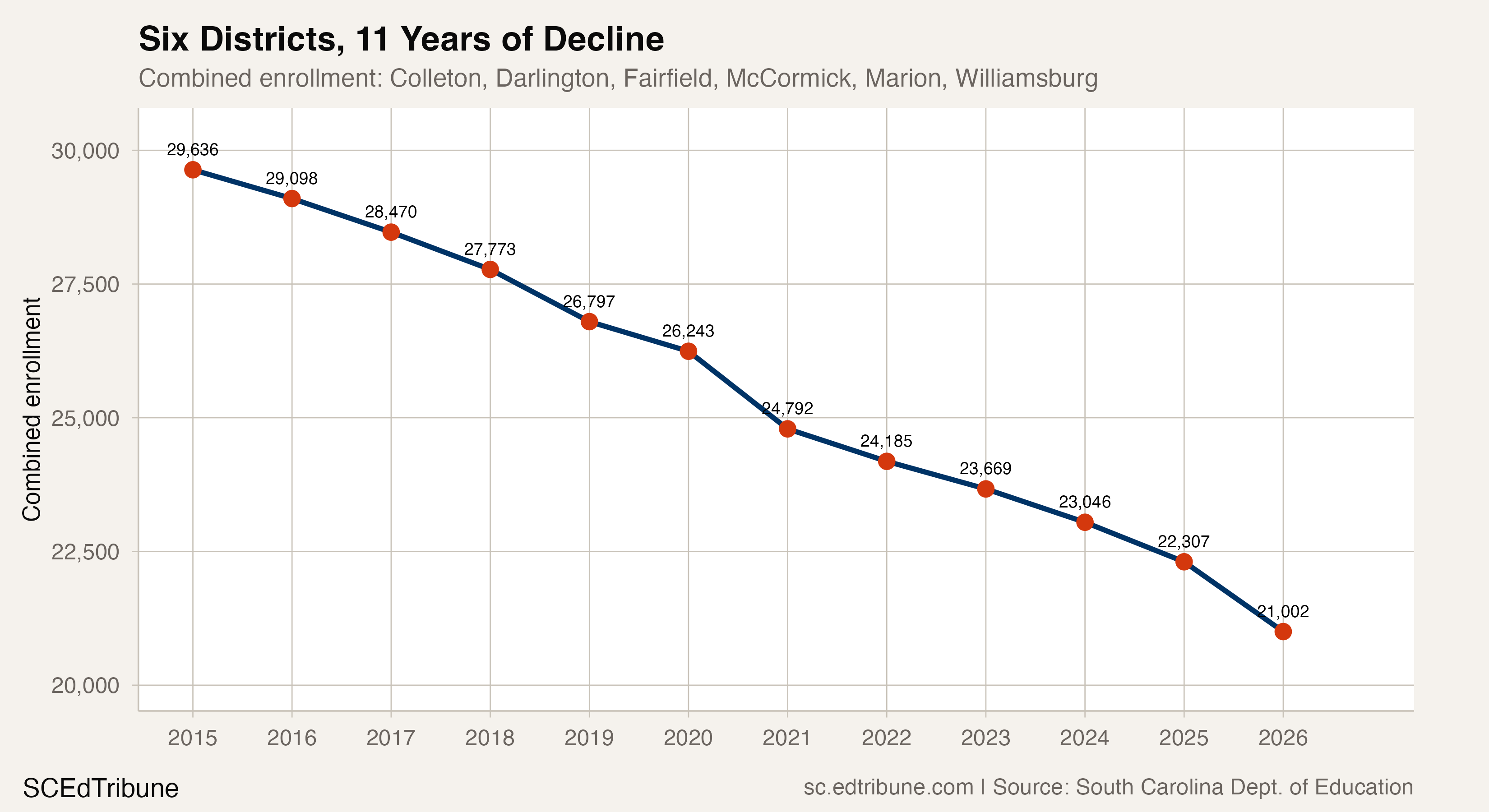
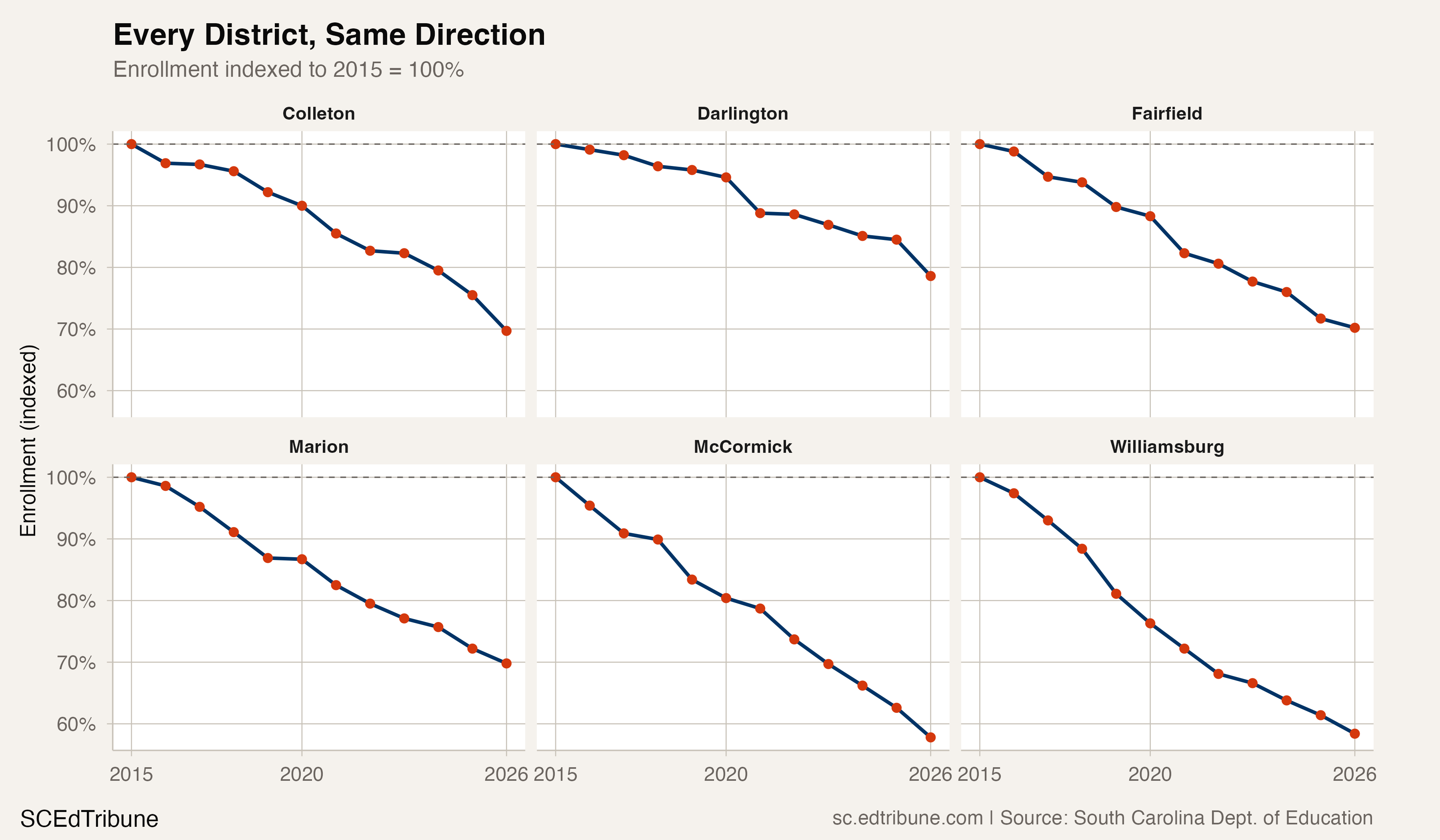
Five other South Carolina districts share that distinction: Colleton 01↗ET, Darlington 01↗ET, Fairfield 01↗ET, Marion 10↗ET, and Williamsburg 01↗ET. Each has declined every year in the 12-year data window, an 11-year streak of unbroken loss with no sign of stabilization. Combined, the six have gone from 29,636 students to 21,002, a 29.1% decline. All six hit all-time lows in 2025-26.
These are not random points on the map. They trace the I-95 corridor through South Carolina's rural interior, the same stretch of counties that gave rise to the term "Corridor of Shame" and the landmark Abbeville County School District v. State of South Carolina lawsuit over whether the state was meeting its constitutional obligation to educate children in its poorest communities.
The gap that keeps widening
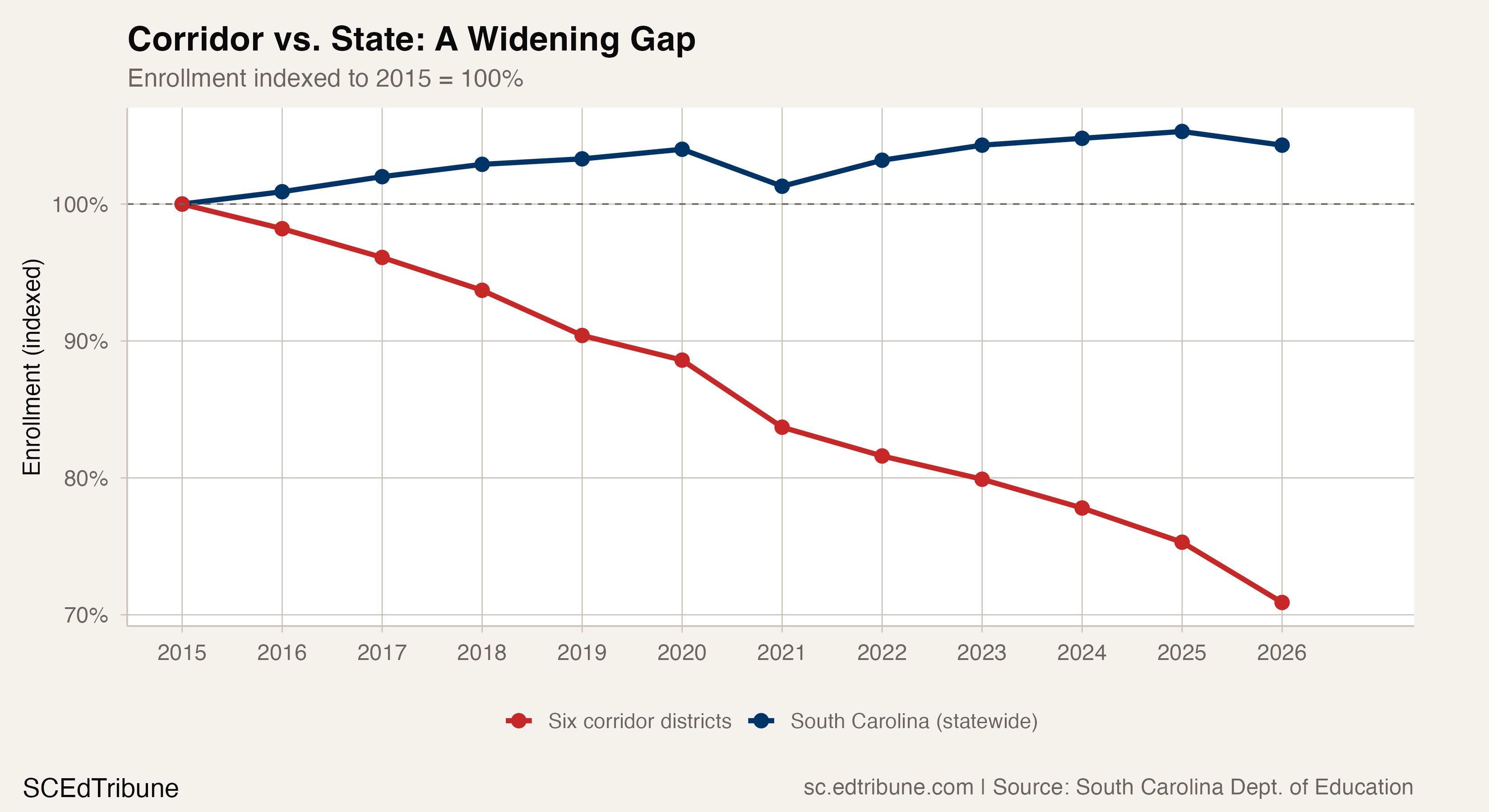
South Carolina's statewide enrollment grew 4.3% between 2014-15 and 2025-26, from 756,866 to 789,086. Coastal boomtowns, Charlotte spillover communities, and charter operators drove that growth. The six corridor districts moved in the opposite direction, and the divergence is accelerating.
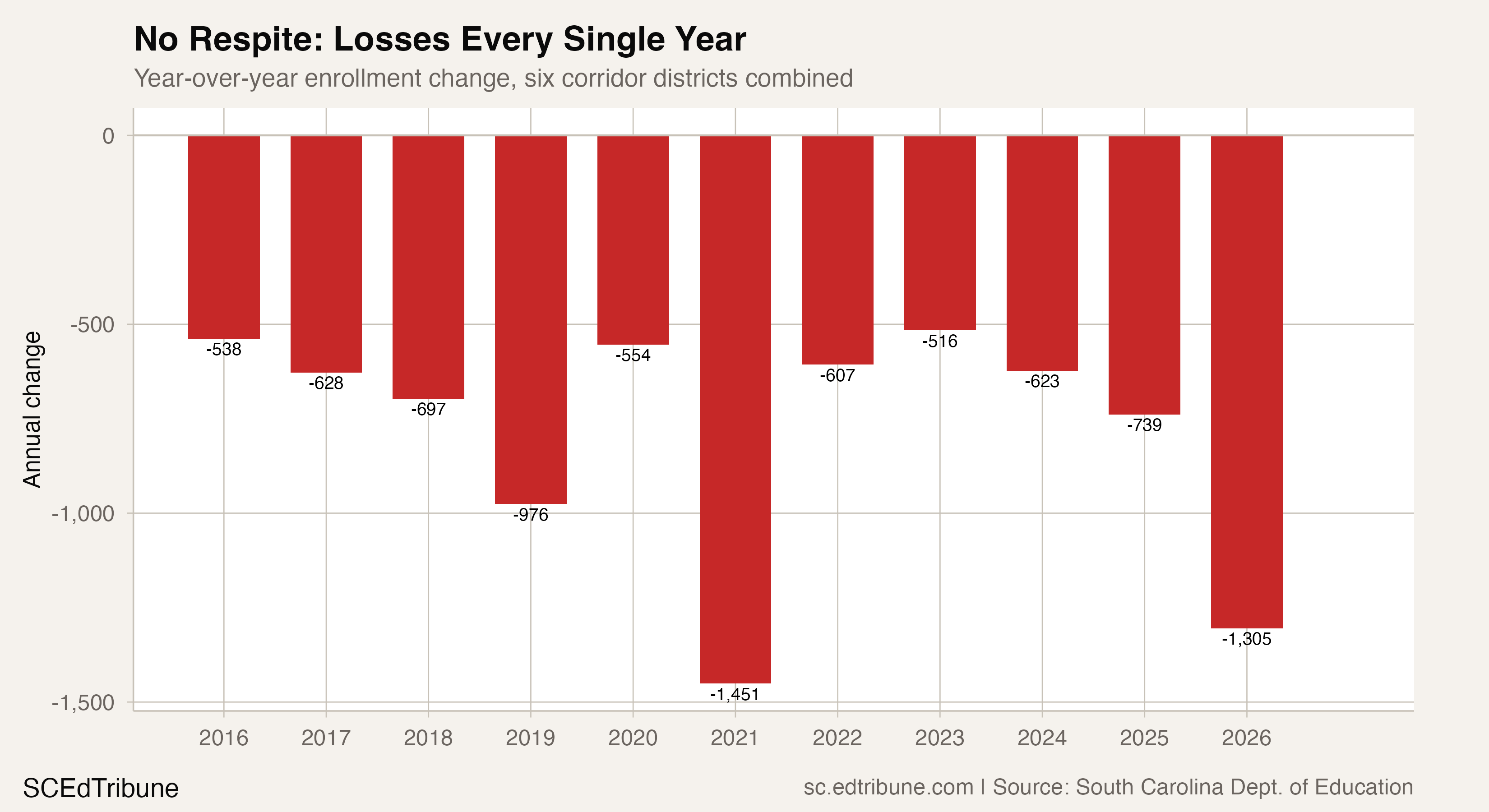
In the first five years of the window (2016 through 2020), the six districts lost an average of 679 students per year. In the six years since (2021 through 2026), the average annual loss rose to 874. The worst year was 2020-21, when COVID pushed the combined loss to 1,451. But 2025-26 was nearly as bad: 1,305 students gone, the second-largest single-year loss on record, with no pandemic to blame.
The corridor's share of statewide enrollment has shrunk from 3.9% to 2.7%. That may sound small, but it represents a structural shift: these districts are losing fiscal and political weight at the same time they need resources most.
District by district
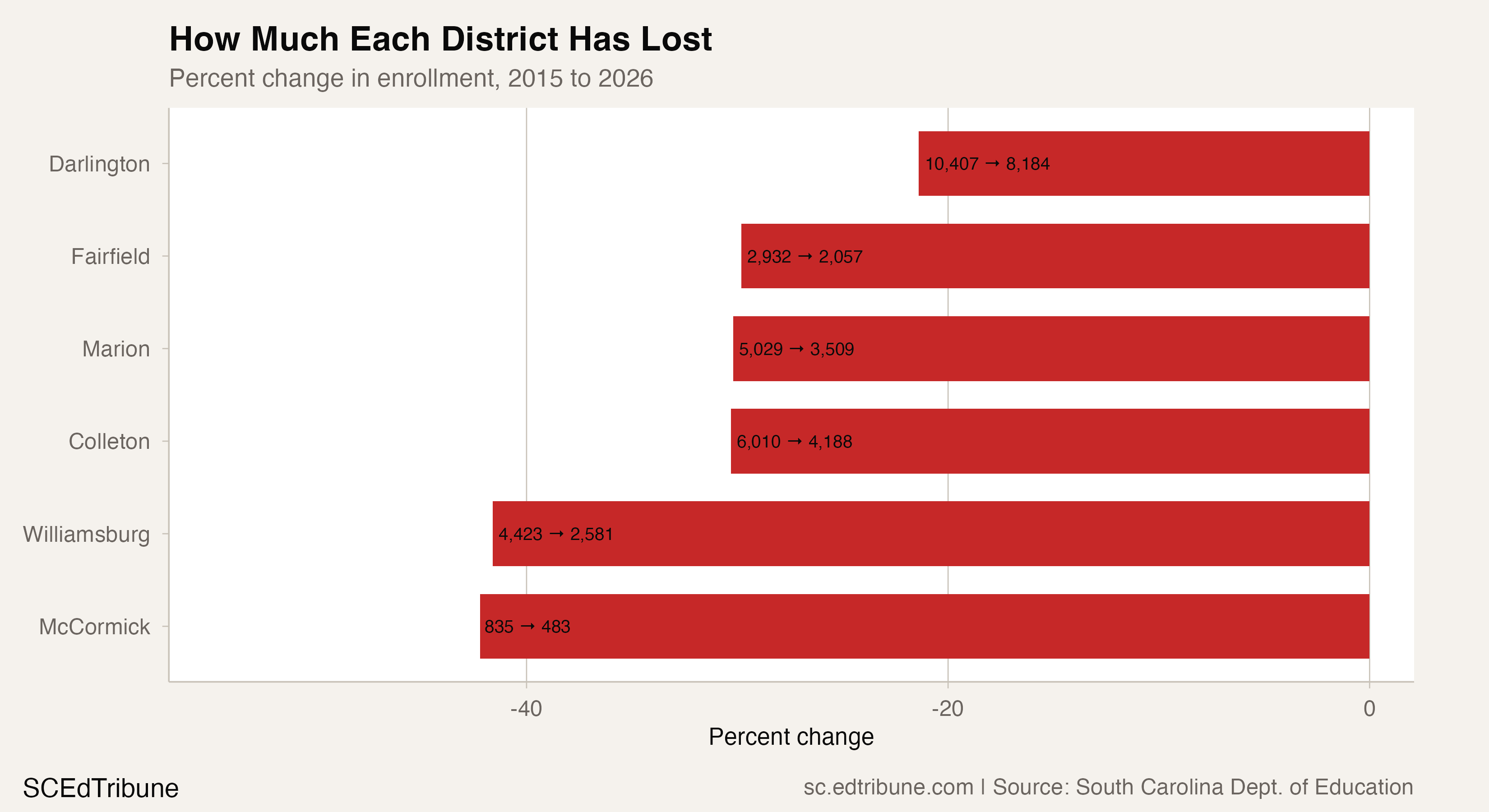
The six districts share a direction but not a speed.
McCormick's 42.2% loss is the steepest, but the district started so small (835 students in 2014-15) that its absolute loss of 352 students is the smallest of the group. At 483, McCormick is approaching the threshold where maintaining a full K-12 program becomes structurally difficult.
Williamsburg↗ET has lost 41.6%, falling from 4,423 to 2,581. Marion has lost 30.2%, Colleton 30.3%. Fairfield, the county between Columbia and Charlotte that state population projections say could lose 38% of its residents by 2042, has lost 29.8% of its students already. Darlington, the largest of the six at 8,184 students, has lost 21.4%, a slower rate but representing the most students in raw terms: 2,223.
The year-over-year pattern is striking for what it does not contain: a single year of growth for any of these districts. Every bar in the chart below points the same direction.
The lawsuit that went nowhere
In 1993, 36 of South Carolina's poorest school districts sued the state, arguing it had failed to provide a "minimally adequate education." The case, Abbeville County School District v. State of South Carolina, became the longest trial in the state's history. In 2014, the South Carolina Supreme Court ruled 3-2 that the state bore primary responsibility and had "failed in their constitutional duty."
Three years later, the same court reversed course. In November 2017, a new 3-2 majority vacated the ruling, holding that the original decision "was wrongly decided as violative of separation of powers." The court released legislators from oversight and ended its jurisdiction.
The Corridor of Shame documentary that gave the region its name identified over 100,000 students enrolled across the 34 plaintiff districts, with 21 of those districts reporting 90% or higher participation in free and reduced-price lunch programs. The enrollment data shows that the underlying population base has continued to erode in the years since the lawsuit ended.
What is driving the losses
The most plausible driver is county-level population decline. These are rural counties where the economic base has narrowed: manufacturing closures, agricultural consolidation, and limited professional employment pull working-age adults toward Columbia, Charlotte, and the coast. Fairfield County's state population projections are particularly grim, with state demographers projecting the county could lose more than a third of its population over the next two decades. McCormick County, which the Census Bureau counts as the second-least populous county in South Carolina, is entirely rural by Census definition.
School choice expansion is a contributing factor, though difficult to quantify precisely. The Charter Institute at Erskine, a statewide charter authorizer, has grown from 8,450 students in 2018-19 to 28,376 in 2025-26. Some portion of that growth comes from families in rural districts choosing charter alternatives, though the data does not track individual student transfers.
South Carolina's legislature has also moved toward mandatory district consolidation. Bill H.3470, introduced in the 2025-26 session, would require every county to operate as a single school district by July 1, 2027, with further regional consolidation by 2032. For counties like McCormick, where a single district already covers the entire county, the bill changes nothing operationally. For the concept of small, independent rural districts as a category, it signals that the legislature has noticed the problem.
The demographic composition is shifting, too
The corridor districts are not just shrinking. Their racial composition is changing. In 2014-15, Black students accounted for 51.3% of enrollment across the six districts. By 2025-26, that share had fallen to 46.8%, a decline of 5,358 students. White enrollment fell from 21.4% to 19.2%, a loss of 2,310. Hispanic enrollment has grown from 1.8% to 3.8%, but the absolute numbers are small: 524 to 798, a gain of 274 students that barely registers against the losses in other groups.
The net effect: the corridor districts are losing students from every major racial group. Hispanic growth is too small to offset Black and white losses, and the overall trajectory is one of depopulation across the board.
Not just six, but nine
Three more districts are in 10-year decline streaks. Florence 03↗ET has lost 29.9% of its enrollment since 2015-16. Sumter 01↗ET, the largest of the group at 13,314 students, has lost 22.6%. Greenwood 50↗ET has lost 9.0%, a slower rate but still 10 consecutive years without a single year of growth.
These nine districts, all at or near all-time lows, represent the leading edge of a pattern visible across rural South Carolina. Statewide, 34 of 81 districts recorded their lowest enrollment in at least 12 years in 2025-26.
What comes next
McCormick operates three schools for 483 students, roughly 37 per grade. The district's annual per-pupil spending, already well above the state average, rises with every departure because the buildings, the buses, and the superintendent do not scale down. Williamsburg, which had nearly 4,500 students a decade ago and now has 2,581, lost the enrollment base needed to sustain specialized programs years ago.
The Abbeville lawsuit asked whether the state owed these communities an adequate education. The Supreme Court said the courts could not answer that. The enrollment data offers a different verdict: six districts, 11 years, not one year of growth. Whatever the legal standard, the demographic arithmetic is running out.
Detailed code that reproduces the analysis and figures in this article is available exclusively to EdTribune subscribers.
Discussion
Sign in to join the discussion.
Loading comments...