Shaw Air Force Base pumps $2.05 billion a year into the Sumter region. It supports 9,404 direct jobs and another 5,466 indirect ones. More than 31,000 active-duty personnel, military families, and retirees live in the area.
None of it has been enough to keep children in Sumter↗ET public schools.
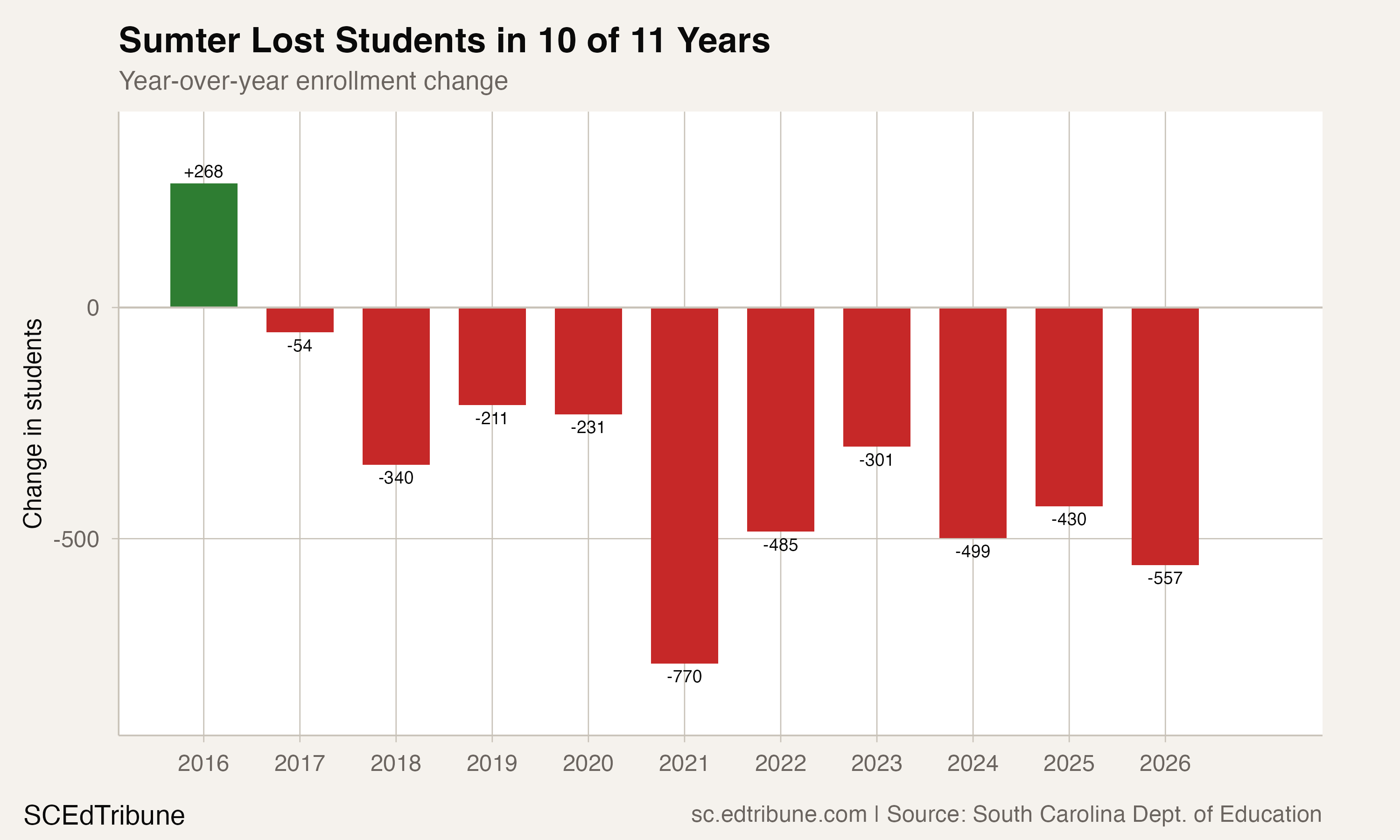
The district enrolled 13,314 students in 2025-26, down 3,610 from 2014-15. That is a 21.3% decline over 12 years, during a period when South Carolina as a whole grew 4.3%. Sumter lost students in 10 of 11 year-over-year transitions, and the losses are accelerating: 2025-26 was the district's worst non-COVID year on record, with 557 students gone.
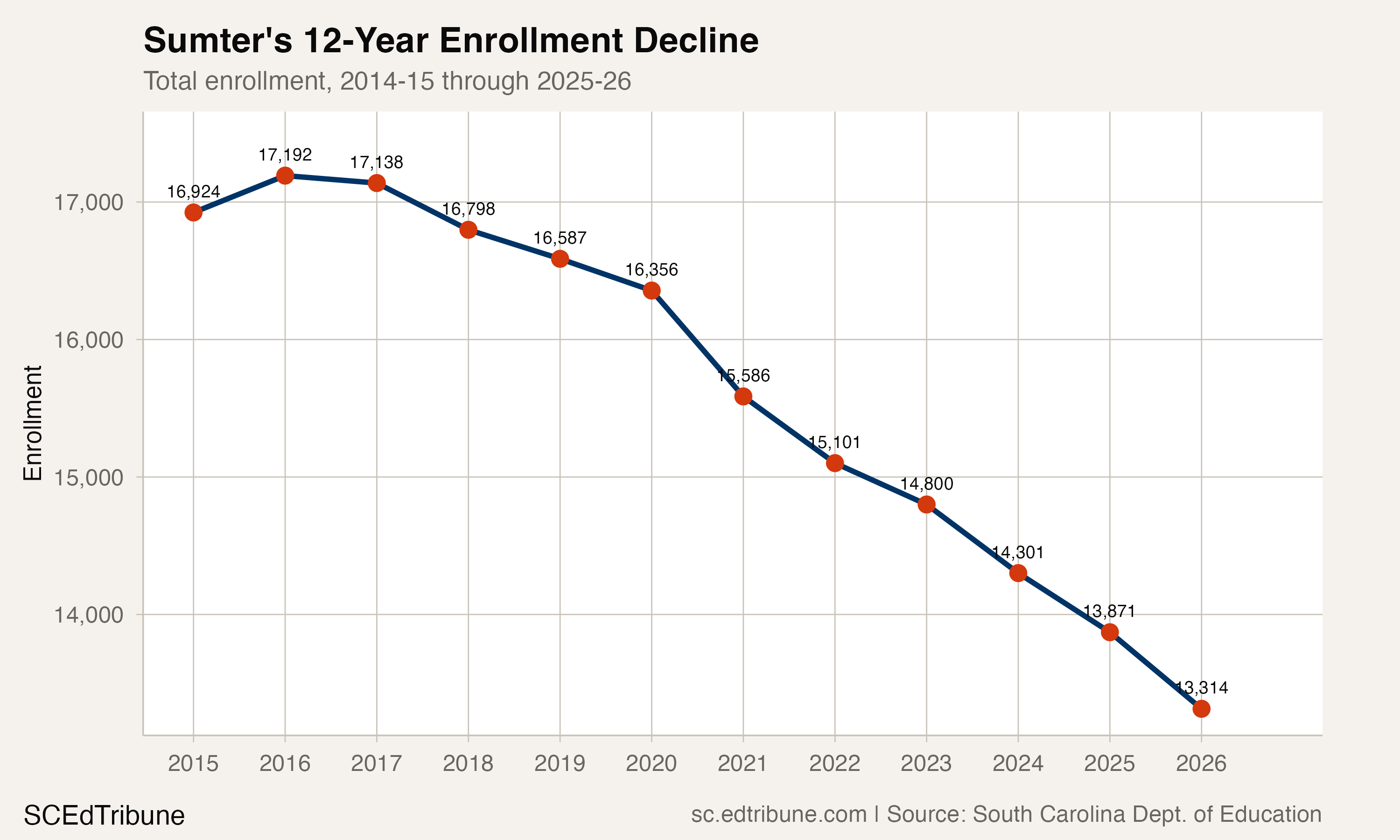
The decline that kept getting worse
The trajectory splits into two eras. Before COVID, Sumter was losing 200 to 340 students a year. Painful, but manageable for a district that peaked at 17,192 in 2015-16. After COVID, the bleeding accelerated. The pandemic year cost 770 students, the largest single-year loss. But the years since have been nearly as bad: 485 in 2021-22, 499 in 2023-24, 430 in 2024-25, and 557 in 2025-26.
The only year Sumter gained students in the entire data window was 2015-16, when enrollment rose by 268. Every year since has been red.
The district's share of statewide enrollment has fallen from 2.24% in 2015 to 1.69% in 2026. In a state that added 32,000 students over the same period, Sumter is shrinking faster than its peers can grow.
When a military base isn't enough
The conventional wisdom about military communities is that bases provide a floor. Active-duty families rotate in on three- to four-year cycles, ensuring a steady pipeline of school-age children. Shaw AFB, home to the Air Force's largest F-16 Combat Wing, hosts roughly 5,400 active-duty members and their families.
But Sumter's decline suggests the floor has a trapdoor. The base's military population generates enrollment, but that enrollment is overwhelmed by losses among the civilian population surrounding it. Sumter County lost approximately 3,600 residents between the 2010 census (107,610) and 2022 estimates (104,012), a 3.3% decline that mirrors the school enrollment trajectory.
The comparison with other South Carolina military base districts is instructive. Berkeley 01↗ET, home to Joint Base Charleston, grew 20.7% over the same period. Richland 02↗ET, adjacent to Fort Jackson, grew 4.0%. Even Beaufort 01↗ET, which hosts Marine Corps Air Station Beaufort and Parris Island, lost only 2.5%.
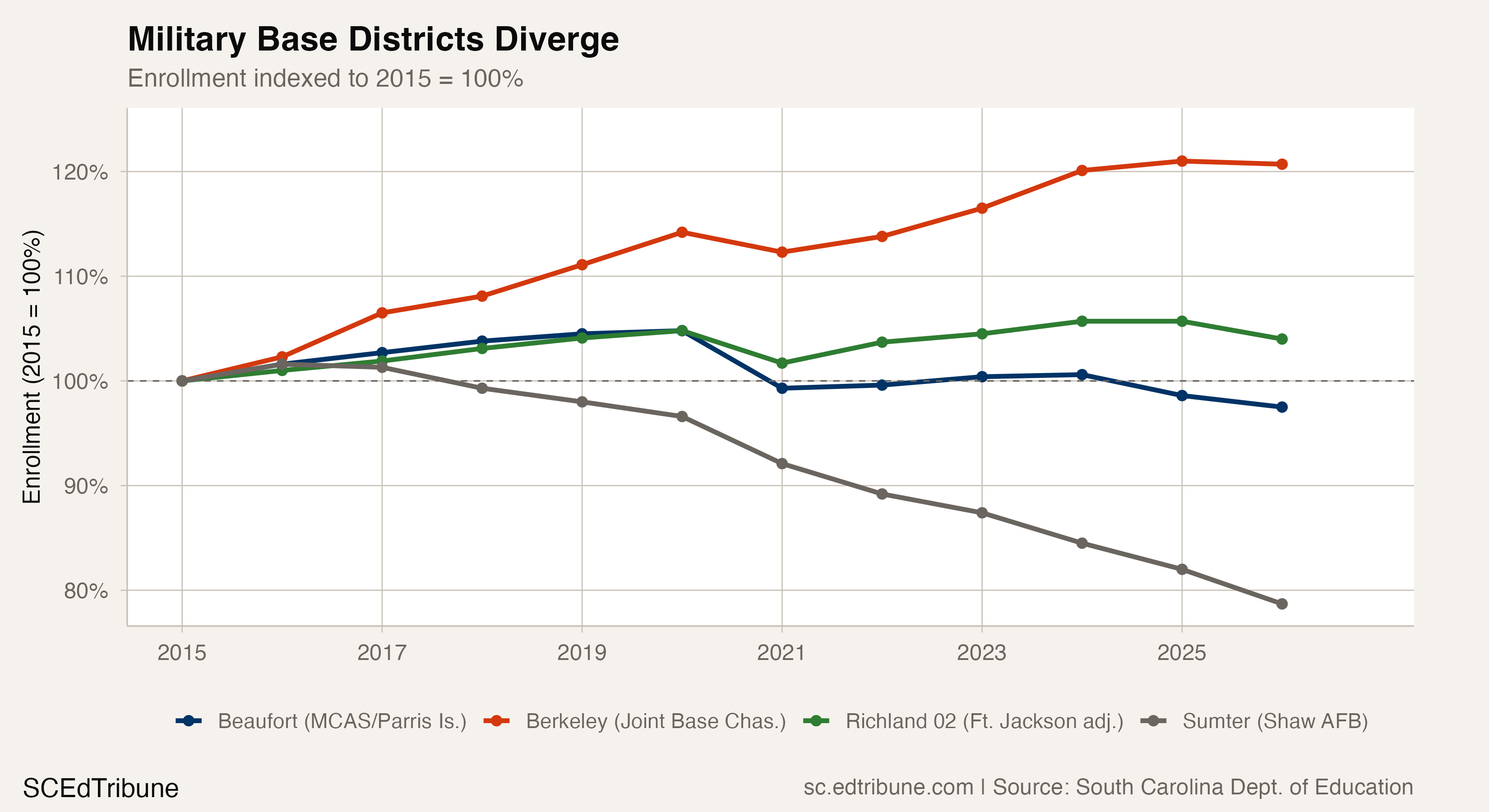
The difference is economic context. Berkeley and Richland sit in Charleston and Columbia metro areas where civilian job growth, new housing construction, and in-migration have supplemented military employment. Sumter sits in the Midlands, where the manufacturing base that once anchored the civilian economy has eroded. South Carolina lost 21.3% of its manufacturing jobs since 2000, and communities like Sumter that depended on textiles and light industry were hit hardest.
Who left, and who stayed
The enrollment decline has not been evenly distributed. White enrollment in Sumter fell 42.0%, from 5,322 students to 3,089. Black enrollment fell 19.8%, from 10,648 to 8,535. Hispanic enrollment, starting from a much smaller base, rose 51.1%, from 618 to 934 students.
The result is a district that has become more concentrated. Black students made up 62.9% of Sumter enrollment in 2015 and 64.1% in 2026, a modest share increase on a sharply declining base. White students fell from 31.4% to 23.2%. Hispanic students nearly doubled their share, from 3.7% to 7.0%.
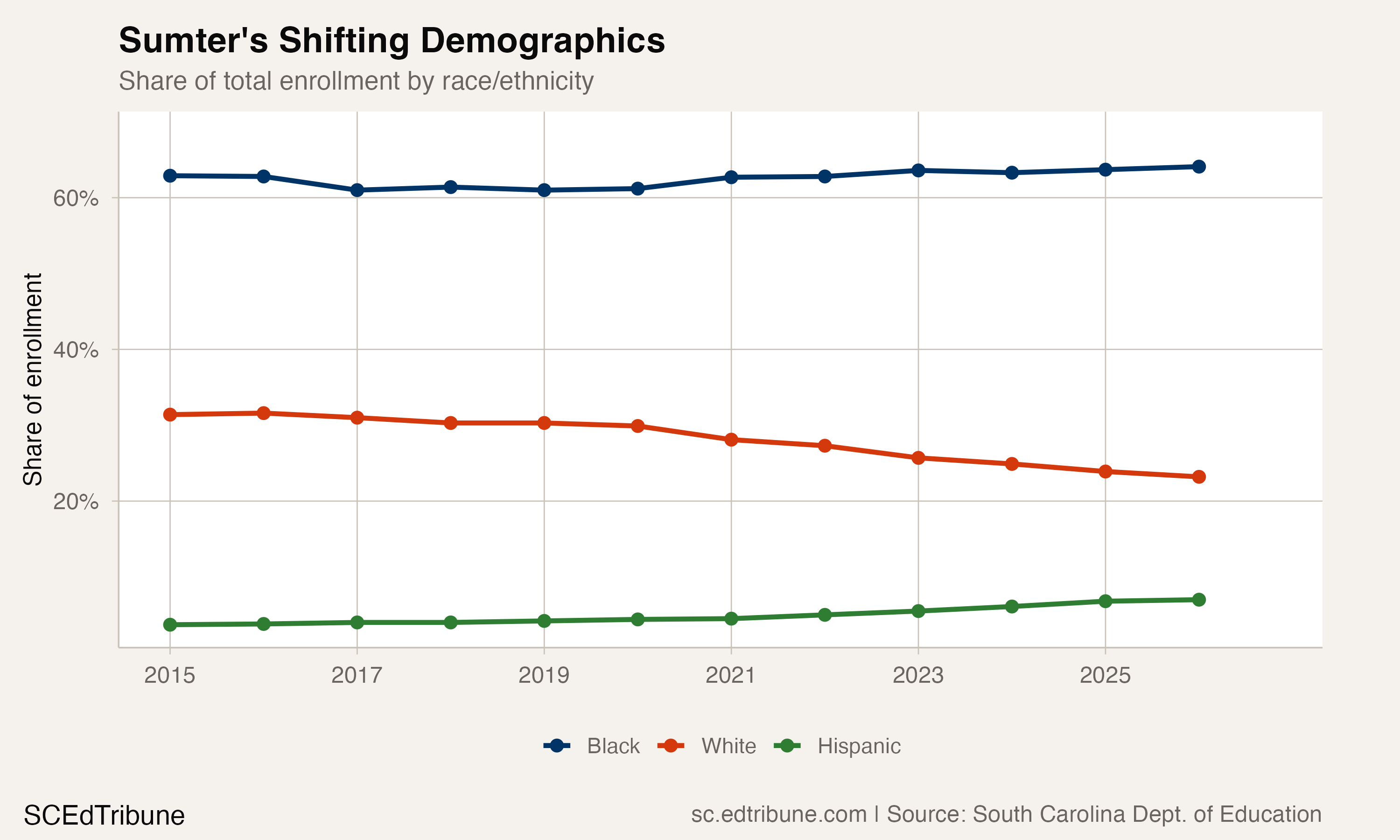
The pattern is consistent with what other rural Southern districts experience: white families leaving for private schools, charter options, or nearby metro areas at higher rates than other groups. South Carolina's Education Scholarship Trust Fund, which awarded all 10,000 available scholarships for 2025-26, may have accelerated that trend, though even with 10,000 statewide participants in 2025-26, the program is unlikely to account for more than a fraction of Sumter's losses.
The economically disadvantaged rate in Sumter has remained above 72% in every year with available data since 2020. In 2025, 79.1% of the district's students qualified. The 2015 figure of 100% is almost certainly a CEP artifact, where Community Eligibility Provision allows entire districts to certify all students for meal programs. But even accounting for that distortion, the rate is high and rising, reflecting the departure of higher-income families.
A pipeline running dry
The kindergarten class tells the story of what is coming. In 2015, Sumter enrolled 1,425 kindergartners. By 2026, that number had fallen to 958, a 32.8% decline. The 12th-grade class, meanwhile, fell from a high of 1,111 in 2018 to 770 in 2026.
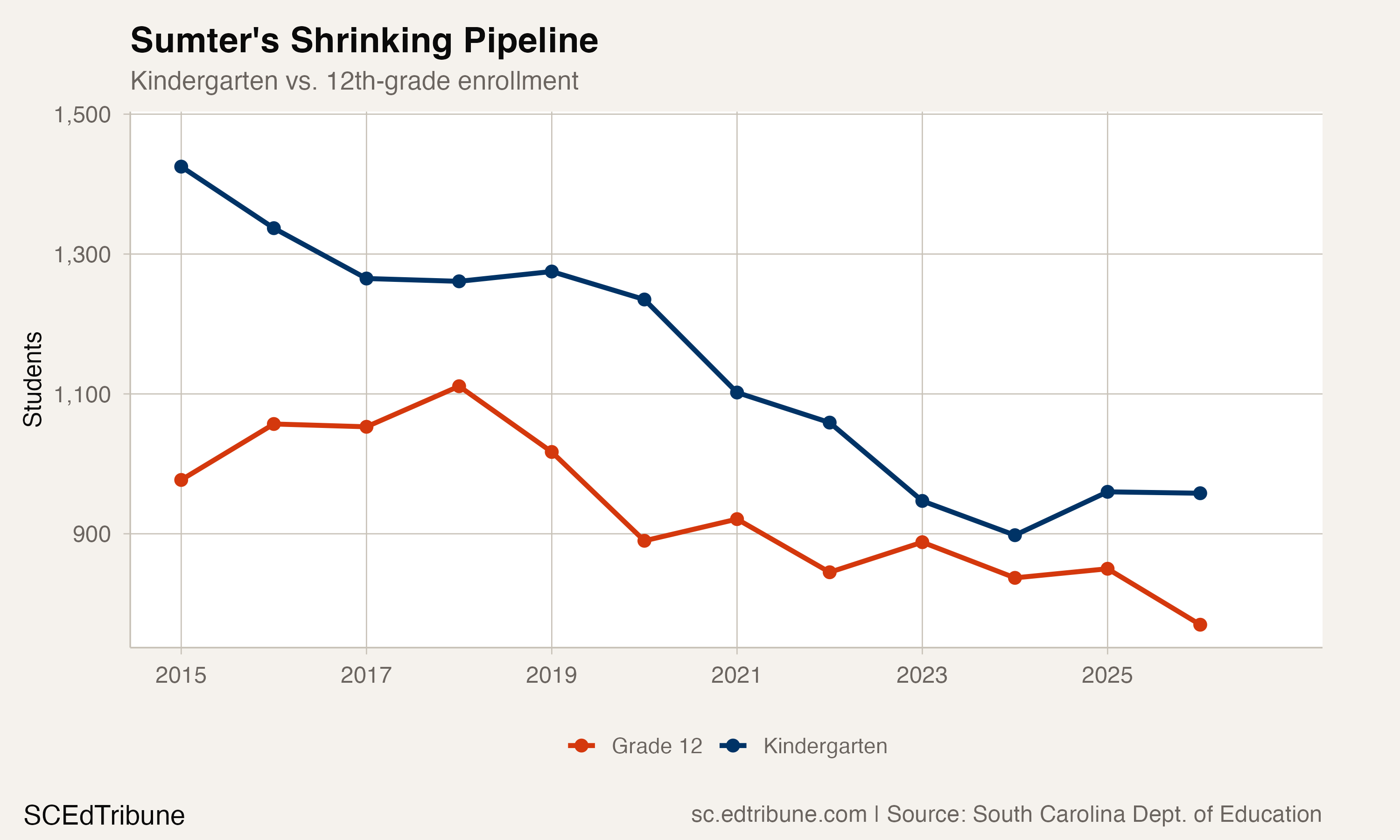
The kindergarten decline is particularly significant because it locks in future losses. Each cohort that enters smaller than the one before it guarantees the trend line continues for 13 years. Sumter's 2026 kindergarten class is 188 students smaller than its 12th-grade class was in 2015, which means the district is feeding fewer students into the top of the pipeline than it is graduating out the bottom.
The fiscal math
Per-pupil funding follows students. A district that loses 3,610 students over 12 years loses the state and federal revenue attached to them. But it does not lose 3,610 students' worth of fixed costs. The buildings remain. The bus routes shorten but do not disappear. The central office still needs a superintendent, a finance director, and a facilities team.
Sumter's 2023-24 budget was $158 million, but the district absorbed $3.8 million in cuts that year, partly because temporary federal pandemic relief funds were expiring. At the same time, South Carolina school districts statewide faced teacher shortages heading into the 2024-25 year, with Sumter reporting 154 vacancies.
Filling 154 teaching positions in a district that is losing 400 to 500 students a year creates a tension: the district needs staff for the students it has now, but may not need those positions three years from now. Hiring aggressively risks layoffs later. Not hiring means larger class sizes and fewer electives for the students who remain.
What the base can and cannot do
Shaw Air Force Base is not shrinking. The City of Sumter's FY2024 economic impact statement puts the base's total impact at $2.516 billion. The city has passed ordinances and acquired land around the base to prevent development encroachment and protect its operational future.
But a military base generates a specific kind of enrollment: transient families on two- to four-year rotations, many of whom arrive with school-age children and leave with them. The base does not generate the kind of rooted, multi-generational community growth that sustains school enrollment over decades. It provides a floor, but in Sumter, the civilian population has been falling through it.
At the current pace, Sumter drops below 12,000 students around 2029. Its 2026 kindergarten class, 958 children, is 33% smaller than the one a decade ago. Shaw's F-16s will still be flying. The district's challenge is everything that happens outside the base fence line.
Detailed code that reproduces the analysis and figures in this article is available exclusively to EdTribune subscribers.
Discussion
Sign in to join the discussion.
Loading comments...