Correction (September 30, 2026): An earlier version of this article said white students first fell below half of South Carolina's enrollment in 2018-19. The state's statewide totals put the white share at 50.2% that year and 49.7% in 2019-20, so the crossing came a year later than reported, and the headline has changed to reflect it. The earlier version also compared racial groups across 2016-17, the year South Carolina began counting multiracial and Pacific Islander students separately. Black, Asian and American Indian counts dropped sharply that year as students moved into the new categories, which made the Black enrollment decline look steeper than the white one and inflated the rise in the diversity index. All racial comparisons now start in 2016-17. On that consistent basis, Black and white enrollment have fallen at similar rates (8.5% and 8.2%), and the diversity index rose from 1.143 to 1.281. The finding that the white share has been falling faster since 2020 is unchanged.
In 2019-20, white students made up less than half of South Carolina's public school enrollment: 49.68%, down from 50.23% the year before. No racial group has held a majority since. In the six years after that crossing, white share fell another 3.8 percentage points, to 45.90% in 2025-26, and the pace of decline picked up.
From 2016-17 to 2019-20, white share fell 1.5 points over three years, about 0.49 points a year. From 2019-20 to 2025-26, it fell 3.8 points over six years, about 0.63 points a year, a 29% faster annual rate. The state did not cross the line and settle there.
The arithmetic under the headline
South Carolina's total enrollment grew 2.2% over this period, from 771,756 students in 2016-17 to 789,086 in 2025-26. The state is gaining students. The groups driving that gain are different from the groups that are shrinking.
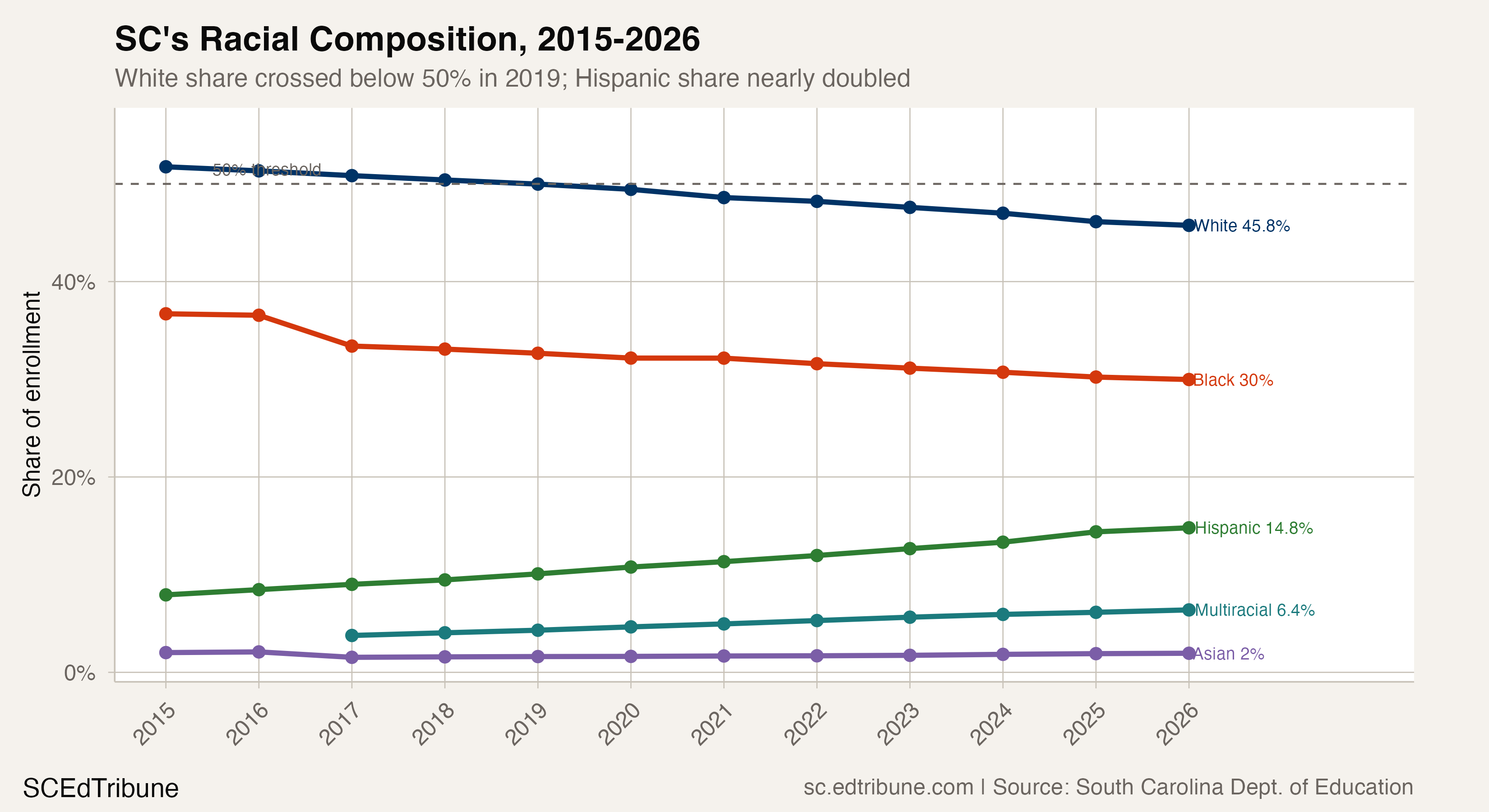
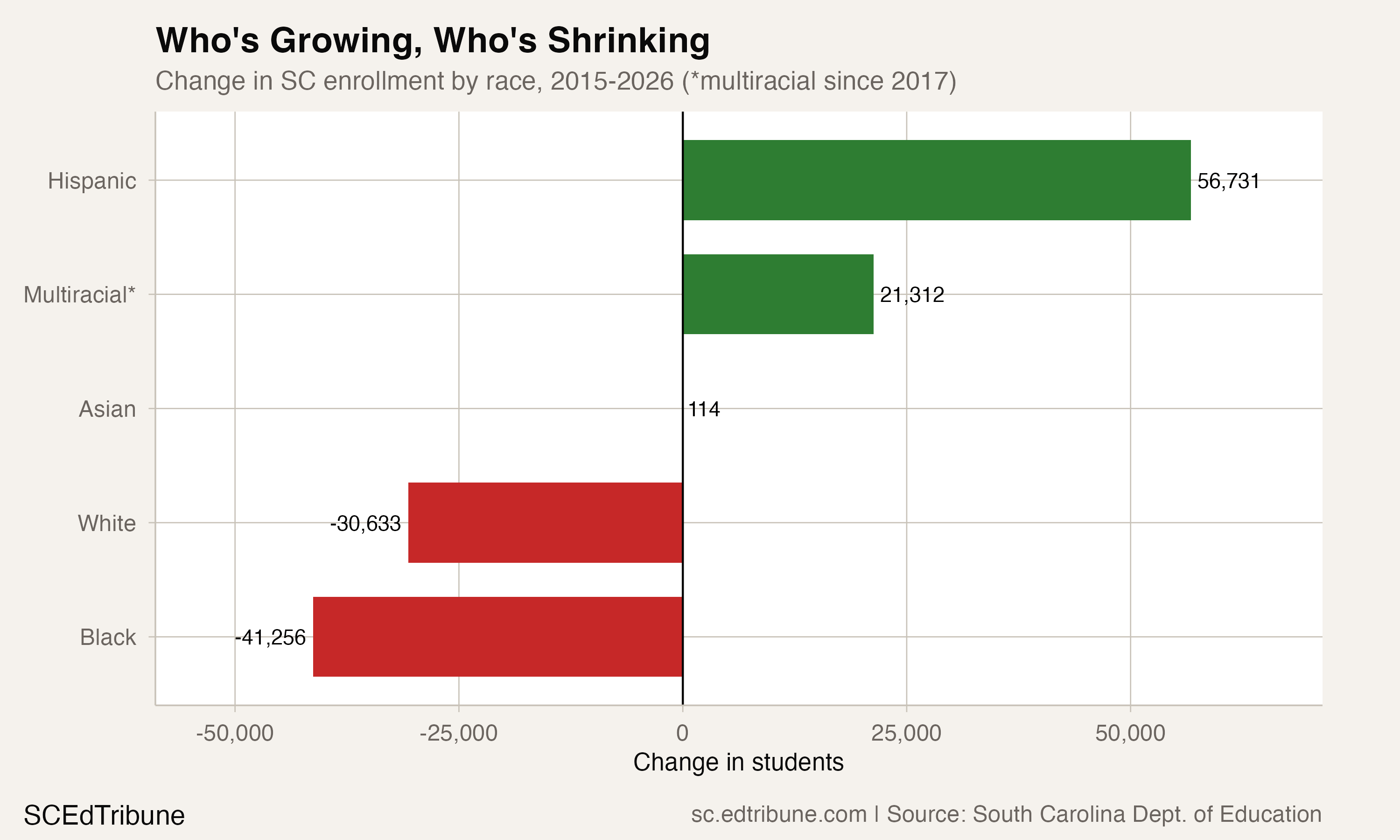
White enrollment fell by 32,458 students (8.2%) between 2016-17 and 2025-26. Black enrollment fell by 22,290 (8.5%). Together, the two groups lost 54,748 students.
Hispanic enrollment grew from 69,814 to 117,140, a gain of 47,326 (67.8%), taking Hispanic students from 9.0% of enrollment to 14.8%. Multiracial students grew from 29,329 to 51,119, an increase of 21,790 (74.3%). Those two groups added 69,116 students, more than the combined white and Black losses.
The shift is not a simple two-group story. The Shannon diversity index, which measures how evenly enrollment is spread across the state's seven reported racial groups, rose from 1.143 in 2016-17 to 1.281 in 2025-26. South Carolina's student body is measurably more varied than it was when the state began reporting these categories.
That starting point matters. Before 2016-17, South Carolina reported five racial groups. When it added two or more races and Pacific Islander that year, 29,329 students were counted as multiracial in the first year, and the Black count alone dropped by 20,281 from two years earlier. Comparisons that reach back before 2016-17 mix a reporting change with real enrollment change, so this article starts there.
The acceleration is real, but uneven
The year-over-year drops in white share were steady before the pandemic: 0.46 points in 2017-18, 0.45 in 2018-19 and 0.55 in 2019-20. In 2020-21, the drop was 0.88 points, the largest single-year change in the period. It eased to 0.40 in 2021-22, then ran 0.61 in 2022-23, 0.63 in 2023-24 and 0.87 in 2024-25, nearly matching the 2020-21 record.
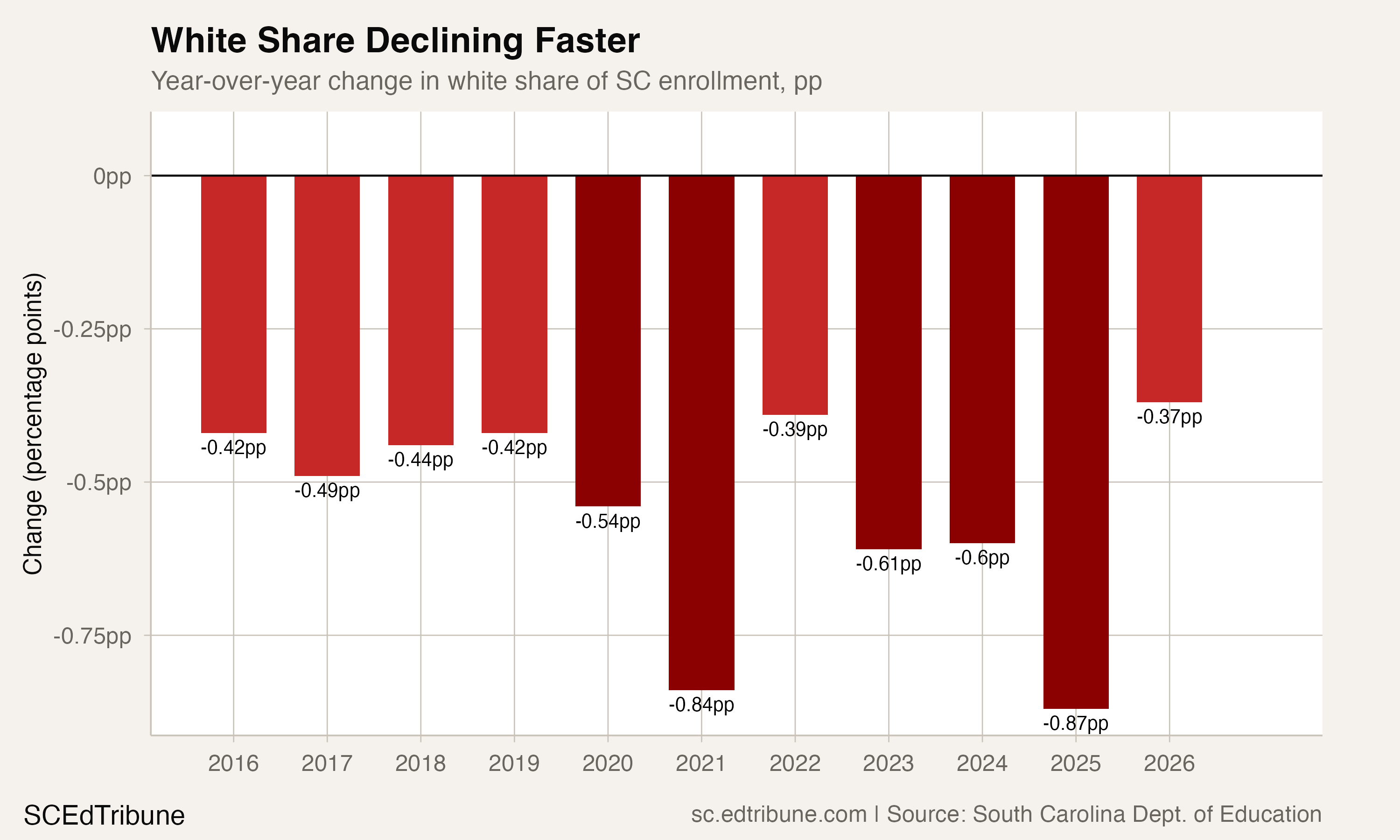
The 2025-26 drop, 0.39 points, was the smallest in the series, so one year has slowed. The longer pattern has not: the drops since 2020-21 average 0.63 points a year, against 0.49 in the three years before. If the post-2020 pace held, a projection rather than a finding, white share would fall below 40% around 2035-36.
What is driving the shift
Three forces are reshaping South Carolina's classrooms at once.
The most visible is Hispanic population growth. South Carolina is the fastest-growing state in the country, adding nearly 80,000 residents between July 2024 and July 2025 alone, with 66,622 net domestic migrants. The state's Hispanic population grew to roughly 436,000 by mid-2024, about 8% of the total population.
Hispanic students are 14.8% of public school enrollment, nearly double their share of the overall population, a gap consistent with a younger Hispanic population.
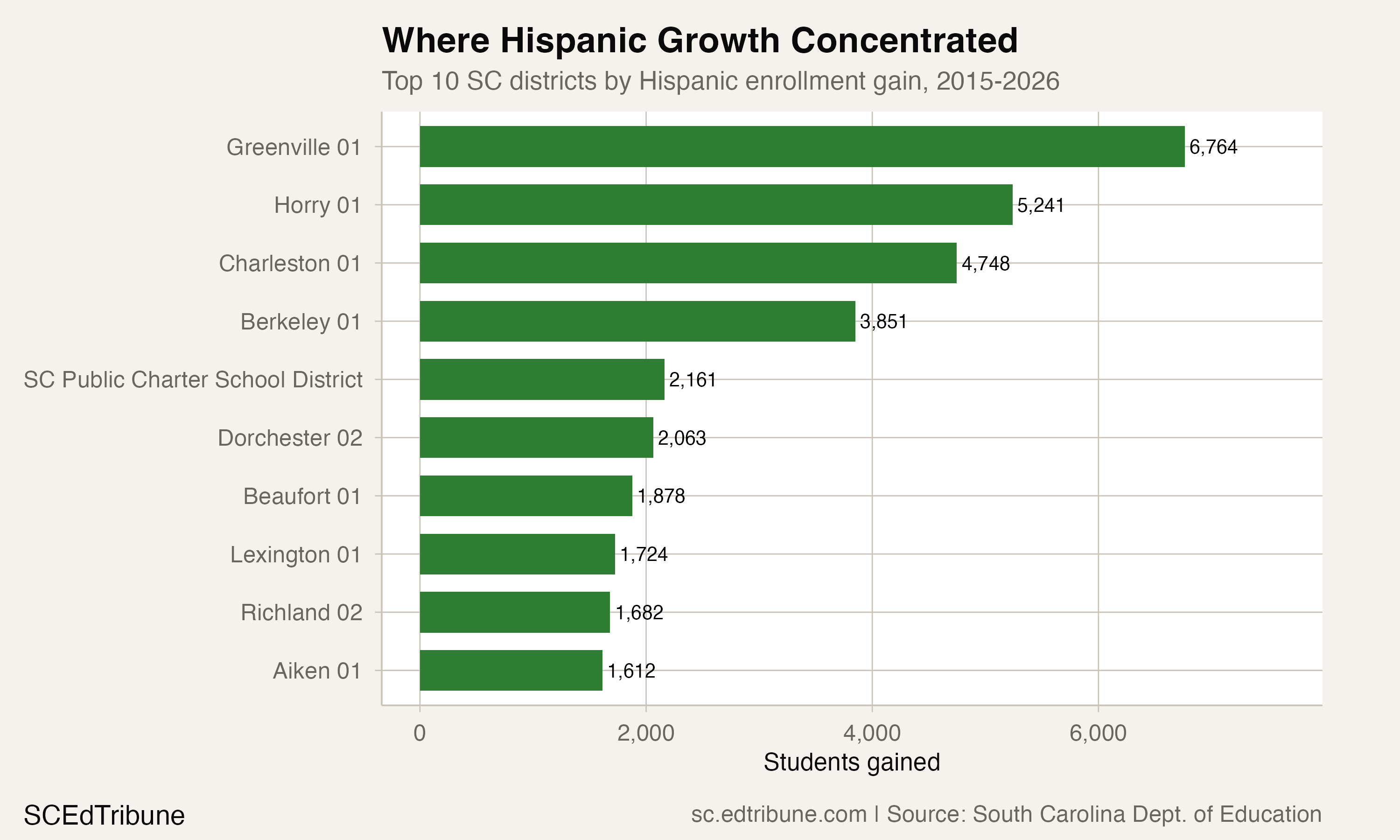
The growth is geographically concentrated. Greenville 01↗ET added 5,518 Hispanic students between 2016-17 and 2025-26, more than any other district. Horry 01↗ET added 4,143, Charleston 01↗ET added 4,132, and Berkeley 01↗ET added 3,105. These four coastal and Upstate districts account for 35.7% of the statewide Hispanic gain.
Growth is also reshaping smaller districts. Jasper 01↗ET is now 58.4% Hispanic. Saluda 01 is 48.0%. Beaufort 01↗ET is 33.2%. In these communities, the classroom demographic arrived ahead of the political infrastructure to support it.
The second force is multiracial identification. The 74.3% rise in multiracial students since 2016-17, the first year South Carolina reported the category, likely reflects both families with mixed heritage and families choosing the "two or more races" category more often over time. The data cannot separate the two.
The third force is Black enrollment decline. Black students went from 34.0% of enrollment in 2016-17 to 30.4% in 2025-26, a loss of 22,290 students. On consistent categories, that 8.5% decline is close to the white decline of 8.2%. The larger gap reported in an earlier version of this article came mostly from the 2016-17 reporting change, not from enrollment.
The mechanisms behind the Black decline are less clear than the Hispanic growth. South Carolina's overall population is growing, not shrinking. One possible factor is the growth of school choice: the state's Education Scholarship Trust Fund filled all 10,000 ESA slots for 2025-26, at an average of $7,500 per account, with the cap rising to at least 15,000 for 2026-27. The enrollment data cannot show whether that program, birth rates or migration explain the pattern.
11 districts crossed the line
In 2016-17, 48 of the 88 districts and statewide school systems the state reports were under half white. By 2025-26, 50 of 81 were. The raw count has not moved much, but the composition has: 11 systems that were majority white in 2016-17 were under half white in 2025-26, while the total number of reporting systems shrank. Two of the 11 are statewide systems rather than geographic districts: the SC Public Charter School District and the Governor's School for Science and Mathematics. One small residential school moved the other way.
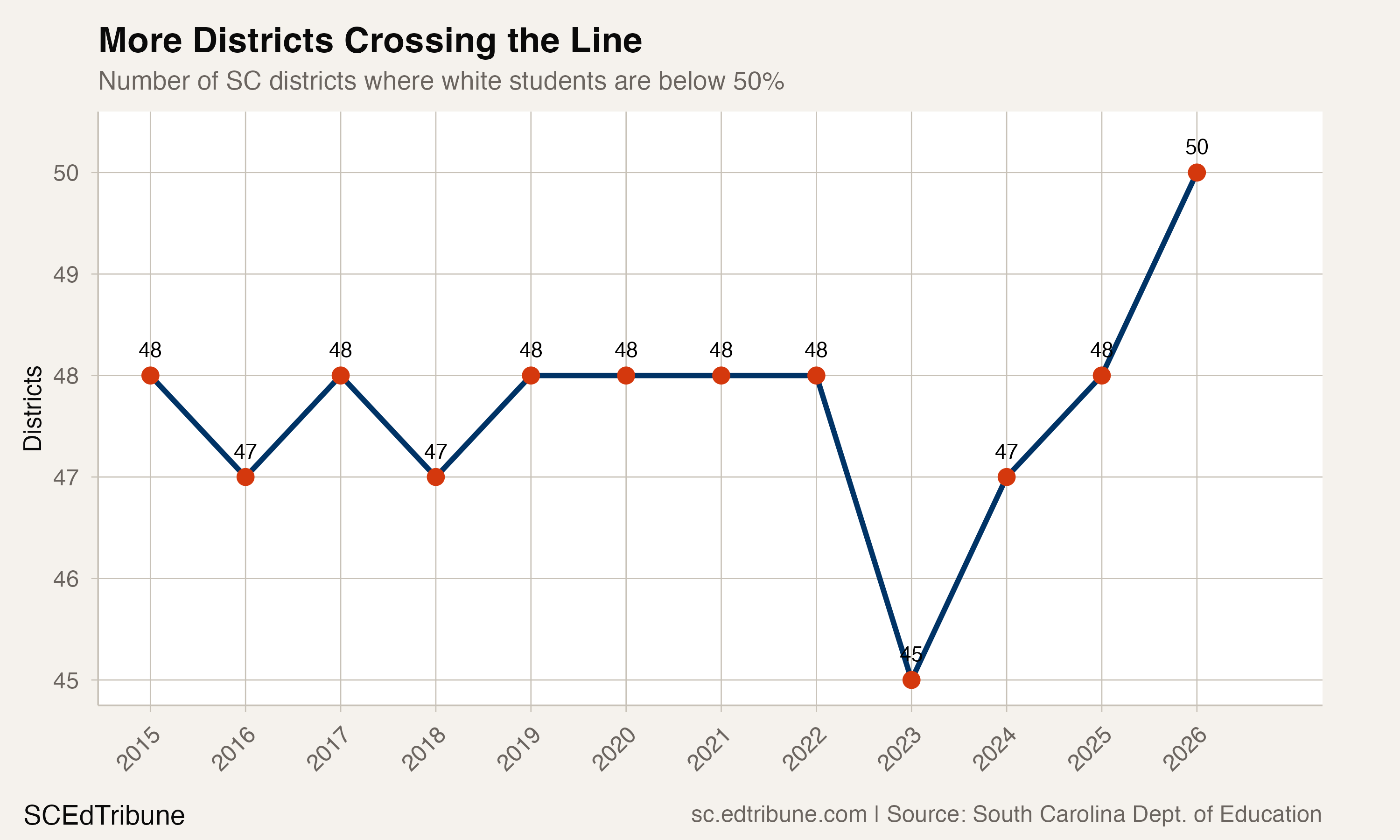
The largest geographic flips are instructive. Lexington 04↗ET saw its white share fall from 61.0% to 45.8%, a 15.2-point drop, alongside Hispanic growth that brought the district to 26.9% Hispanic. Aiken 01↗ET went from 52.0% to 42.0%. Anderson 05↗ET went from 52.5% to 44.2%. Greenville 01↗ET, the state's largest district, went from 54.8% to 47.4%. Dorchester 02↗ET and Berkeley 01↗ET both flipped, part of the broader Charleston-area change.
These are not urban-core districts. They are suburban and exurban communities in the state's growth corridors. The demographic shift is no longer confined to historically majority-Black rural districts. It is arriving in the districts where much of the state's growth is happening.
What this means for schools
A state where no racial group holds a majority faces a different kind of operational challenge than one where a single group dominates. Bilingual education staffing, for example, is calibrated to a Hispanic student population that has grown by two-thirds since 2016-17. In Lexington 04, the Hispanic share doubled over that span, from 13.3% to 26.9%. In Jasper 01 it went from 26.2% to 58.4%. Districts like these have had to build language programs quickly.
The fiscal question is equally pressing. South Carolina's school funding formula distributes weighted pupil allocations that adjust for student characteristics. A student body that is growing more diverse in linguistic background and shrinking in its historically largest groups creates a mismatch between the districts experiencing the most rapid change and the ones with the institutional capacity to absorb it.
For Black enrollment, the decline poses a separate set of questions. Black students were 30.4% of enrollment in 2025-26.
March of Dimes data show that 26.7% of South Carolina births are to Black mothers, a smaller share than in today's classrooms. The pipeline is narrowing. Whether the enrollment decline so far reflects families choosing private options, leaving the state, or declining birth rates is not clear from enrollment data alone.
South Carolina did not reach a plateau after white students fell below half of enrollment in 2019-20. The decline sped up. More districts are likely to cross the same line, and the open question is how soon.
Enrollment counts come from the South Carolina Department of Education's active student headcounts.
Detailed code that reproduces the analysis and figures in this article is available exclusively to EdTribune subscribers.
Discussion
Sign in to join the discussion.
Loading comments...