Sumter↗ET is a district defined by Shaw Air Force Base, a military community that rotates families in and out with each deployment cycle, and a chronic absenteeism rate of 35.9% in 2024-25, the worst of any large district in South Carolina. More than 5,400 of its 15,138 students missed at least 18 school days last year, a threshold that researchers consistently link to academic failure.
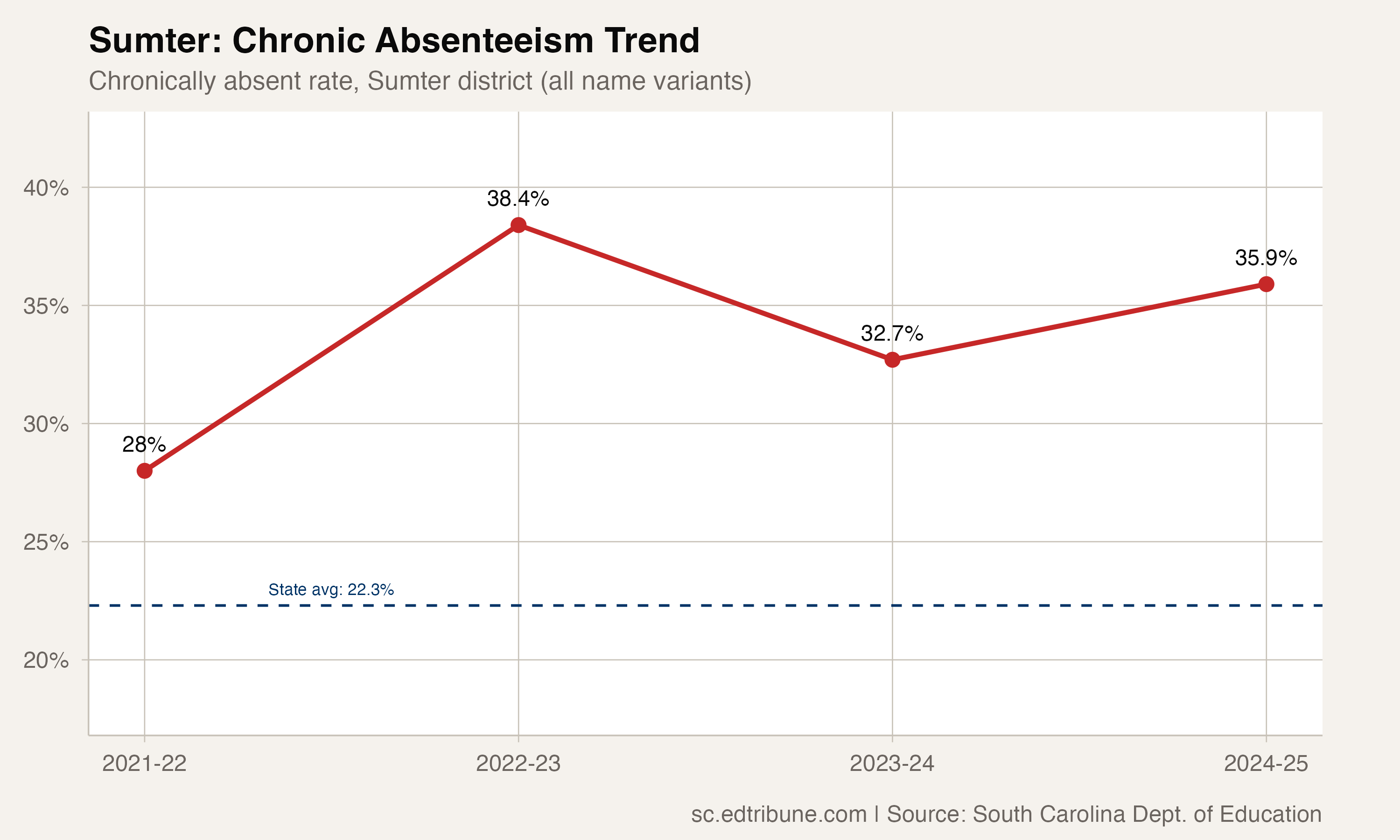
The trajectory over four years of available data tells a story of a district that cannot find traction. The rate was 28.0% in 2021-22, spiked to 38.4% in 2022-23, dropped to 32.7% in 2023-24, then climbed again to 35.9% in 2024-25. The sawtooth pattern, improvement followed by reversal, is worse than a district that simply plateaus. It suggests that whatever interventions Sumter deploys have temporary effects.
The rate crosses every line
Most districts with high chronic rates can point to a specific subgroup driving the number. In Sumter, the pattern crosses every line. Black students, who make up the majority of enrollment, have a 38.1% chronic rate. White students are at 32.4%. Students who are economically disadvantaged are at 40.2%. Even the "best" performing demographic subgroup in Sumter would be among the worst in most South Carolina districts.
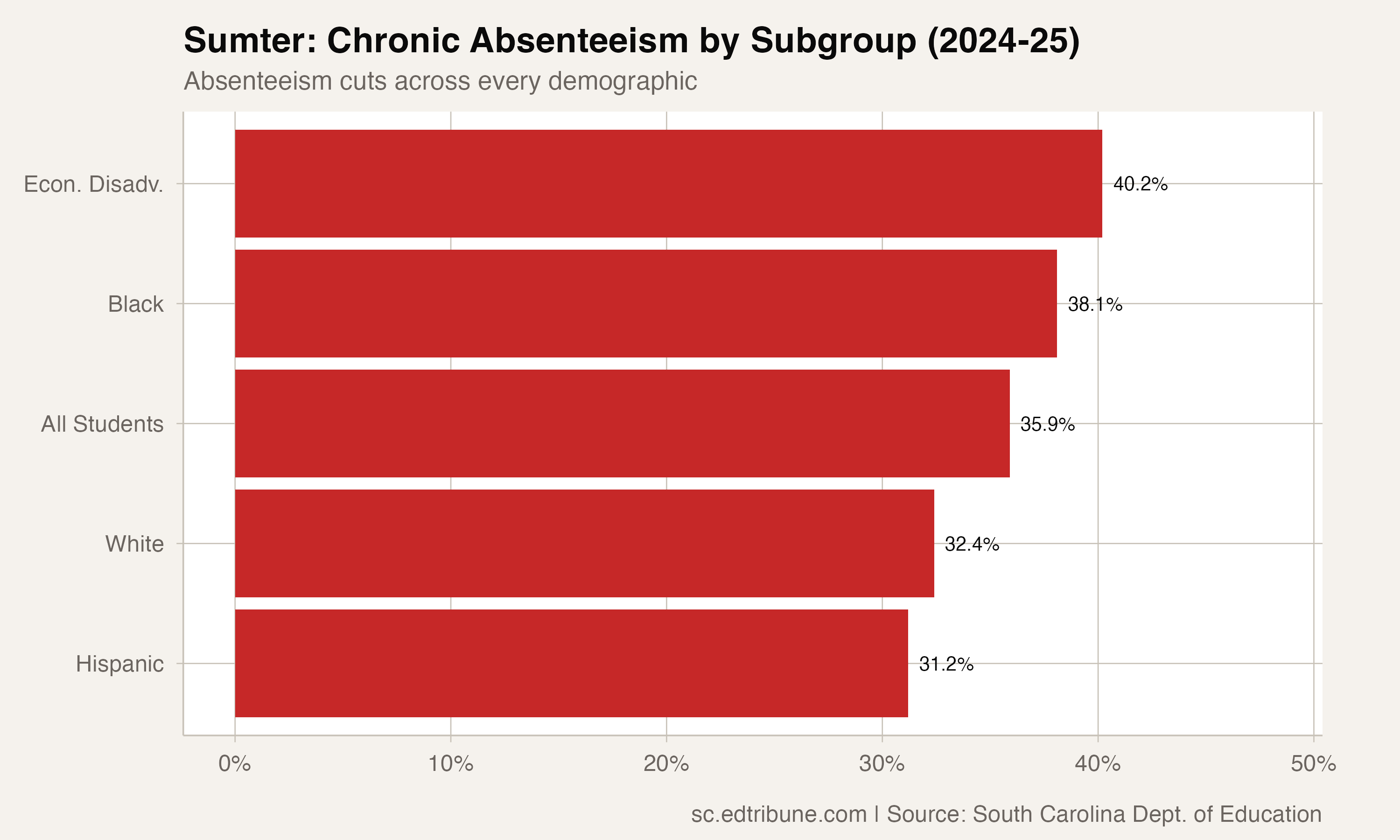
The gap between Black and white students in Sumter (5.7 percentage points) is narrower than the statewide Black-white gap (7.9 points). That is not because Black students in Sumter attend school at high rates. It is because white students in Sumter attend school at rates that would be alarming anywhere else. When 32.4% of white students are chronically absent, the attendance problem has metastasized beyond any single demographic explanation.
The military factor
Shaw Air Force Base is the single largest employer in the Sumter area. Military families bring both advantages and challenges to a school district. On one hand, they tend to be insured, employed, and housed. On the other, deployments disrupt family stability, PCS (permanent change of station) moves force mid-year school transfers, and the emotional toll of having a parent deployed or frequently absent can manifest in a child's own attendance.
The enrollment series for The SCEdTribune documented Sumter's enrollment decline in the context of its military dependence. The attendance data adds a dimension: even the families who are there are not consistently getting their children to school 90% of the time.
What 35.9% means for learning
At 35.9%, Sumter has roughly one chronically absent student for every three enrolled. In a classroom of 24, that is eight or nine students who have missed at least four weeks of instruction. The teacher in that classroom is not teaching a class in the traditional sense. They are managing a rotating cast of students at different points in the curriculum, some of whom have missed the foundational lesson for today's work.
InformEd SC data shows that only 23% of students in grades 3-8 who are chronically absent are on grade level for math. In a district where more than a third of students are chronically absent, the academic implications cascade through every measure of school performance.
Sumter vs. the state
The state average is 22.3%. Sumter is 13.6 points above that, the largest deficit of any district with more than 10,000 students. The next-worst large district is Orangeburg County at 30.9%, and even that is five full points below Sumter.
At 15,138 students, Sumter is not a small district where a few families move the needle. Its 5,432 students who are chronically absent represent 3% of the state's total absence count, a mid-sized district carrying an outsized share of a statewide problem. The sawtooth pattern in the data, 28% to 38% to 33% to 36%, suggests that whatever the district tries works for a year, then loses its grip. That is not a district that needs more pilot programs. It is a district that needs something to stick.
Detailed code that reproduces the analysis and figures in this article is available exclusively to EdTribune subscribers.
Discussion
Sign in to join the discussion.
Loading comments...