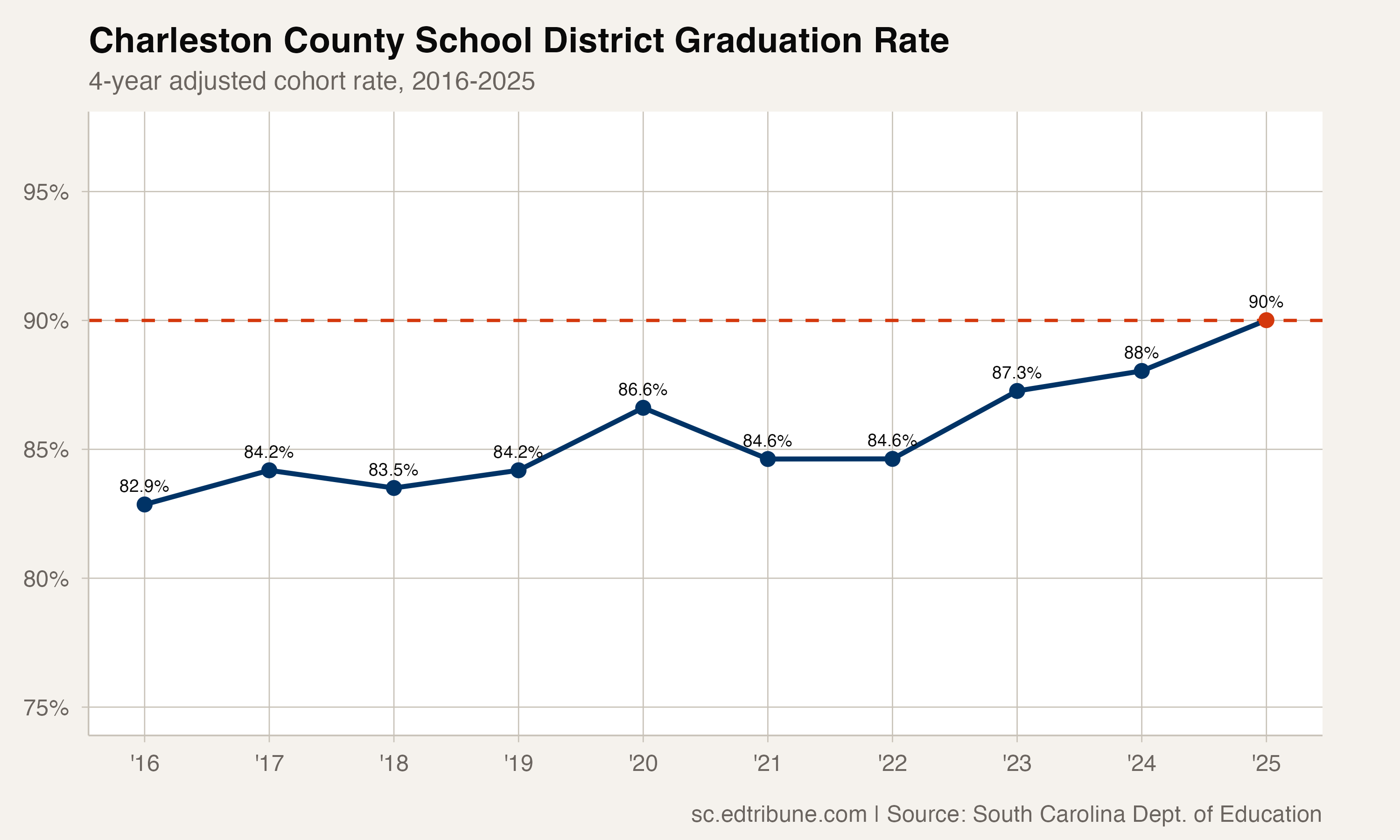
Charleston↗ET County School District posted a 90.0% four-year graduation rate in 2025, its first time at the 90% threshold, and the second consecutive year the district posted its highest rate ever. With a cohort of 2,913 students, Charleston is the second-largest South Carolina district at or above 90%, behind Greenville↗ET at 90.6%.
The milestone caps a steady nine-year ascent. Charleston graduated 82.9% of its class of 2016. The rate slipped slightly to 83.5% in 2018 during the statewide cohort methodology change, then climbed: 84.2% in 2019, 86.6% in 2020, a dip to 84.6% in 2021 during the COVID disruption, then a sustained push through 87.3% in 2023, 88.0% in 2024, and 90.0% in 2025.
Superintendent Anita Huggins said the threshold matters because it represents "thousands of students crossing a stage prepared for their next chapter" and the collective work of teachers, school leaders, support staff, families and community partners. The district, she said, sees the number as evidence that "sustained, student-centered work is making a difference."
Huggins also pointed beyond the diploma rate. She said Charleston's college and career readiness work included broader access to dual enrollment, Advanced Placement courses, career and technical education, industry credentials, work-based learning and military readiness pathways. Those readiness measures are separate from the state graduation file.
The racial equity dimension
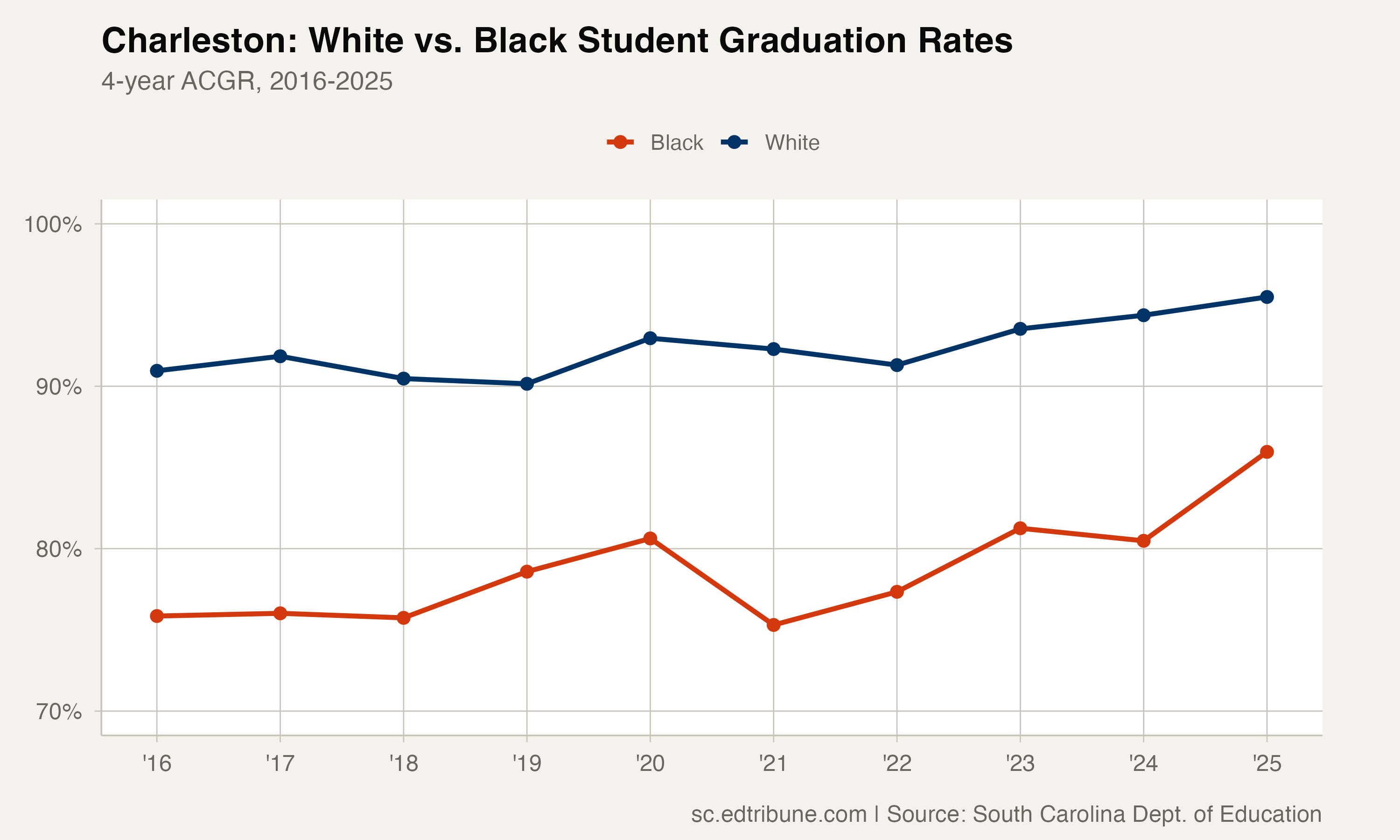
Charleston's improvement story has an important equity dimension. The district's white-Black graduation gap narrowed from 15.1 percentage points in 2016 to 9.5 points in 2025, a reduction of 5.6 points.
White students climbed from 91.0% to 95.5%. Black students climbed from 75.9% to 86.0%. The gains were not proportional (Black students gained 10.1 points while white students gained 4.5) which is exactly how gaps close. The students furthest behind improved fastest.
By the numbers: Charleston graduated roughly 2,622 of its 2,913 seniors in 2025. At its 2018 rate of 83.5%, about 2,432 would have graduated, roughly 190 fewer students walking at commencement.
The 9.5-point gap that remains is still significant. Among South Carolina districts with at least 100 white graduates and 100 Black graduates in the 2025 cohort, Charleston's white-Black gap is the fifth widest, behind SC Public Charter District, Spartanburg 7, Limestone Charter Association and Richland 1↗ET. But the direction of travel is clear and sustained.
Huggins said the narrowing gap reflects years of work to expand access, remove barriers and shift resources toward strategies that produce stronger student outcomes. She cited Universal Pre-K, strengthened literacy instruction, academic interventions, attendance supports and expanded access to rigorous coursework and college- and career-ready pathways. "The progress tells us the work is making a difference," Huggins said. "The remaining gap reminds us that the work must continue."
The 90% club
Charleston's arrival at 90% means South Carolina now has multiple large districts at or above the threshold. York 4 (Fort Mill)↗ET leads at 95.8%, a level it has maintained consistently since data is available. Dorchester 2↗ET reached 91.4%. Greenville hit 90.6%. Charleston posted 90.0%.
One note on which Charleston number this is. The state publishes two totals for every district: one covering the district's own schools, and one that also folds in the charter schools operating inside district lines. Charleston's district reporting uses the narrower figure, and so does this article. By the broader measure, Charleston graduated 90.6% of a 3,449-student cohort. The two figures describe different groups of students, not a disagreement about how many graduated.
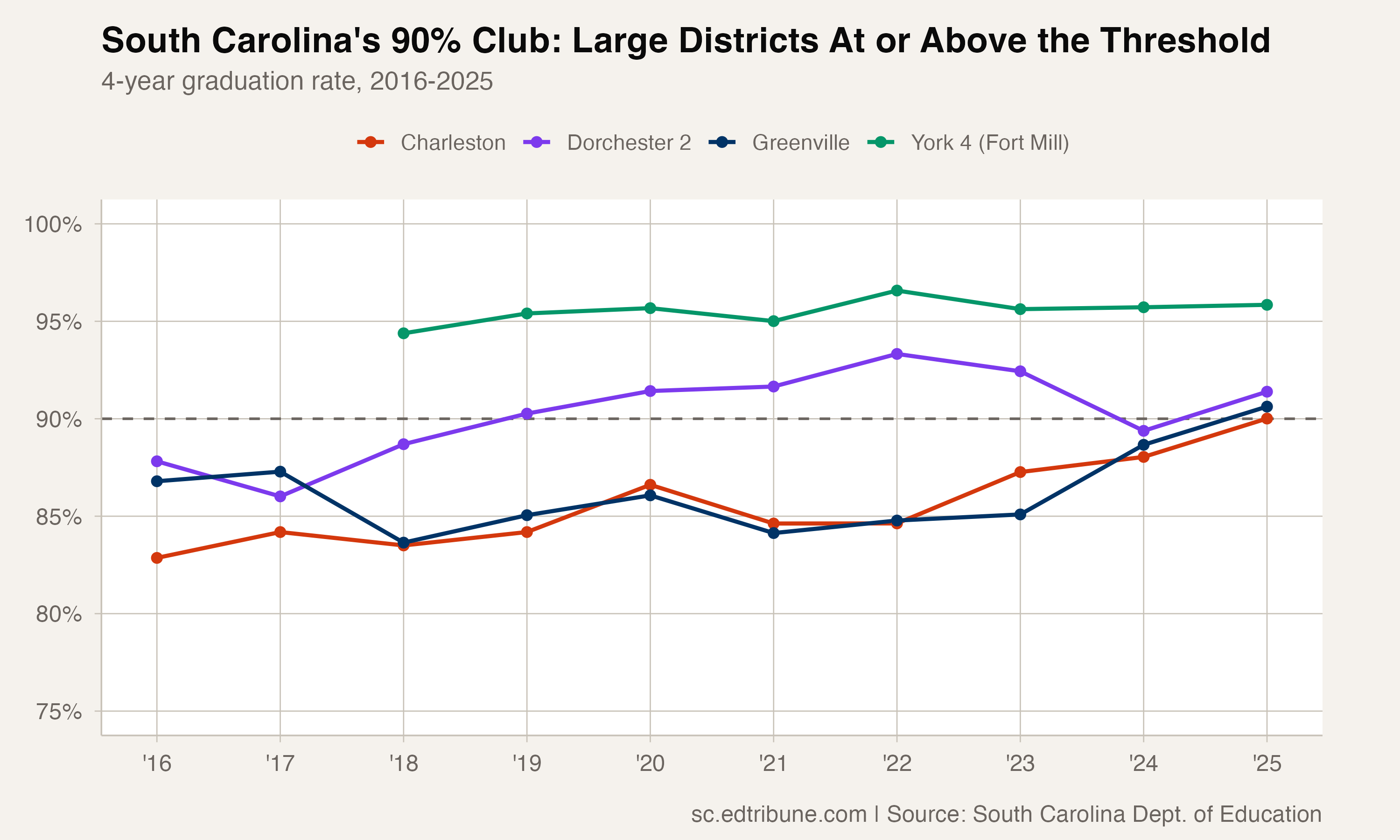
What distinguishes Charleston and Greenville from Fort Mill is the breadth of their challenge. Fort Mill's cohort is 1,372 students. Charleston's is 2,913, and Greenville's is 5,887. Reaching 90% with cohorts that large is a different kind of accomplishment than doing it in a smaller system.
These are not tiny cohorts where a handful of students can move the rate. They are large school systems that have improved graduation outcomes across demographic lines.
Huggins said there was not one program behind Charleston's nine-year climb. She pointed instead to early literacy work, intervention systems, attendance, school leadership, Advanced Placement, dual enrollment, career and technical education, workforce development and industry certification pathways. She also cited the district's Weighted Student Funding model, which allocates resources based on student need, and its CCSD ONE PLAN strategic planning process as ways Charleston is aligning goals, resources and accountability around student outcomes.
That same theme appears in a leadership document the district shared during preview review. The document frames Huggins' approach around people, aligned leadership and resources following plans: "tell me what you need to meet your goals, and I will get it to you." The result, it says, is "intentionality, agency, and outcomes."
What remains below 90%
Several of Charleston's subgroups remain well below the 90% threshold. Economically disadvantaged students graduated at 83.8%. English learners at 72.7%. Students with disabilities at 62.0%. Male students at 86.3%, compared to 93.7% for female students.
The 90% overall rate is an average that blends very high outcomes for some students with much lower outcomes for others. The district's challenge is whether it can maintain the headline number while closing the subgroup gaps that persist beneath it.
Detailed code that reproduces the analysis and figures in this article is available exclusively to EdTribune subscribers.
Discussion
Sign in to join the discussion.
Loading comments...