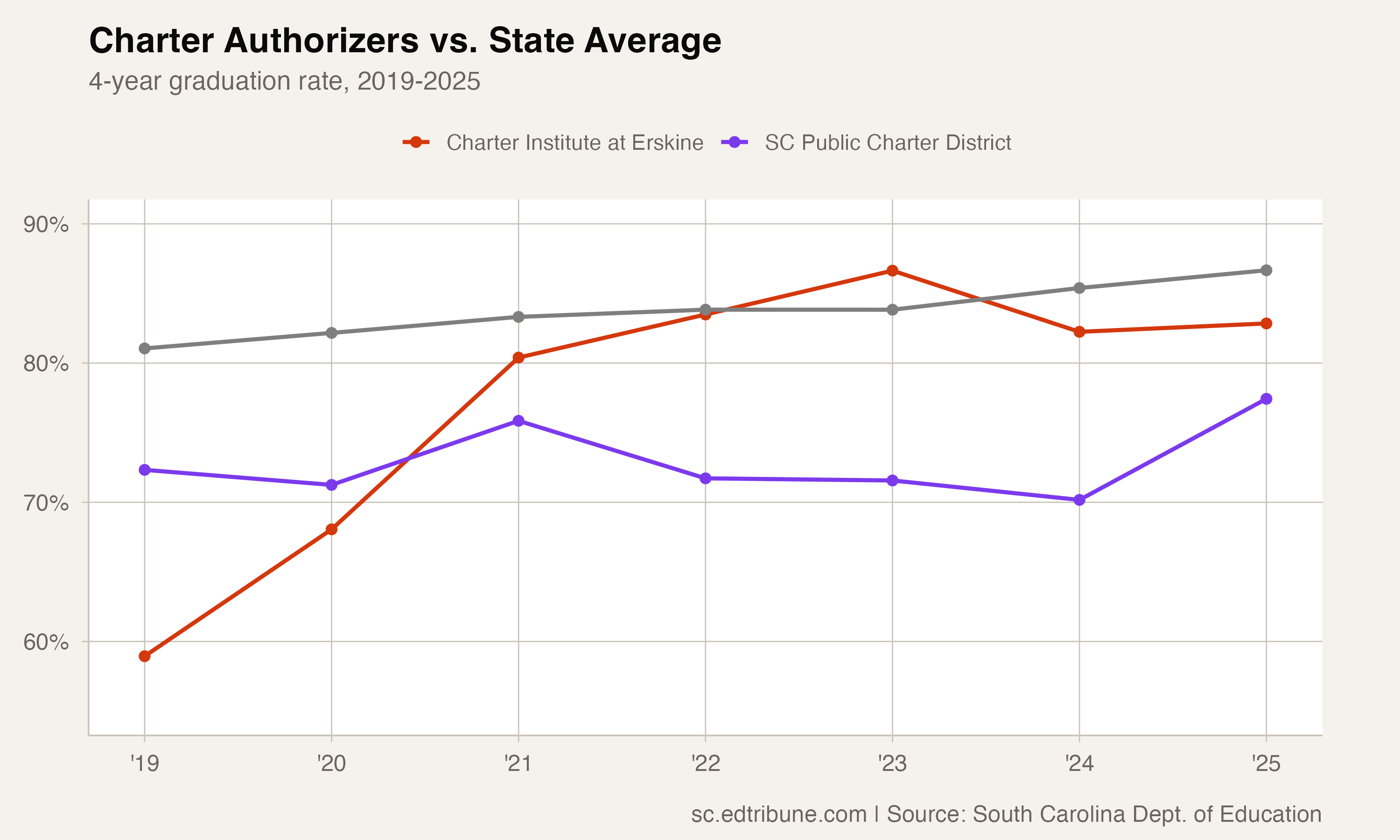
Correction (August 1, 2026): An earlier version of this article gave the SC Public Charter School District's 2019 graduation rate as 78.3% and described that authorizer as roughly flat ever since. Its 2019 rate was 72.3%, and it gained 5.1 points through 2025. Both authorizers improved over the window. Erskine's gain is more than four times as large, which makes the contrast one of degree rather than direction.
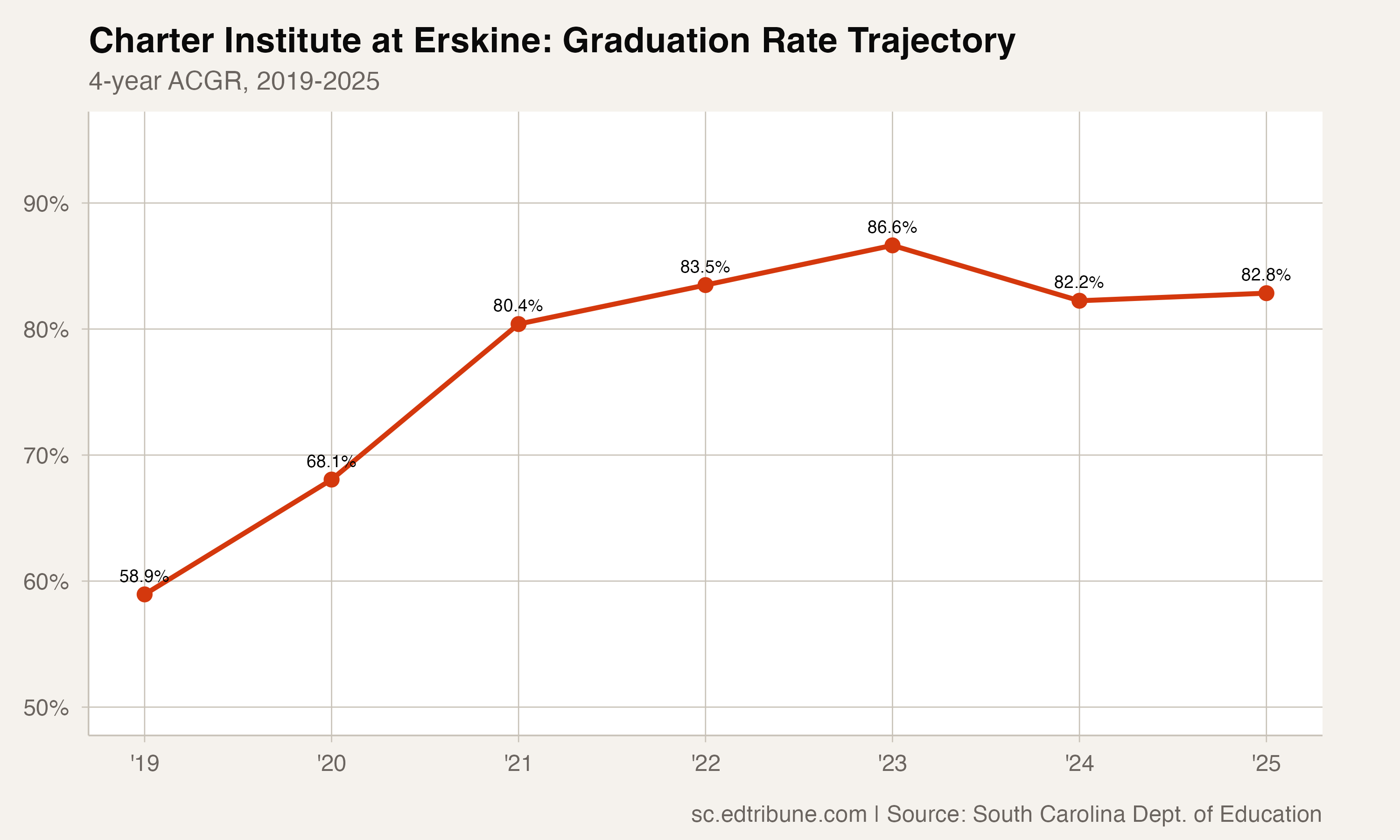
The Charter Institute at Erskine, which authorizes charter schools across South Carolina, reported a 58.9% graduation rate in 2019. In 2025, it reported 82.8%, a 23.9 percentage-point improvement, the largest of any entity in the state over that span.
With a cohort of 2,734 students in 2025 (the fifth largest in South Carolina), this is not a small-sample phenomenon. Erskine's improvement happened at scale, with a cohort that more than doubled from 1,269 in 2019 while the rate climbed simultaneously. Growing and improving at the same time is the hardest thing to do in education.
The trajectory was not linear
Erskine's improvement came in two distinct phases. From 2019 to 2023, the rate surged from 58.9% to 86.6%, an extraordinary 27.7-point gain in four years. Then it dropped to 82.2% in 2024 before recovering slightly to 82.8% in 2025.
The 2023 peak and subsequent decline suggest the initial gains may have included some one-time factors: school closures that removed lower-performing campuses from the denominator, or cohort composition changes as the institute grew rapidly. The 2024-2025 plateau around 82-83% may represent the more sustainable rate.
Even the plateau represents a dramatic transformation. An entity that graduated barely three in five students six years ago now graduates more than four in five.
By the numbers: Erskine graduated about 2,264 of its 2,734 seniors in 2025. At the 2019 rate, only 1,610 would have graduated from the same size cohort, 654 fewer.
Erskine vs. SC Public Charter District
South Carolina has two charter authorizers that report graduation data: the Charter Institute at Erskine and the SC Public Charter School District (SCPCD). Both improved over the same six years, at very different speeds.
Erskine improved from 58.9% to 82.8%, a gain of 23.9 points. SCPCD improved as well, from 72.3% in 2019 to 77.4% in 2025, a gain of 5.1 points. Both serve large cohorts (Erskine: 2,734; SCPCD: 1,830), and Erskine's gain is more than four times the size of SCPCD's.
The comparison raises a question about what is driving Erskine's gains. Is it the authorizer's accountability practices, the types of schools it authorizes, or the demographics of the students it serves? The data alone cannot answer this, but the divergence between two charter authorizers in the same state is notable.
The growing cohort
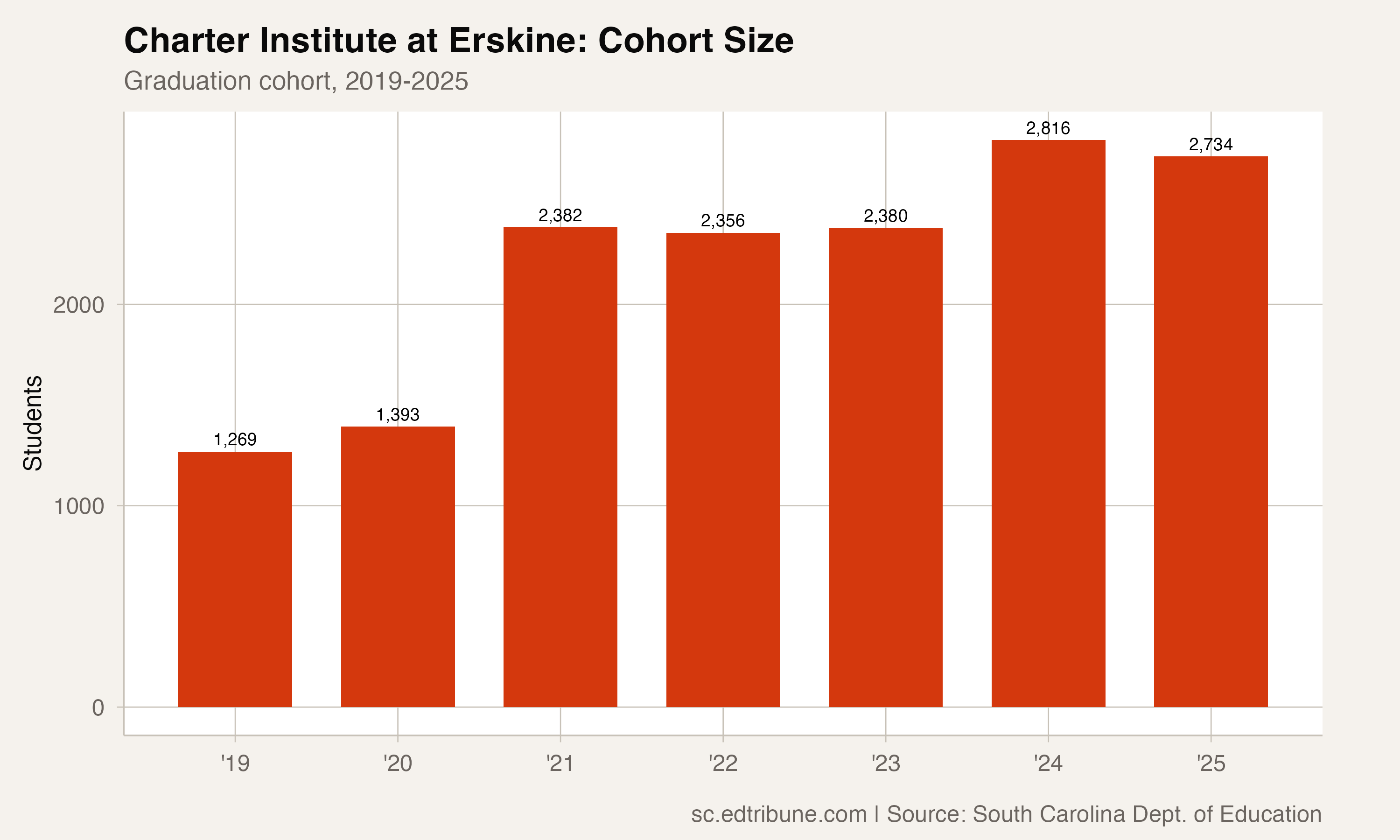
Erskine's cohort more than doubled from 1,269 in 2019 to 2,734 in 2025. It is now the fifth-largest graduation entity in South Carolina, behind only Greenville, Horry, Charleston, and Berkeley. The rapid growth reflects the expansion of Erskine-authorized charter schools across the state.
The simultaneous cohort growth and rate improvement is the most striking feature of the data. In most contexts, rapid growth dilutes quality: new students are harder to serve, new schools take time to mature, and the organizational challenges of scaling are well-documented. Erskine's numbers went the other direction.
What the data does and does not show
Erskine is an authorizer, not a single school. Its graduation rate is an aggregate of multiple charter schools that serve different populations in different parts of the state. A school closing or opening changes the denominator. A school that converts from Erskine authorization to SCPCD (or vice versa) moves students between buckets.
The 23.9-point improvement is real in the aggregate: these students graduated under Erskine's authority. But the cause of the improvement is harder to pinpoint from the data alone. It could reflect better-performing schools joining the portfolio, lower-performing schools exiting, improved instruction across existing schools, or all of the above.
What is clear is that the charter sector in South Carolina is not monolithic. Two authorizers, serving similar-sized cohorts, improved at very different speeds over six years. As the state's charter sector grows, the distinction between authorizers matters as much as the distinction between charter and traditional.
Detailed code that reproduces the analysis and figures in this article is available exclusively to EdTribune subscribers.
Discussion
Sign in to join the discussion.
Loading comments...