Correction (August 1, 2026): An earlier version of this article said the male graduation rate spent three consecutive years below 76%. It spent two, in 2018 and 2019. That version also dated the peak gender gap to 2019; the gap was fractionally wider in 2020, and both years display as 12.2 points. Spartanburg 5's 2025 rate is 91.2%, not 91.1%. Two comparisons to a national gender gap have been removed, because the federal government does not publish graduation rates by sex and EdTribune has no source for that figure.
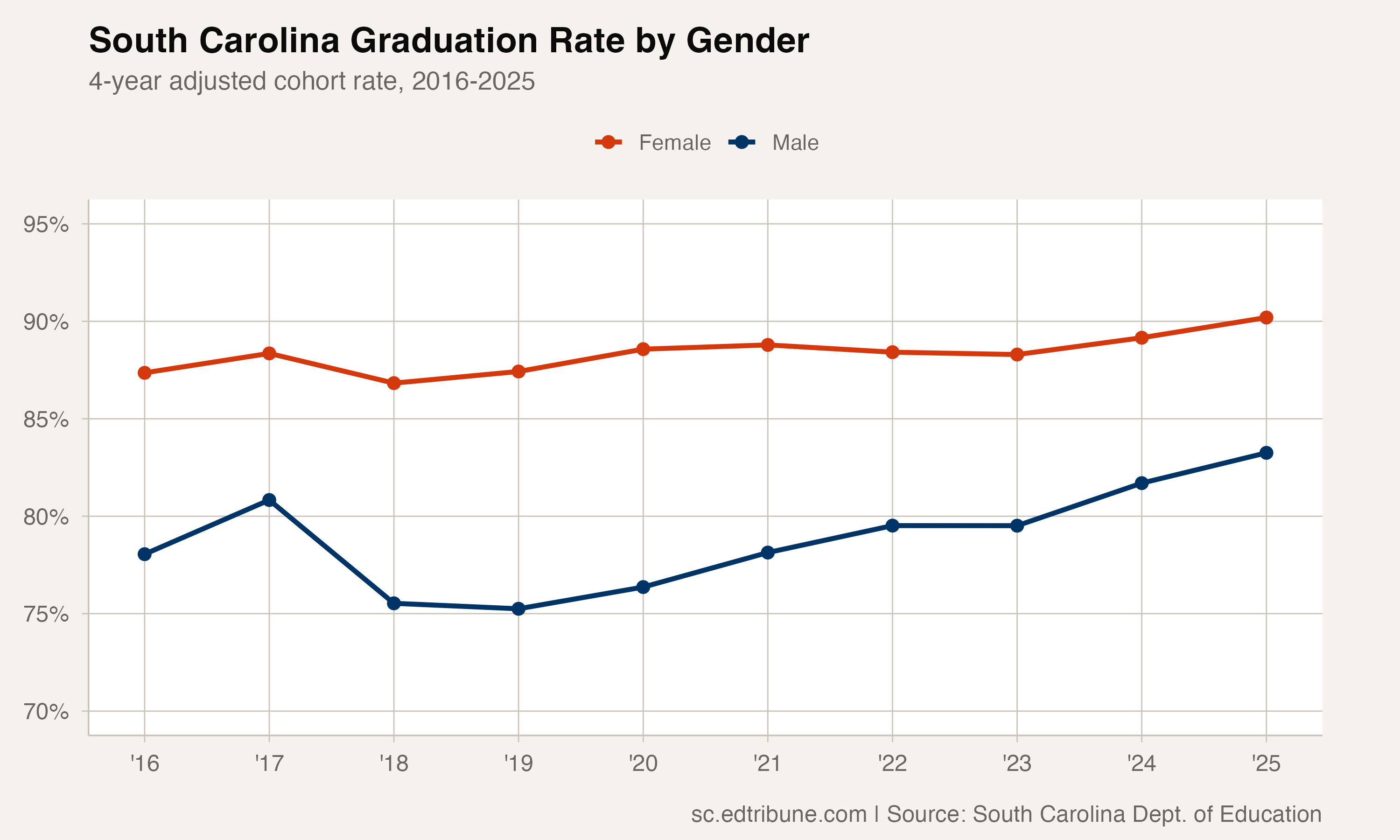
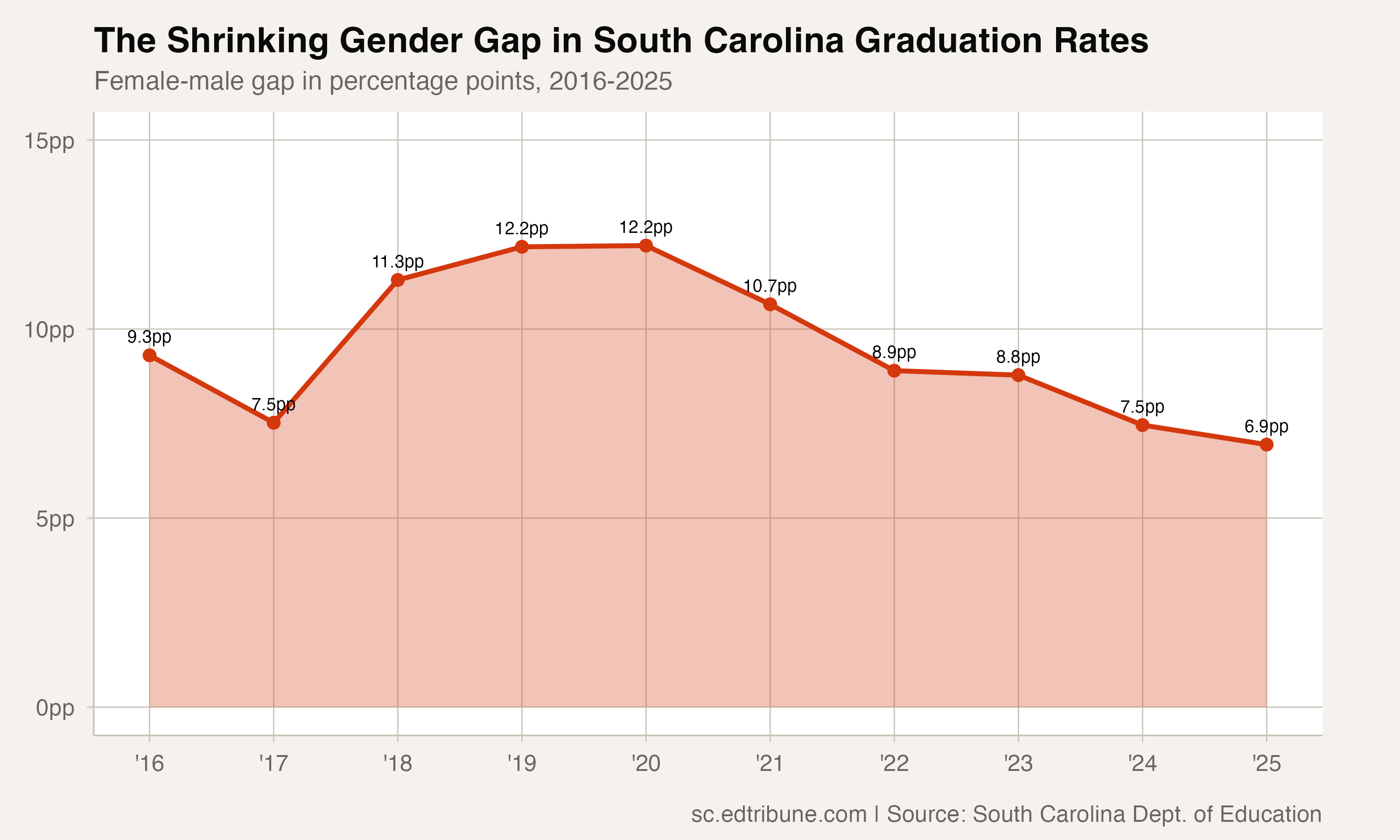
South Carolina's gender gap in graduation rates peaked at 12.2 percentage points, a level it reached in both 2019 and 2020. In 2019, male students graduated at 75.3% and female students at 87.4%. One in four boys who entered ninth grade four years earlier did not finish on time.
Six years later, that gap has narrowed to 6.9 points. Male students crossed 83% for the first time in 2025, reaching 83.3%. Female students crossed 90% for the first time, reaching 90.2%. The convergence is real, but it came almost entirely from one direction: boys improved 8.0 percentage points since 2019, while girls improved 2.8.
The anatomy of the gap
The gender gap has moved in two distinct phases. From 2016 to 2019, it widened dramatically (from 9.3 to 12.2 points) as female rates held steady in the high 80s while male rates dropped from 78.1% to 75.3%. The 2018-2019 period was the nadir for boys: two consecutive years below 76%.
Since 2019, the pattern reversed. Male students climbed from 75.3% to 83.3%, gaining in every year but one, when the rate held flat. Female students also improved, but at a slower pace, from 87.4% to 90.2%.
By the numbers: 83.3% of South Carolina's male students graduated in 2025, up from 75.3% in 2019. That improvement translated to roughly 2,500 additional male graduates per year compared to the 2019 rate applied to the current cohort of 32,252.
District gender gaps: where it is widest
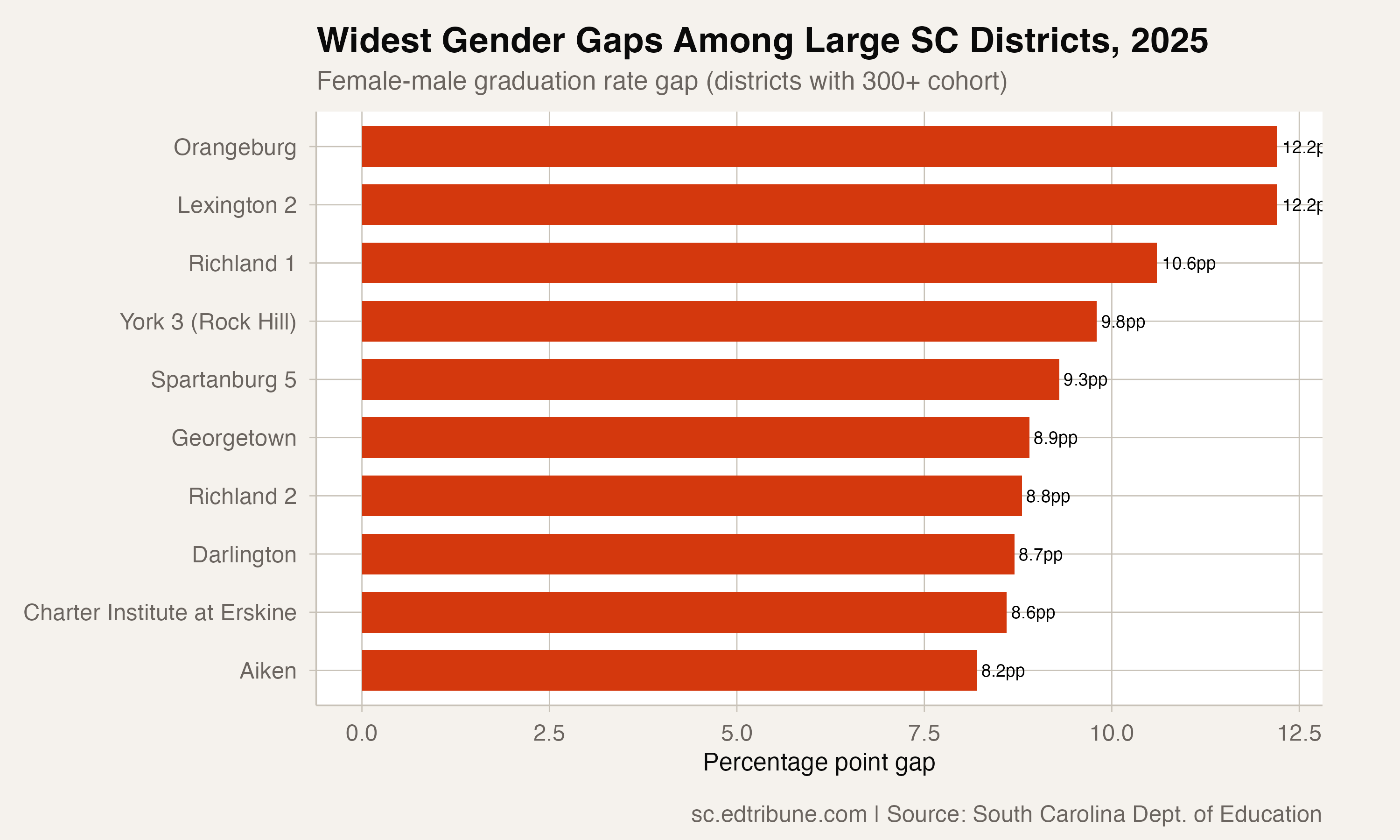
The statewide 6.9-point gap masks much wider gaps at the district level. Among districts with at least 300 students in the graduation cohort, Lexington 2↗ET and Orangeburg↗ET each posted 12.2-point gender gaps in 2025, matching the state's own peak. At Orangeburg, female students graduated at 86.5% while male students managed only 74.3%.
Richland 1↗ET had a 10.6-point gap. York 3 (Rock Hill)↗ET showed 9.8. Spartanburg 5↗ET, despite a strong overall rate of 91.2%, had a 9.3-point gap between its female (95.8%) and male (86.4%) graduates.
Even districts celebrated for their overall performance carry significant gender gaps. Greenville↗ET had a 6.0-point gap, Charleston↗ET 6.9. Horry↗ET at 6.1. The pattern holds across geography, demographics, and performance level: wherever you look in South Carolina, boys graduate at lower rates than girls.
What closing looks like
The gender gap narrowed by about 0.9 points per year from 2019 to 2025, but that is a description of past cohorts, not a forecast. Competing explanations for the improvement include better credit recovery programs, expanded summer school, and improved ninth-grade transition supports; this analysis does not test which, if any, contributed. Further narrowing would require reaching students with deeper barriers: behavioral issues, attendance problems, disconnection from school culture.
The boys who did not graduate on time in 2025 are the students left outside the reported graduate count. South Carolina's 6.9-point gender gap is narrower than it was, but it still represents roughly 5,400 male students who did not graduate on time in the class of 2025.
Detailed code that reproduces the analysis and figures in this article is available exclusively to EdTribune subscribers.
Discussion
Sign in to join the discussion.
Loading comments...