Correction (August 1, 2026): An earlier version of this article said every major subgroup in Greenville improved after 2018. Youth in foster care did not. The district's foster care graduation rate fell over that period, on cohorts of a few dozen students.
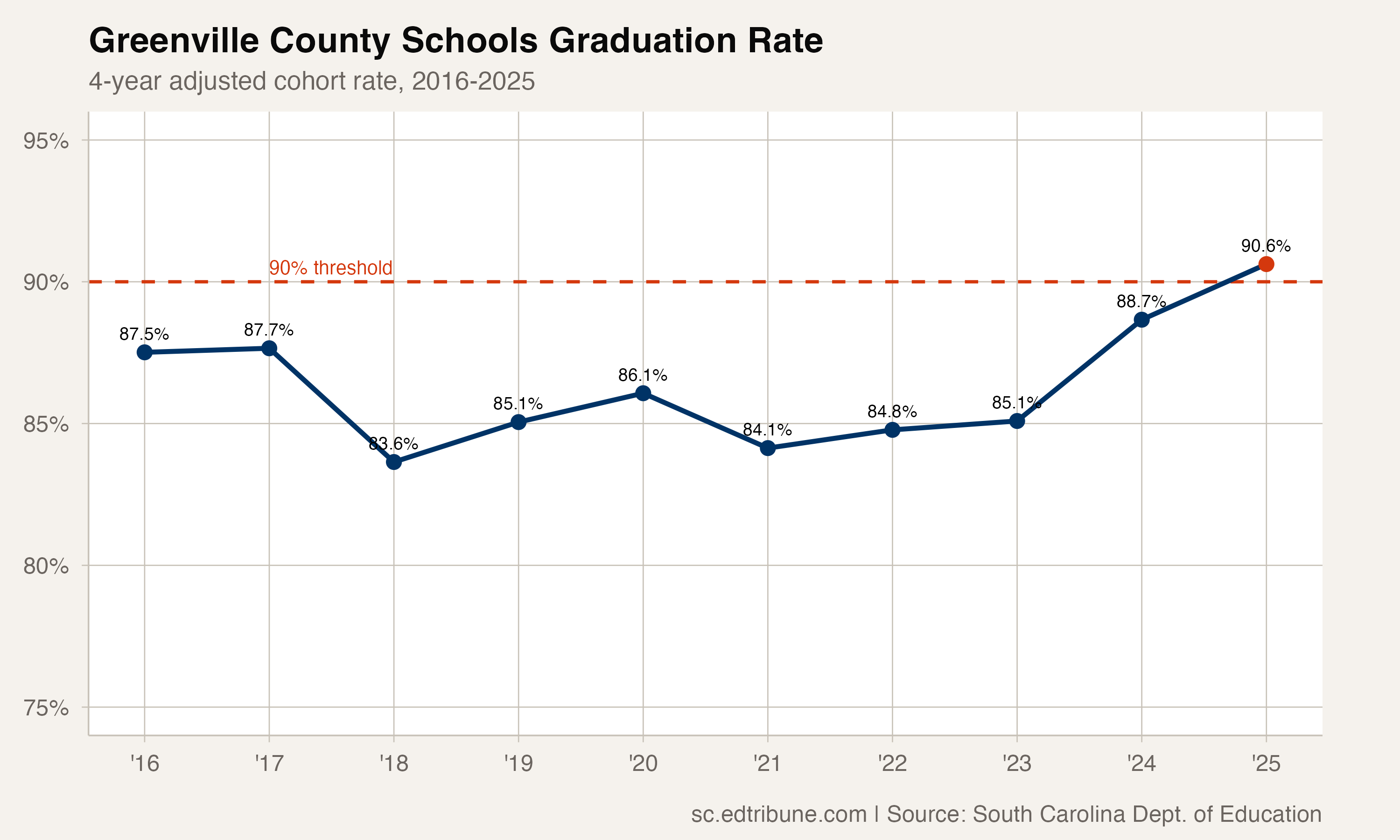
Greenville↗ET County Schools, the largest district in South Carolina with a cohort of 5,887 students, posted a 90.6% four-year graduation rate in 2025. It is the first time in district history that Greenville has crossed 90%.
The milestone did not come from a single breakout year. Greenville's rate dropped to 83.6% in 2018, part of a statewide dip driven by a cohort methodology change, and has climbed back over seven years. The ascent was not always linear: the rate dipped to 84.1% in 2021 during the COVID disruption, then climbed 6.5 percentage points over the four years that followed. But the trajectory has been unmistakably upward, and the 2025 number marks the highest point in every year of available data.
Gains across the board
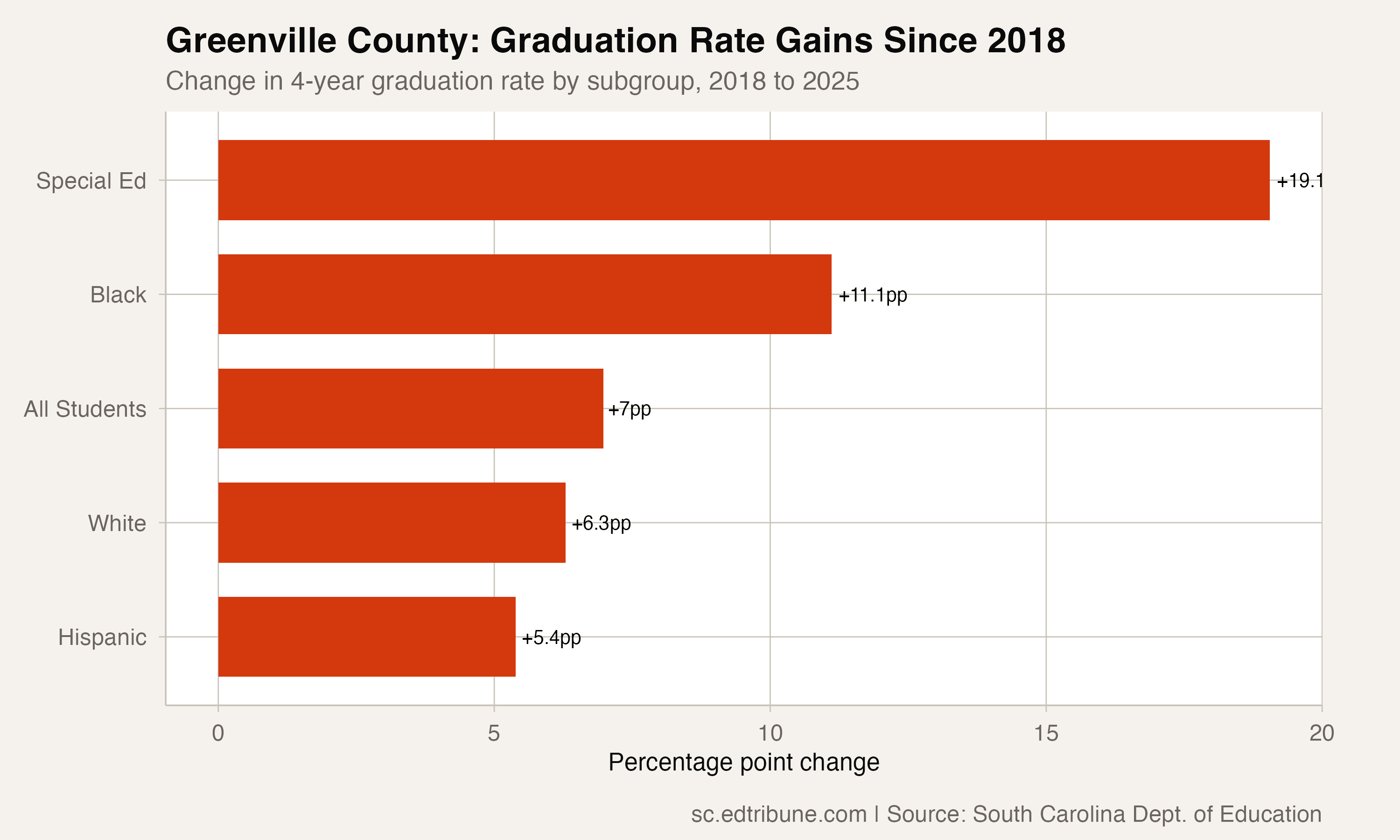
What separates Greenville's improvement from a statistical artifact is its breadth. Since 2018, every subgroup the state reports for Greenville improved except youth in foster care, whose rate fell 10.0 points. That group counted 13 students in 2018 and 27 in 2025, small enough that a single student moves the rate by several points. Most of the largest gains came from the students who started furthest behind.
Black students climbed from 76.6% to 87.8%, an 11.2 percentage-point gain that narrowed the white-Black gap from 10.3 to 5.4 points. Hispanic students went from 81.8% to 87.2%. Male students improved from 79.7% to 87.6%. And students with disabilities posted the most dramatic shift: from 50.8% to 69.9%, a 19.1 percentage-point improvement that represents dozens of additional graduates each year from a cohort of 856.
By the numbers: Greenville graduated 5,335 of its 5,887 seniors in 2025, roughly 410 more than it would have with its 2018 graduation rate applied to the same cohort.
Context among large districts
Greenville is not the only large South Carolina district reaching new heights. Charleston↗ET also hit 90.6% in 2025, crossing the threshold alongside Greenville. Dorchester 2↗ET reached 91.4%. York 4 (Fort Mill)↗ET leads all large traditional districts at 95.8%.
But Greenville's achievement carries particular weight because of its size and demographics. At 5,887 students, its graduating cohort is nearly 60% larger than the next biggest district. It serves a meaningfully diverse student body (26.6% Black, 20.8% Hispanic, 53.4% economically disadvantaged in its 2025 cohort), and its improvement has not been concentrated in its highest-performing subgroups.
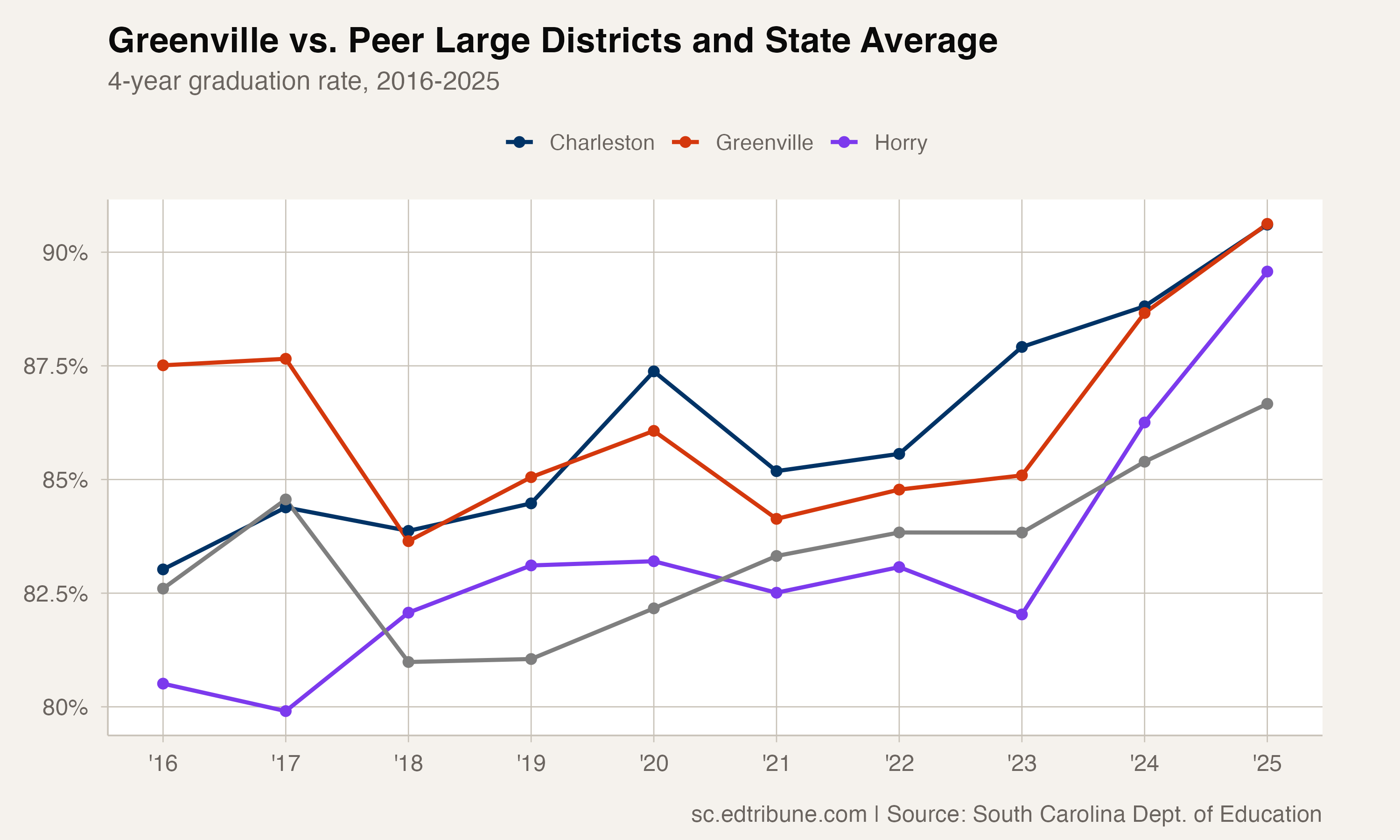
Greenville has also outpaced the state average in every year since 2016. The margin between Greenville and the state has ranged from 0.8 to 4.9 points. In 2025, it was 3.9 points: Greenville at 90.6% versus the state at 86.7%.
What the remaining 10% looks like
A 90.6% graduation rate means 552 students in Greenville's 2025 cohort did not finish on time. The subgroup data suggests where many of those students are: English learners graduated at 82.9%, economically disadvantaged students at 85.9%, and students with disabilities at 69.9%. The special education rate, despite its 19-point improvement since 2018, still means nearly one in three students with disabilities did not graduate on schedule.
The district also faces a gender gap. Female students graduated at 93.7%, male students at 87.6%, a 6.1-point difference that mirrors the statewide pattern. The gap has narrowed slightly from 8.1 points in 2018, but it remains substantial.
Crossing 90% is a milestone, not a finish line. But for a district of Greenville's size, diversity, and starting point, the seven-year trajectory from 83.6% to 90.6% represents something that is not easily explained away by cohort fluctuation or methodological noise. The improvement is real, it is broad, and it is, for the first time, above 90%.
Detailed code that reproduces the analysis and figures in this article is available exclusively to EdTribune subscribers.
Discussion
Sign in to join the discussion.
Loading comments...