Correction (August 1, 2026): An earlier version of this article said the English learner decline happened over the past decade and that English learners were the only major group to lose ground, and its headline and summary called it the steepest subgroup decline in the state. Across 2016 to 2025 the English learner rate rose. The decline runs from 2018, the year the state changed how it defines a graduation cohort. Two other subgroups also lost ground over that period, and youth in foster care lost more. The national comparison is now treated as context rather than a numeric comparison, and a claim about how other states have trended, which EdTribune cannot support, has been removed.
South Carolina's graduation rate has climbed steadily since the 2018 cohort methodology change, and most subgroups climbed with it. Black students, Hispanic students, students with disabilities, male students, students who are currently homeless: all moved upward. Three subgroups went the other way.
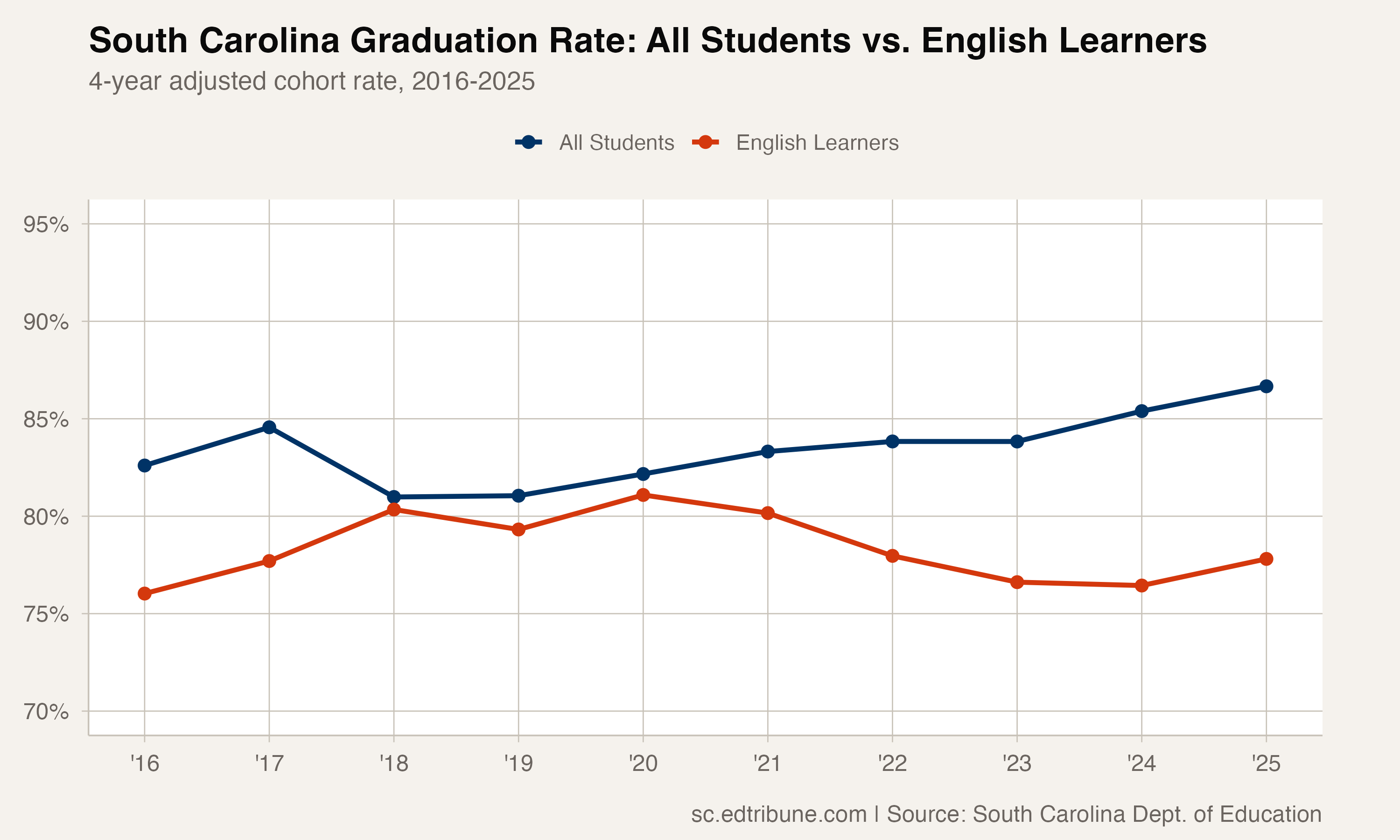
Limited English Proficient students graduated at 80.3% in 2018. In 2025, the rate is 77.8%. While the rest of the state climbed from 81.0% to 86.7%, English learners went in the opposite direction. So did students who are economically disadvantaged and youth in foster care, and the foster care decline is steeper still.
From parity to a 9-point gap
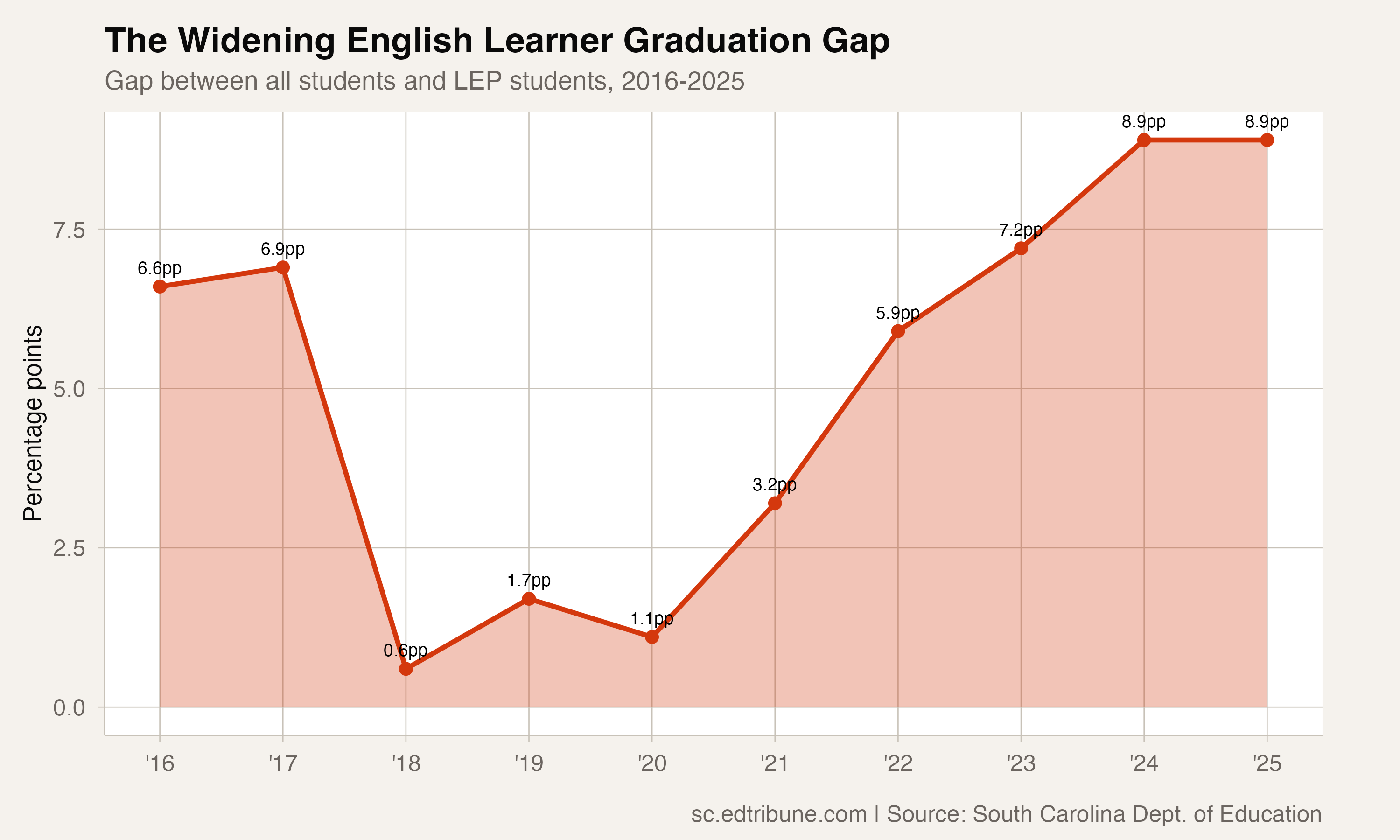
In 2018, the LEP graduation rate was essentially at parity with the state (80.3% vs. 81.0%), a gap of just 0.7 points. For a brief window, English learners and the state moved in step.
By 2025, the gap has widened to 8.9 percentage points. The state improved by 5.7 points over that span. LEP students declined by 2.5 points. The divergence is not a single bad year. It is a persistent, multi-year pattern of the state moving in one direction and English learners moving in the other.
By the numbers: 3,997 English learners were in South Carolina's class of 2025 graduation cohort. At the 2018 rate of 80.3%, roughly 3,210 would have graduated. At the actual 2025 rate of 77.8%, about 3,110 did, roughly 100 fewer graduates per year than the old rate would have produced from the current cohort.
A growing cohort, a declining rate
The LEP cohort has grown substantially. In 2016, 1,869 English learners were in the graduation pipeline. By 2025, that number had more than doubled to 3,997. South Carolina's immigrant population has grown, and more recent arrivals face a steeper path to on-time graduation. They have had less time to acquire English proficiency, less time to accumulate credits, and may have experienced interrupted formal education before entering the state's schools.
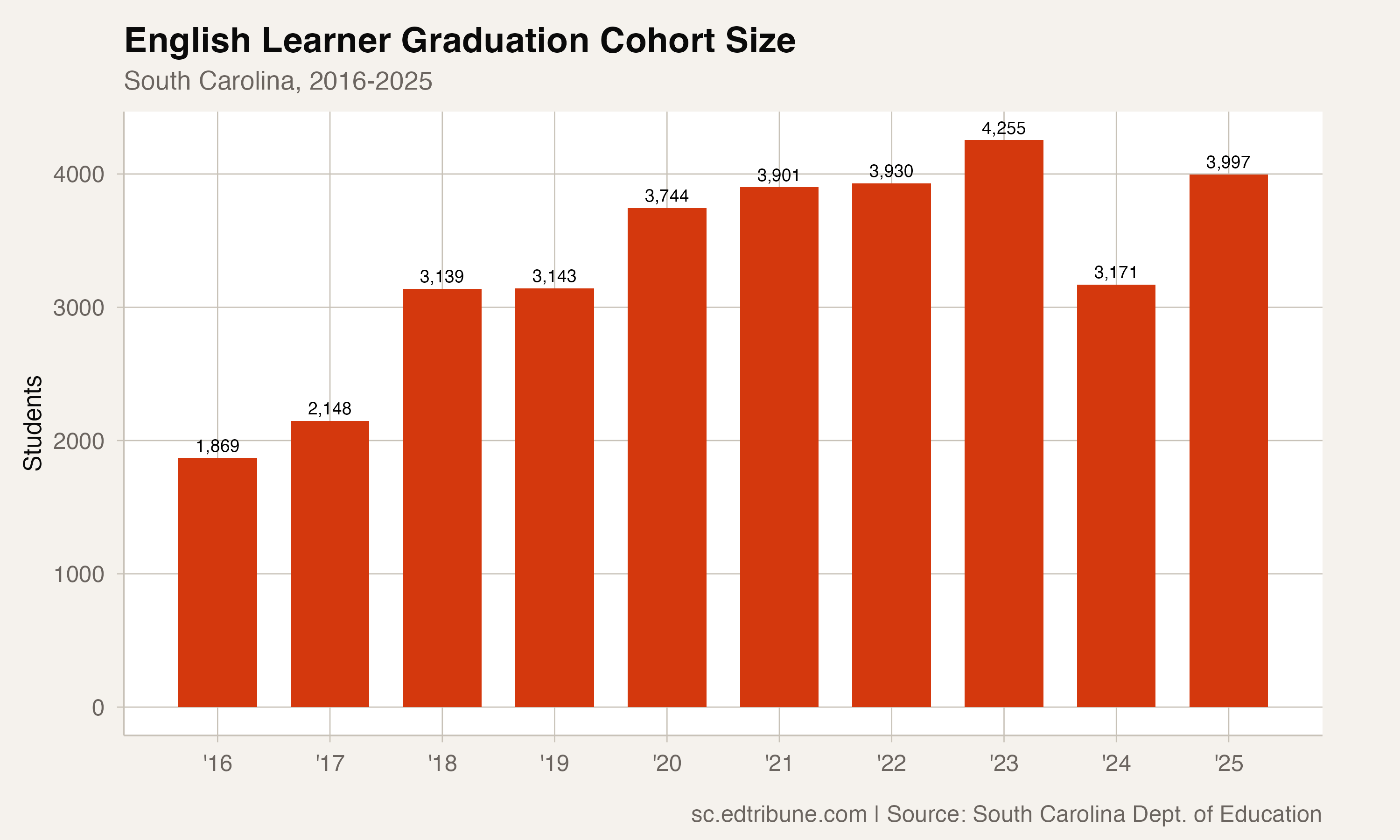
The growing cohort explains part of the declining rate. A 2016 LEP cohort of 1,869 students likely included many who had been classified as LEP in earlier grades but had years of English instruction by high school. A 2025 cohort of 3,997 likely includes a higher share of more recent arrivals with less English proficiency, pulling the average down even if individual students are no worse off.
But explanatory does not mean acceptable. The LEP classification identifies students who need additional language support. A declining graduation rate among that group suggests the support is not sufficient for the growing number of students who need it.
The policy dimension
South Carolina's LEP graduation gap exists in a national context where English learners consistently graduate at lower rates than their peers. Federal data provide context, but the years and methodologies are not directly comparable to this state panel (National Center for Education Statistics). The level is not the problem here. The direction is.
The state expanded its English learner services in recent years, including additional ESL endorsements for teachers and increased Title III funding. Whether those investments are keeping pace with the growth in the LEP population is the central question. A cohort that more than doubled while the rate declined suggests the investments have not scaled proportionally.
English learners are the canary in South Carolina's graduation story. When the state improves its rate by 5.7 points over seven years, the expectation is that the improvement reaches every subgroup, if not equally, then at least directionally. The LEP divergence is a signal that something is not working for the state's fastest-growing student population.
Detailed code that reproduces the analysis and figures in this article is available exclusively to EdTribune subscribers.
Discussion
Sign in to join the discussion.
Loading comments...