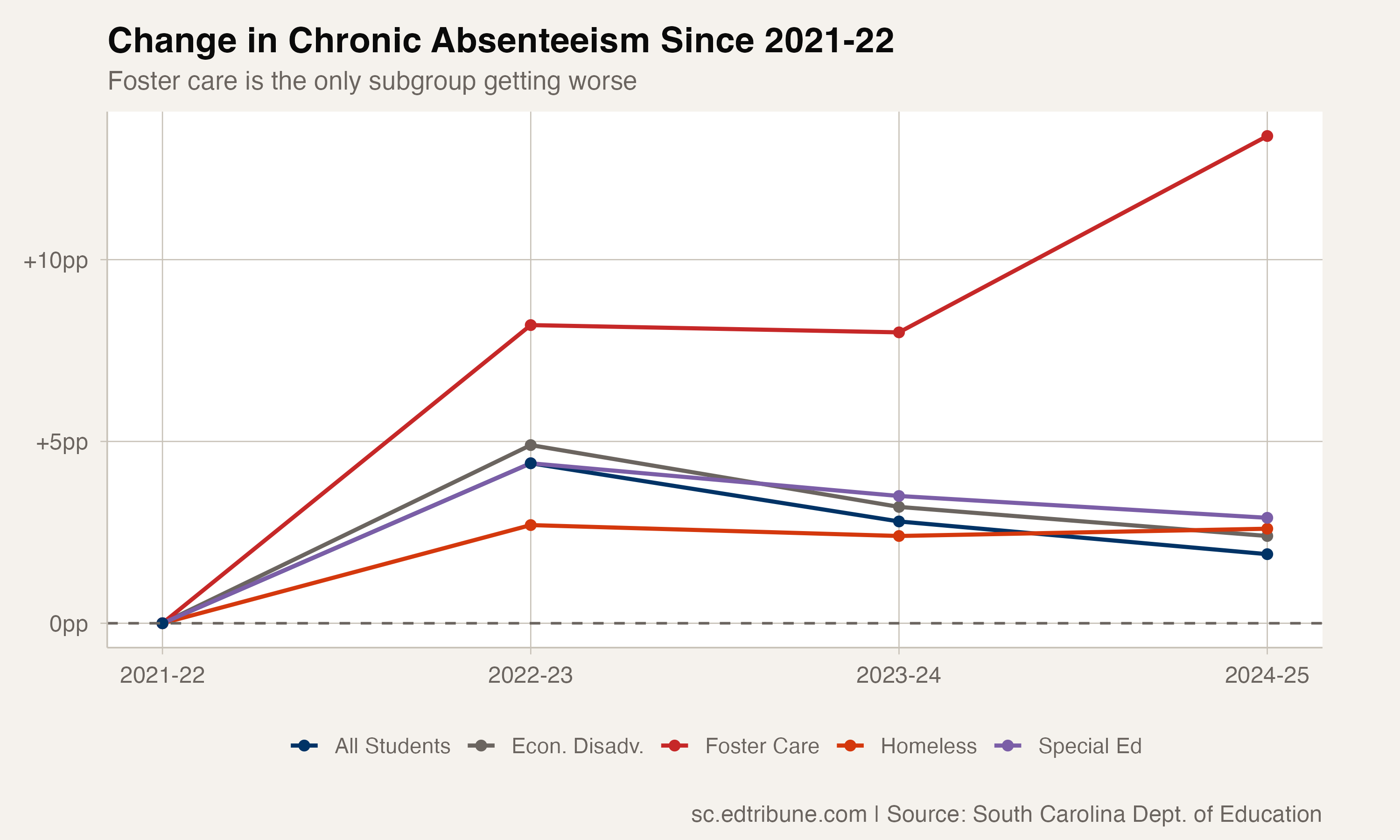
Every student subgroup in South Carolina has seen chronic absenteeism improve since the 2022-23 peak. Every subgroup except one. Students in foster care are heading the opposite direction, and the magnitude of the reversal should alarm anyone who works with the state's most vulnerable children.
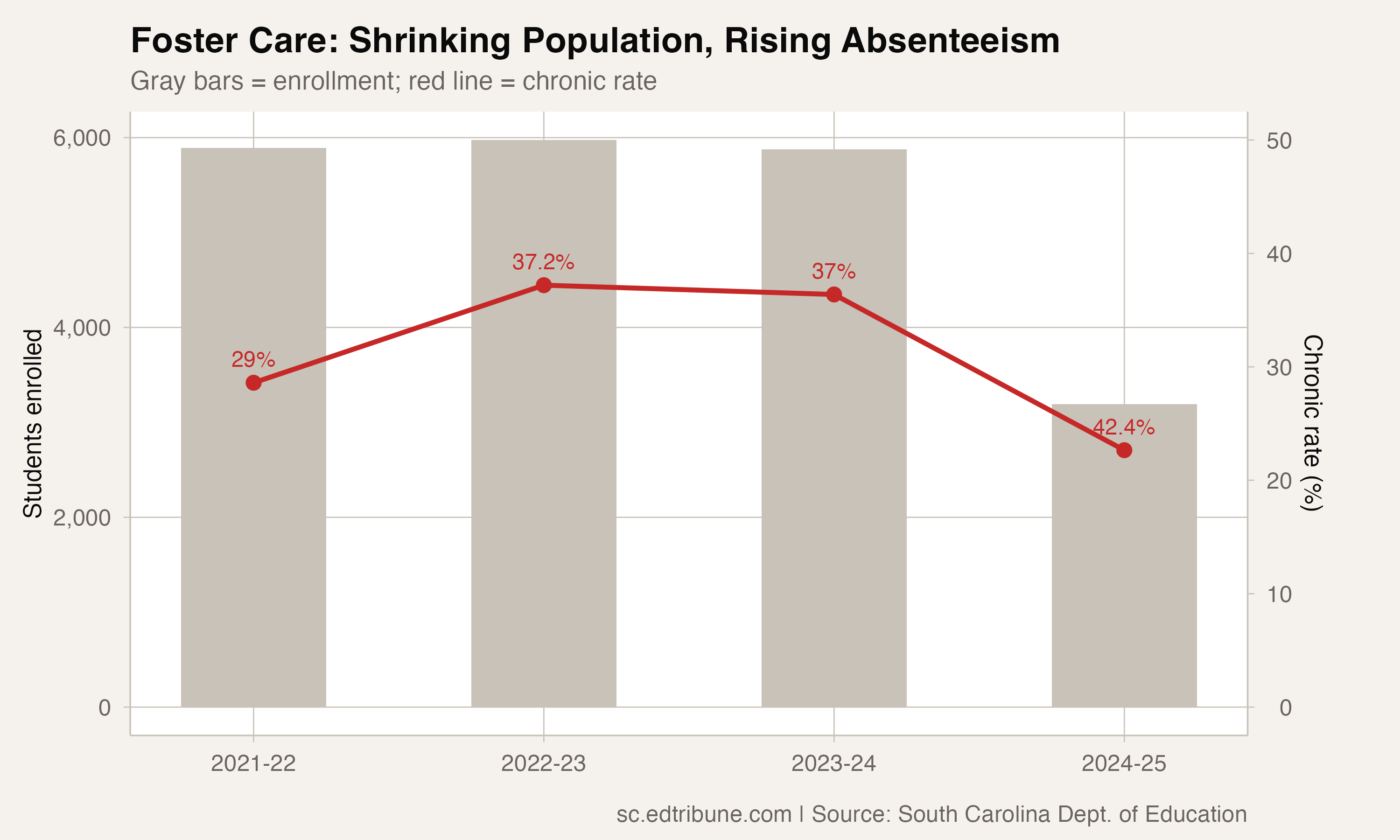
The chronic absenteeism rate for students in foster care was 29.0% in 2021-22. By 2024-25, it reached 42.4%. That is a 13.4 percentage point increase over four years, a trajectory that diverges sharply from every other population the state tracks. In 2024-25 alone, the rate jumped 5.4 points, from 37.0% to 42.4%, the largest single-year increase of any subgroup.
Fewer students, worse outcomes
What makes the foster care trajectory especially troubling is that it is happening to a shrinking population. South Carolina identified 5,892 students in foster care in 2021-22. By 2024-25, that number had dropped to 3,192, a 45.8% decline. Fewer children are in foster care, but the ones who remain are dramatically more likely to miss school.
There are two ways to read this. One is that the students most easily returned to stable placements, those with shorter foster stays, stronger family connections, or fewer behavioral challenges, have been successfully moved out of the system, leaving behind a population with more severe needs. The other is that something about the foster care system itself has changed in ways that produce worse attendance outcomes. Both readings point to the same conclusion: the current approach is not working for the students who remain.
Placement instability and school instability
A foster care placement change almost always means a school change. A school change means lost relationships with teachers, a new bus route or none at all, unfamiliar hallways, and the anxiety of starting over in a building full of strangers. Research consistently shows that each school change costs students three to six months of academic progress. Chronic absenteeism is the attendance-side expression of the same disruption.
In 2024-25, 1,352 students in foster care were chronically absent out of 3,192 enrolled. That is 42.4%, nearly twice the overall state rate of 22.3%. For context, even students who are currently homeless, whose chronic rate of 48.7% is the highest in the state, have shown more stability over time. Students who are currently homeless' rate fluctuated between 46.1% and 48.8% over four years. Students in foster care went from 29.0% to 42.4%, a straight line upward.
What other states have tried
Several states have implemented specific protections to keep children in foster care in their school of origin even after a placement change, absorbing the transportation costs rather than forcing a school transfer. Federal law under the Every Student Succeeds Act requires "best interest determinations" for school placement, but implementation varies widely. In practice, many children in foster care still change schools when they change homes.
South Carolina's Guardian ad Litem program and the Department of Social Services both have responsibilities to coordinate educational continuity. The data suggests that coordination is not producing continuity in attendance.
The smallest group, the loudest signal
Students in foster care are a small share of South Carolina's enrollment, 3,192 out of 792,005 in 2024-25, less than half a percent. Their numbers will never move the state's topline chronic rate. But their trajectory functions as a signal: when the most vulnerable students are getting worse even as the overall picture improves, the recovery is incomplete in the ways that matter most.
South Carolina's statewide chronic rate improved by 2.5 points over two years. In the same period, the foster care rate climbed 5.2 points. Somewhere in that divergence are 1,352 children whose attendance records say the system meant to protect them is failing at the most basic level: getting them through the school door.
Detailed code that reproduces the analysis and figures in this article is available exclusively to EdTribune subscribers.
Discussion
Sign in to join the discussion.
Loading comments...