The districts that line Interstate 95 as it cuts through South Carolina's rural interior carry a name that was given to them two decades ago and has proven impossible to shake. The "Corridor of Shame," made famous by a 2005 documentary and the decades-long Abbeville County School District v. State lawsuit, described communities where school buildings were crumbling and funding was thin enough to count by pennies. Now those same communities face another layer of crisis: chronic absenteeism rates roughly double the state average.
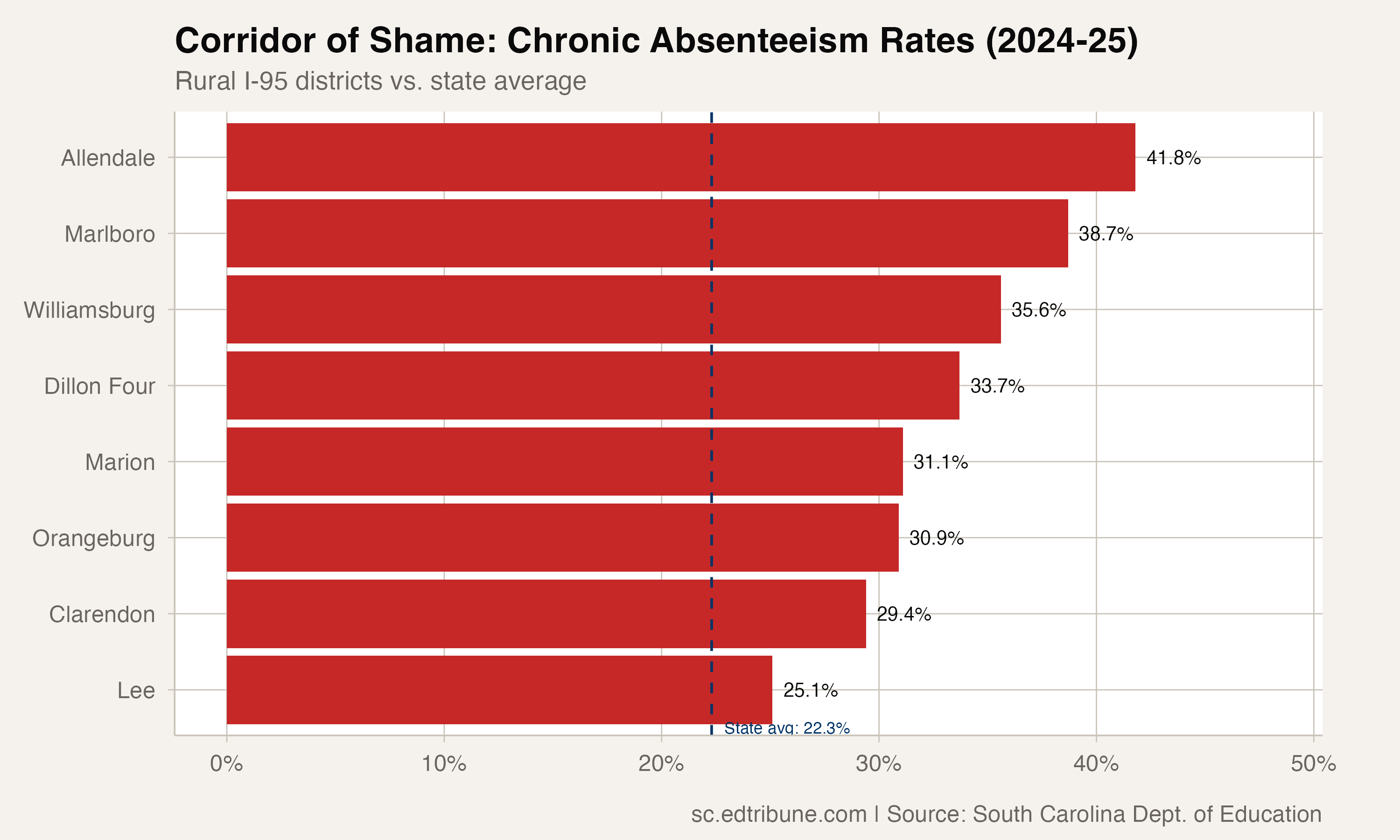
In 2024-25, Allendale County↗ET leads the state at 41.8%, meaning more than two in five students miss at least 18 school days per year. Marlboro County↗ET follows at 38.7%. Williamsburg County↗ET is at 35.6%. Dillon Four reaches 33.7%, Marion County↗ET 31.1%, and Orangeburg County↗ET 30.9%. The state average is 22.3%.
A map of disadvantage
These are not districts that simply happen to cluster at the top of the absenteeism rankings. They share a geography and a history. The I-95 corridor runs through the Pee Dee and Lowcountry regions, where majority-Black populations, high poverty, limited transportation infrastructure, and generations of underfunding have created conditions that produce exactly this kind of data.
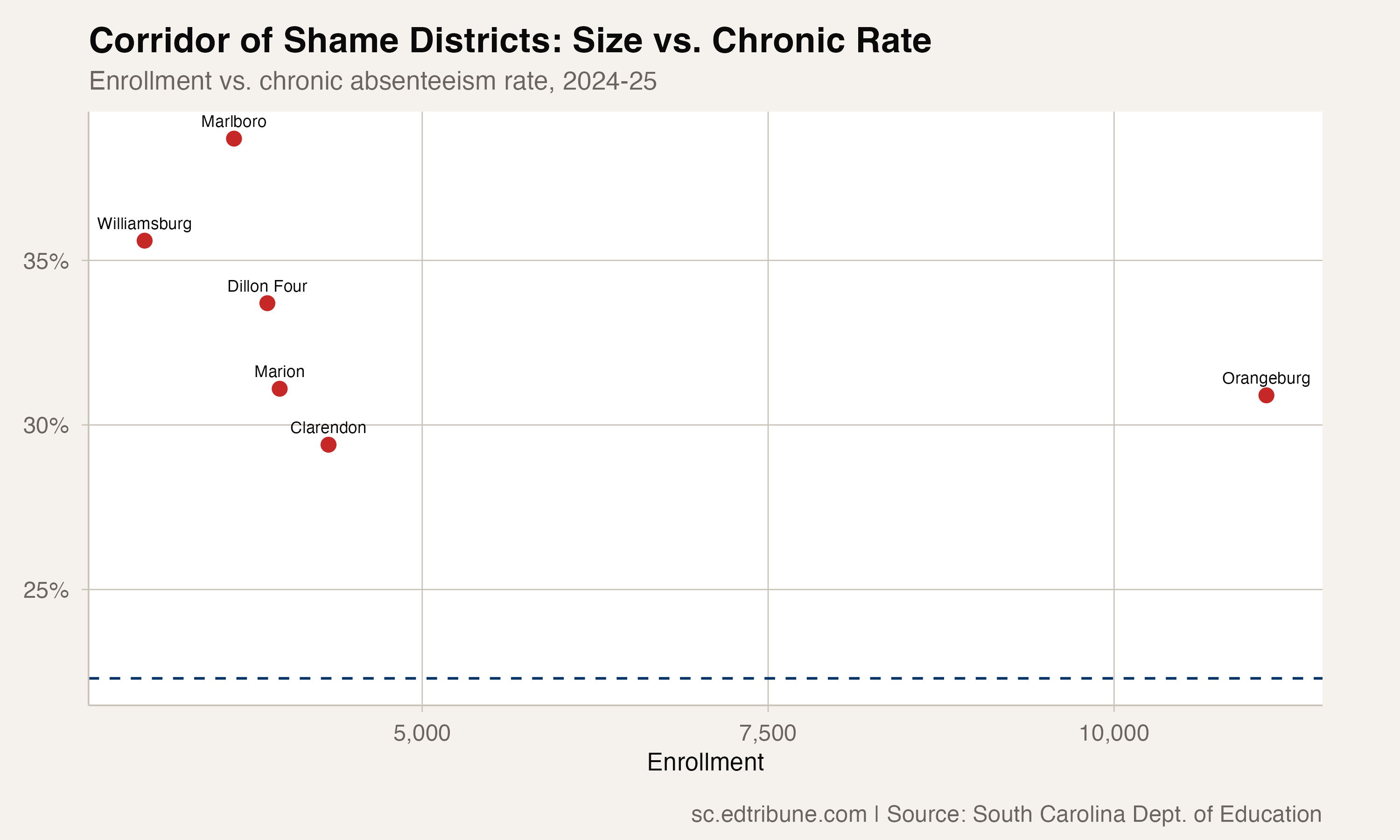
Allendale County enrolls just 929 students, a district so small that a single school bus breaking down can shift the chronic rate. But Orangeburg County, at 11,101 students, is large enough that its 30.9% rate cannot be dismissed as small-sample noise. And Florence One, a 16,699-student district that serves the corridor's largest city, has a rate of 26.4%, four points above the state average despite the urban advantages of denser transportation networks and more service providers.
The same districts, the same crisis
The enrollment series for The SCEdTribune documented these same districts' enrollment declines: Williamsburg lost 39.7% of its students since 2015, Marion lost 24.3%, and Allendale's enrollment dropped below 1,000. Now the attendance data adds another dimension. The students who remain in these districts are missing school at rates that make academic recovery nearly impossible.
Research from InformEd SC found that only 23% of chronically absent students in grades 3-8 are on grade level for math, compared to 47% of students attending regularly. In districts where more than a third of students are chronically absent, the arithmetic of academic recovery is stacked against the entire community.
Clarendon and Lee
Clarendon County, at 29.4%, and Lee County, at 25.1%, sit slightly closer to the state average but still well above it. Clarendon is historically significant as the home of Briggs v. Elliott, one of the five cases consolidated into Brown v. Board of Education. More than seventy years after that landmark ruling, the district's students are still navigating educational barriers that begin with whether they can get to school.
Lee County, with only 1,434 students, is one of the smallest districts in the state. At 25.1%, its rate is "only" three points above the state average, but in a district this small, that translates to roughly 360 students, each one visible in a community where everyone knows whose child missed school this week.
What the funding gap looks like in attendance
The Abbeville v. State lawsuit, which began in 1993 and went through multiple rounds of litigation, argued that the state failed to provide a "minimally adequate" education to students in these districts. The lawsuit focused on facilities, teacher quality, and per-pupil spending. Chronic absenteeism was not on the radar in 1993. It is now.
The connection is not complicated. Underfunded districts have fewer attendance interventions, fewer counselors, fewer social workers, fewer resources to address the transportation and health barriers that keep students home. When Governor McMaster announced the doubling of school-based mental health counselors statewide, the question for these districts was not whether counselors help but whether the per-district allocation is proportional to the need.
Two decades after a documentary gave these districts their name, and three decades after the Abbeville lawsuit argued their children deserved better, the Corridor of Shame's attendance data reads like an indictment that has not yet been answered.
Detailed code that reproduces the analysis and figures in this article is available exclusively to EdTribune subscribers.
Discussion
Sign in to join the discussion.
Loading comments...