In this series: South Carolina Chronic Absenteeism 2024-25.
Every morning across South Carolina, 13,919 students classified as homeless wake up in shelters, motels, doubled-up apartments, or cars and try to get themselves to school. Nearly half of them do not make it often enough. The chronic absenteeism rate for students who are currently homeless hit 48.7% in 2024-25, a figure so high that it effectively means a coin flip determines whether a child who is homeless in South Carolina will miss more than a month of school in any given year.
What makes the number alarming is not just its magnitude but its stubbornness. Four years of data tell a flat line where there should be improvement: 46.1% in 2021-22, 48.8% in 2022-23, 48.5% in 2023-24, and 48.7% in 2024-25. The state's overall chronic rate peaked at 24.8% in 2022-23 before falling to 22.3%, though it remains above the 20.4% rate when the data begins in 2021-22. For students who are currently homeless, the needle barely moved.
A growing population and a widening count
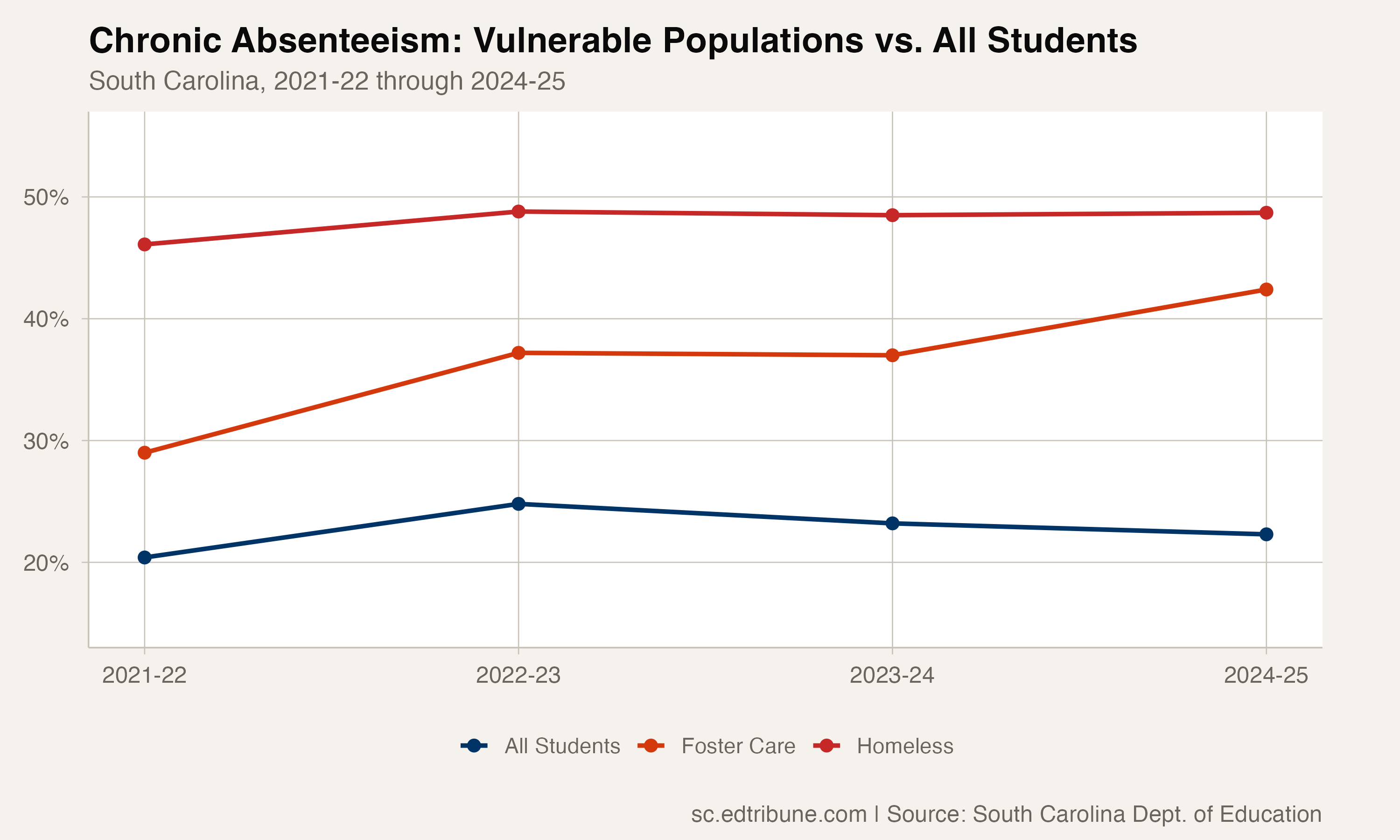
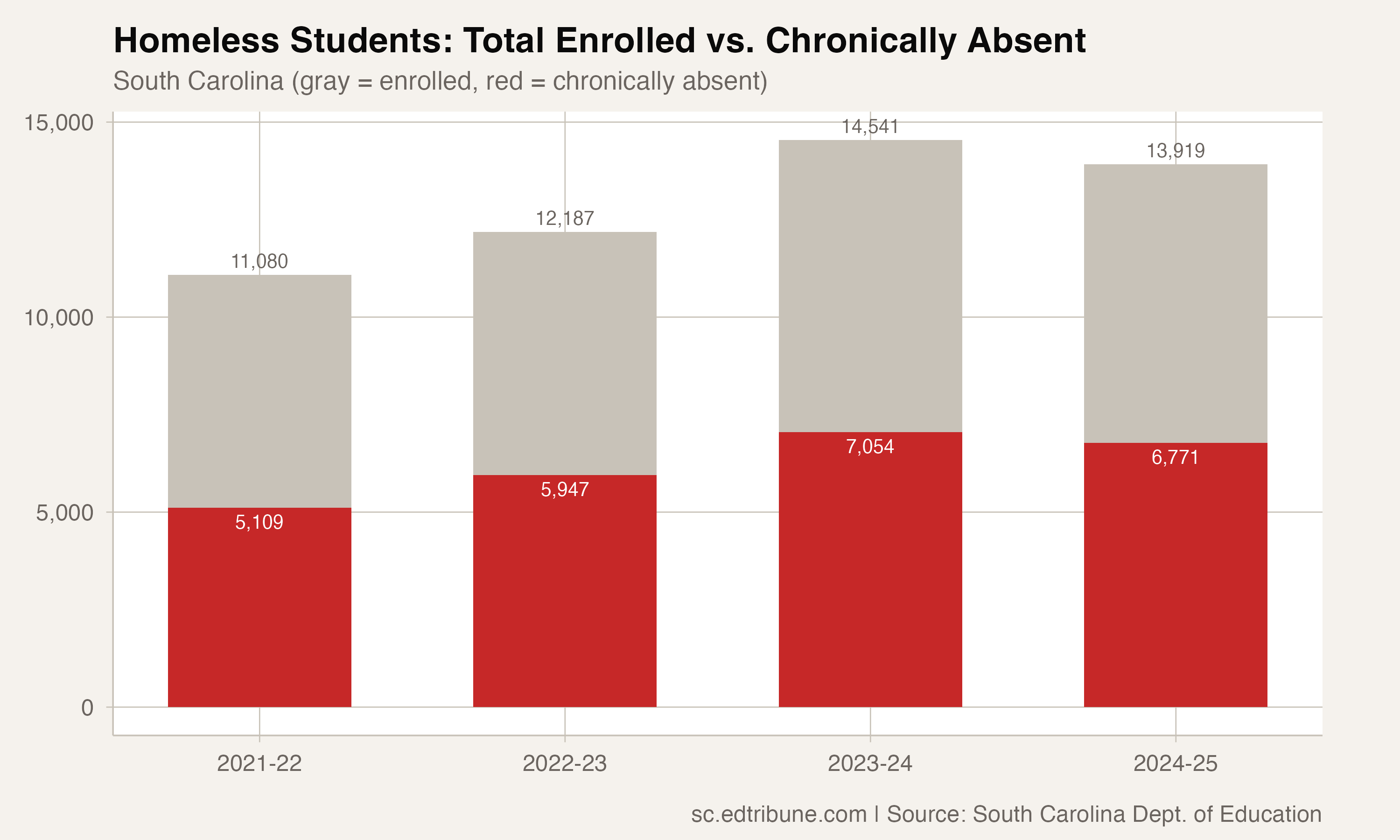
The gap between students who are currently homeless and the general population has widened from 25.7 percentage points in 2021-22 to 26.4 points in 2024-25. And it is a gap applied to a larger base: the number of students identified as homeless grew from 11,080 in 2021-22 to 13,919 in 2024-25, a 25.6% increase. In raw terms, that means 6,771 students who are currently homeless were chronically absent last year, up from 5,109 four years earlier, an increase of 1,662 students.
The McKinney-Vento Act, which guarantees educational rights for students who are currently homeless, requires schools to provide transportation, immediate enrollment, and access to services. South Carolina's data suggests that even with those protections, the sheer instability of homelessness overwhelms any intervention school districts can provide. A student who moved three times during the school year and does not have consistent transportation is going to miss school, regardless of what the attendance plan says.
Foster care: heading the wrong direction
If students who are currently homeless represent a crisis frozen in place, students in foster care represent one that is actively worsening. Their chronic absenteeism rate was 29.0% in 2021-22. By 2024-25, it reached 42.4%, a 13.4 percentage point increase that is the worst trajectory of any student subgroup in South Carolina.
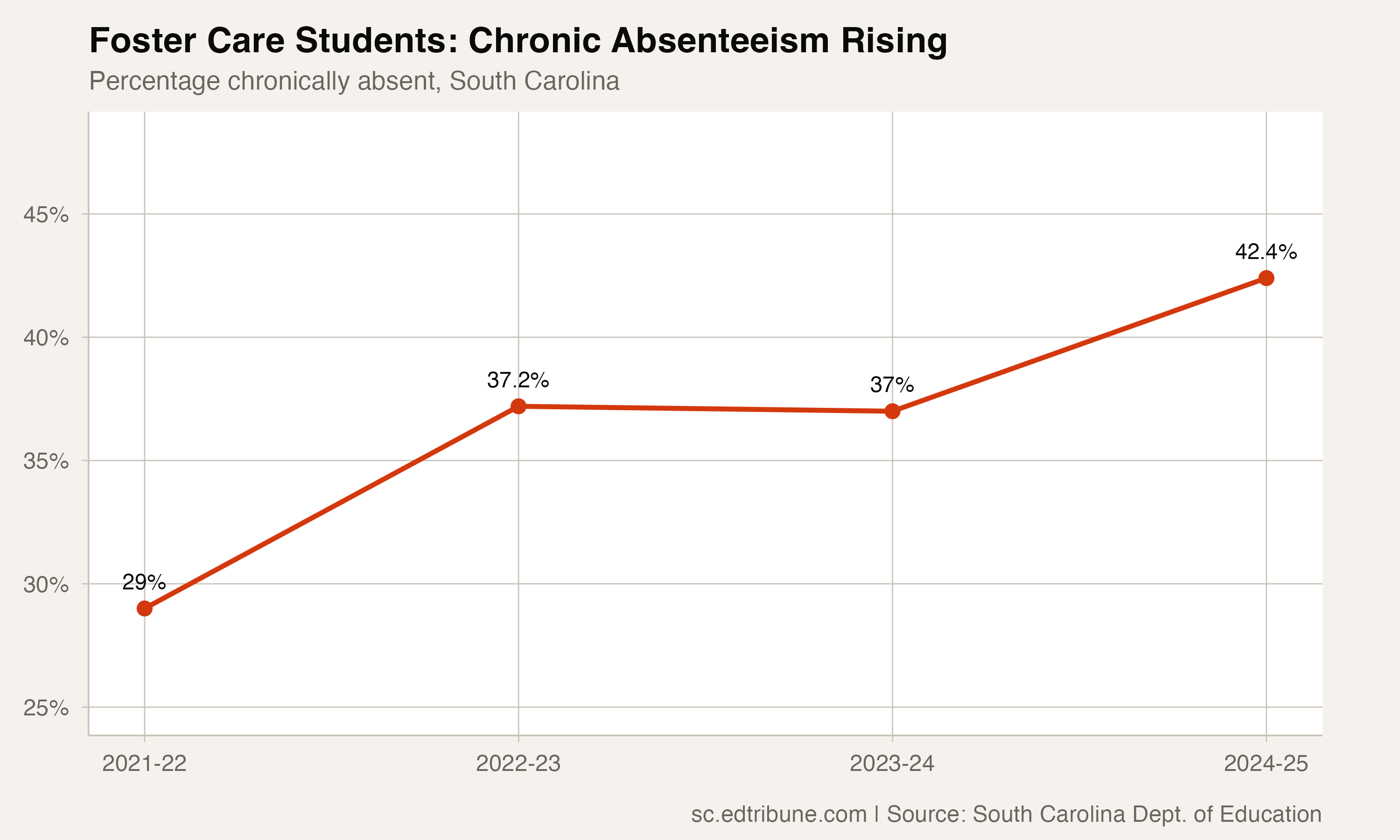
The 2024-25 jump alone was striking: a 5.4 point increase from 37.0% to 42.4%, the largest single-year increase of any subgroup. This happened even as the foster care population itself shrank dramatically, from 5,892 students to 3,192 over four years, a 45.8% decline. The students who remain in foster care are, by this measure, those with the most severe barriers to attendance.
Foster care placement changes mean school changes. School changes mean lost relationships, new bus routes, unfamiliar classrooms, and a child who may simply stop trying to navigate the system. With 1,352 students in foster care chronically absent in 2024-25, the numbers are smaller than for students who are currently homeless, but the trajectory is more dire.
The achievement connection
InformEd SC data puts the academic stakes in sharp terms: only 23% of chronically absent students in grades 3 through 8 are at grade level in math, compared to 47% of students with regular attendance. For students who are homeless and those in foster care, who already face achievement gaps from instability, chronic absenteeism compounds the disadvantage.
The state doubled its school-based mental health counselors from 600 to 1,209 between 2022 and the 2023-24 school year. That addresses one thread of the problem. But a counselor cannot drive a child from this week's motel to last week's school. A counselor cannot prevent the third placement change in a semester for a child in foster care who has stopped unpacking their backpack. The barriers for these students begin before they reach the school building, and that is where they must be met.
Detailed code that reproduces the analysis and figures in this article is available exclusively to EdTribune subscribers.
Discussion
Sign in to join the discussion.
Loading comments...