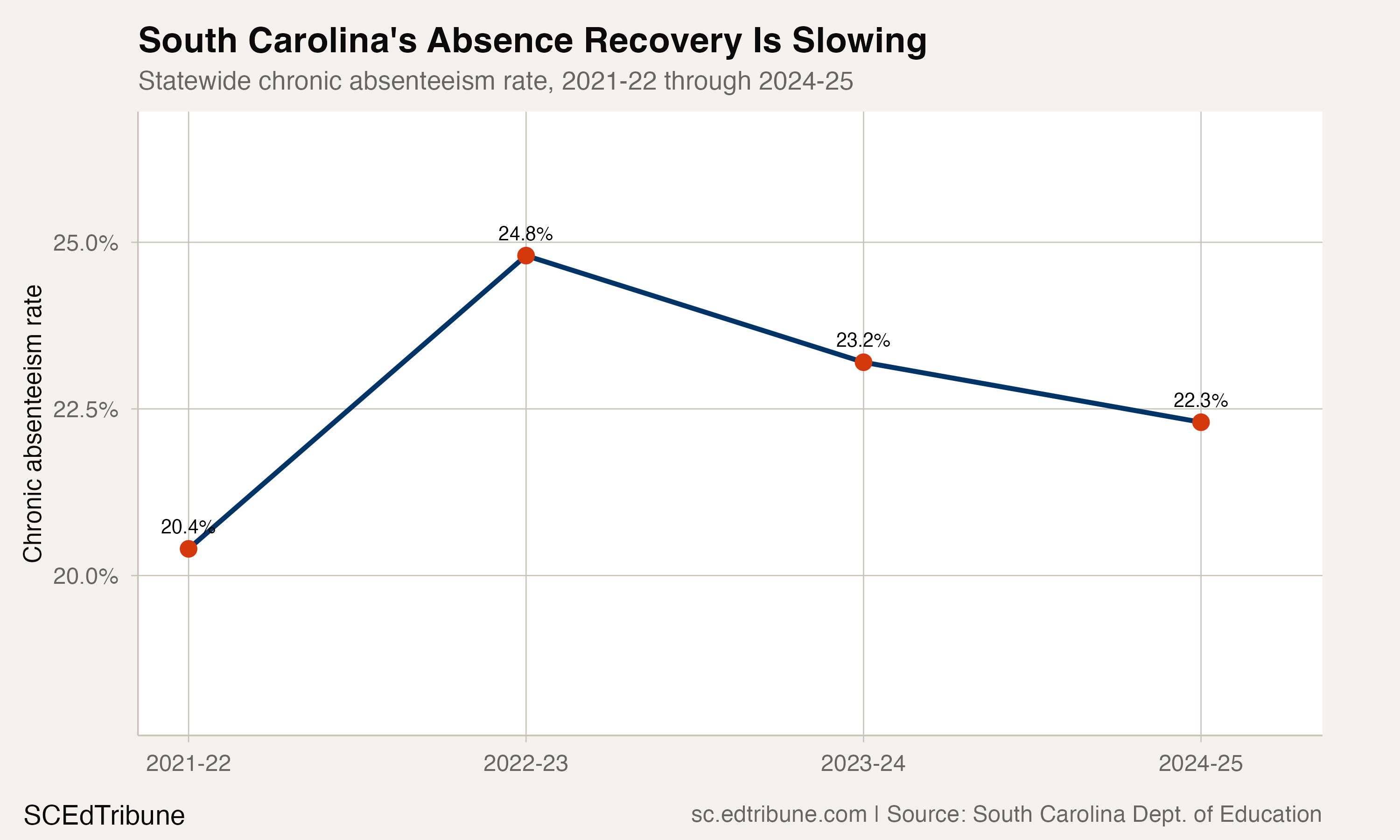
South Carolina's chronic absenteeism rate peaked at 24.8% in 2022-23, when roughly 209,000 students missed 10% or more of the school year. Two years later, the rate is 22.3%, or 176,344 students. The improvement is real. The pace of improvement is slowing.
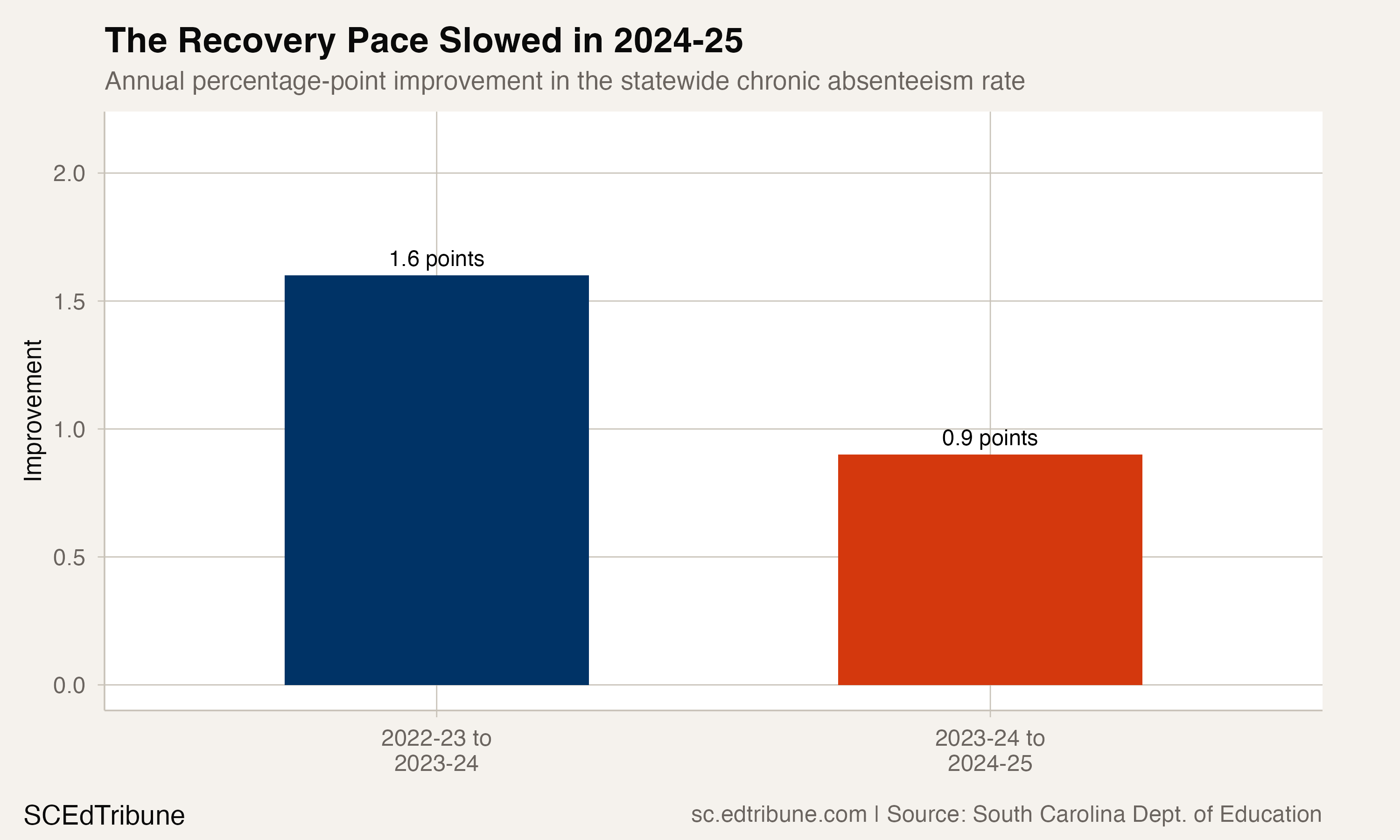
The state dropped 1.6 percentage points in 2023-24. It dropped 0.9 points in 2024-25. After two years of recovery, South Carolina is still 1.9 points above its 2021-22 level. Every year that 176,000 students miss too much school keeps attendance recovery from being just a school-climate problem. It is an instructional-time problem at statewide scale.
The Scale of the Problem
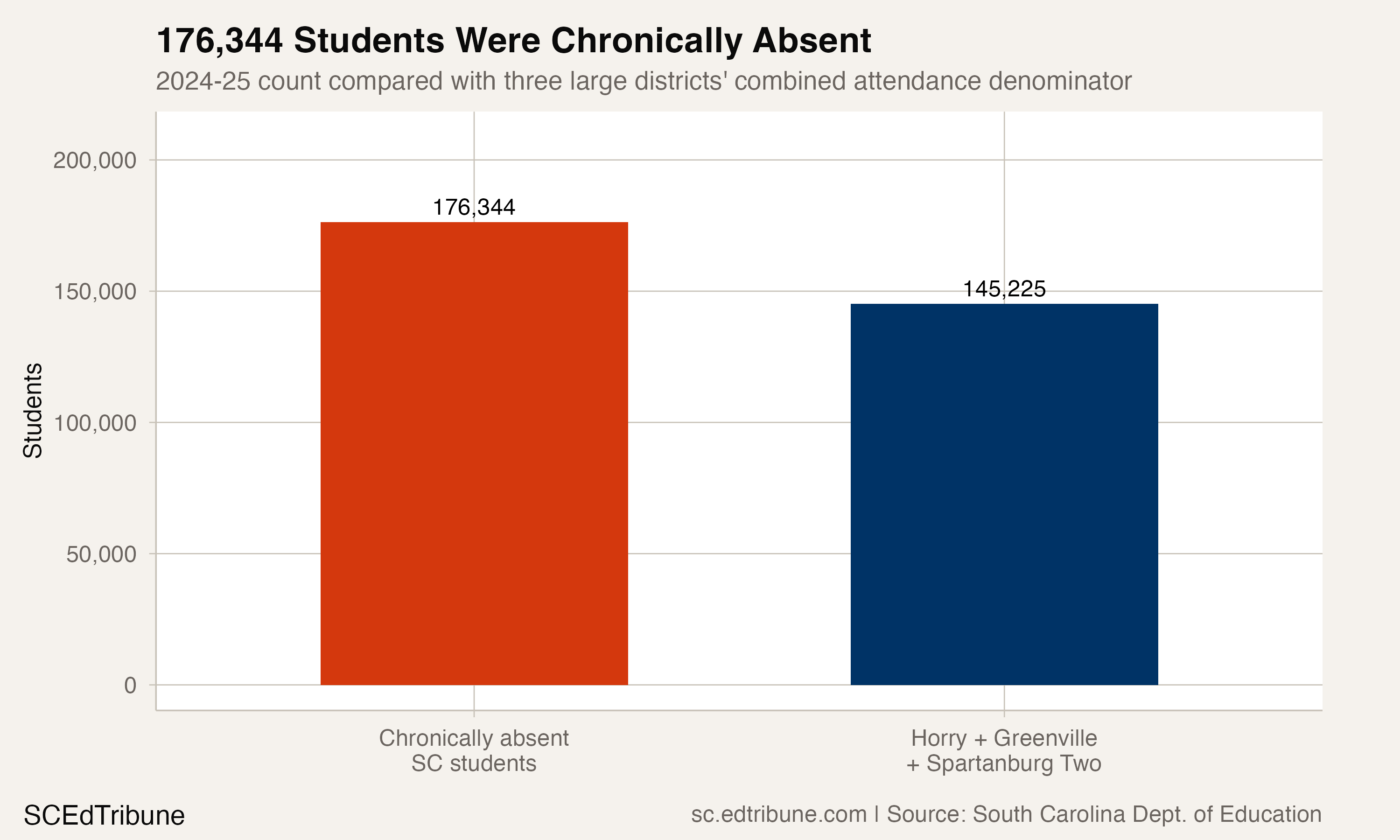
In 2024-25, 176,344 students were chronically absent statewide, more than the entire enrollment of Horry County, Greenville County, and Spartanburg Two combined.
Only 23 of 77 trackable district-level entities have returned to, or improved on, their 2021-22 chronic absenteeism rates. That leaves 54, or 70%, still worse off on attendance than they were three years earlier. Fourteen district-level entities reached their lowest rate in the 2021-22 to 2024-25 data window, which is genuine progress, but the statewide rate remains above 20%.
Two Approaches, One Problem
South Carolina is running two natural experiments on attendance simultaneously, and their philosophies could not be more different.
Be Present S.C. is the Education Oversight Committee's statewide attendance campaign. The EOC said the campaign would kick off July 28, 2025, with 55 public schools, after student and parent focus groups and a survey of more than 2,000 parents shaped the messaging; partner schools received resources, marketing materials, and social media materials (direct evidence). The campaign's current page says more than 6,700 students have taken its attendance pledge (direct evidence).
Charleston County's $25-per-week pilot takes a direct financial incentive approach. In spring 2025, close to 1,900 students across 10 schools were eligible for $25 weekly payments for perfect attendance (direct evidence). The district's current incentive page says the pilot produced a 1.48-point attendance increase in pilot school-grade groups compared with non-pilot groups, or 2.11 points excluding West Ashley High (direct evidence).
The two approaches represent fundamentally different theories of why students are absent.
Be Present S.C. assumes the problem is partly informational and motivational: families and students need clearer prompts, shared language, and repeated reminders that missed days add up. That is direct evidence about the campaign design, not proof of effect. The EOC's own focus-group summary pointed to doctor's visits, mental-health concerns, and the belief that daily attendance is not necessary as contributors to absences (suggestive context).
Charleston's incentive pilot assumes the problem is partly economic, and CCSD explicitly links chronic absenteeism to barriers such as transportation, family responsibilities, and financial hardship (direct evidence for the district's rationale). The early attendance numbers are encouraging, but they do not prove whether the gains will persist once payments stop.
The Intervention Gap
Both approaches face the same structural challenge. The worst rates in the state are not small misses around the edges of the school calendar. They are places where more than one-third of students are chronically absent.
In Marlboro County, the chronic rate is 38.7%. In Allendale, it is 41.8%. In Williamsburg, 35.6%. These are not communities where parents do not understand that school matters. They are communities where poverty, transportation, health care access, and generational trauma create barriers that no pledge or modest incentive can overcome alone.
The bright spots in this series point in a different direction. Greenwood 52 is at 7.8%. Laurens 55 fell from 28.8% in 2021-22 to 17.7% in 2024-25. Fort Mill is at 8.5%, and Clover reached 14.4%. The data cannot say which local practice caused those results. It can say the strongest attendance outcomes are unevenly distributed, and that local execution matters.
The Mental Health Factor
The state has also invested in a third theory of the problem: that some chronic absenteeism is tied to student mental health. SCDHHS's January 2026 update says the number of school-based mental health counselors rose from about 600 in 2021-22 to 1,391 at the start of 2025-26, while the statewide counselor-to-student ratio improved from roughly 1:1,300 to about 1:567 (direct evidence).
The counselor expansion is resource-intensive and potentially more direct than messaging. A student who will not come to school because of anxiety needs something different from a student who cannot come because of transportation. That is suggestive context, not causal proof; the attendance data do not isolate mental-health access as the driver of the statewide decline.
Meanwhile, H.4735 would create a Truancy Root Cause Intervention Study Committee and require legislative recommendations before July 1, 2027. As of this July 2026 fact-check, the joint resolution is still in the House Education and Public Works Committee (direct evidence). South Carolina's current truancy rules already say school districts should take reasonable educational steps and complete a written intervention plan before referral to Family Court (direct evidence).
The Path From Here
At the current pace of recovery, South Carolina is improving, but slowly. The latest year cut the statewide rate by less than a point. That is a meaningful change when the denominator is 792,005 students. It is not fast enough to make chronic absenteeism feel like a temporary pandemic aftershock.
The question is whether any combination of Be Present pledges, financial incentives, mental-health access, and truancy reform can accelerate the recovery. The data show the scale of the problem. The linked policy sources show what the state and Charleston are trying. They do not yet show which intervention, if any, can move South Carolina from incremental improvement to a durable attendance reset.
The 14 district-level entities at available-period lows suggest the answer is not uniform. Some communities are solving this problem. The challenge is making what works in Greenwood 52, Fort Mill, Laurens 55, or Clover work in Allendale, Marlboro, and Williamsburg, places where the obstacles are fundamentally different and where a $25 check or a student pledge may be only part of what is needed.
Detailed code that reproduces the analysis and figures in this article is available exclusively to EdTribune subscribers.
Discussion
Sign in to join the discussion.
Loading comments...