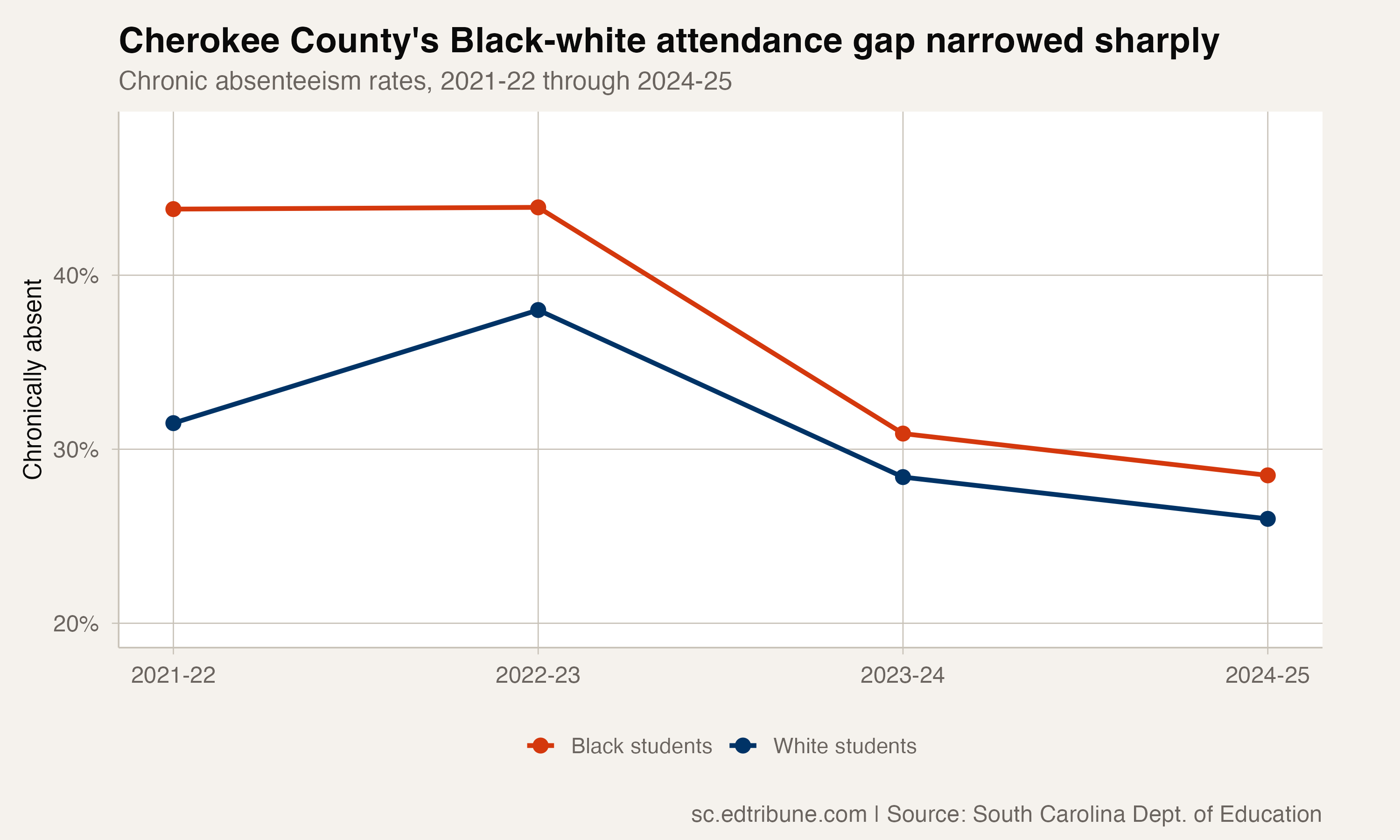
In 2021-22, Cherokee County School District↗ET had a problem visible in two numbers: 43.8% and 31.5%. Those were the chronic absenteeism rates for Black and white students, respectively. The 12.3 percentage point gap was 50% wider than the statewide Black-white gap of 8.2 points, and it meant that Black students in Cherokee County were missing school at crisis levels, nearly one in two chronically absent.
Three years later, the gap is 2.5 percentage points. Black students are at 28.5%, white students at 26.0%. Near parity.
What happened in Cherokee County is the largest Black-white attendance equity gap closure among South Carolina districts averaging 5,000 to 10,000 students across 2021-22 and 2024-25. And it did not happen because one group got worse. Both groups improved substantially. Black students just improved faster.
The Math of Genuine Convergence
Equity gaps can close in ugly ways. If white students' rates spike to match Black students' rates, the gap closes, but nobody is better off. That is not what happened in Cherokee County.
Black students' chronic rate dropped from a 43.9% peak to 28.5% in 2024-25, a 15.4 percentage point improvement. White students dropped from 38.0% (their 2022-23 peak) to 26.0%, a 12.0-point improvement. Both groups improved by double digits, with Black students improving 3.4 points more.
| Student Group | 2021-22 | 2022-23 | 2023-24 | 2024-25 | Change from Peak |
|---|---|---|---|---|---|
| Black | 43.8% | 43.9% | 30.9% | 28.5% | -15.4 pp |
| White | 31.5% | 38.0% | 28.4% | 26.0% | -12.0 pp |
| Gap | 12.3 pp | 5.9 pp | 2.5 pp | 2.5 pp | |
| All Students | 35.1% | 39.3% | 28.6% | 26.2% | -13.1 pp |
Source: SC Department of Education, 2021-22 through 2024-25
The gap closed fastest between 2021-22 and 2022-23, dropping from 12.3 to 5.9 points, but that first narrowing was partly an artifact of white students' rates spiking to 38.0% while Black students' rates held flat. The meaningful convergence came in 2023-24, when both groups dropped sharply and the gap compressed to 2.5 points. It has held at that level through 2024-25.
Compared to the State
While Cherokee County was closing its gap by nearly 10 points, the statewide Black-white chronic absenteeism gap barely moved: 8.2 points in 2021-22, 7.9 points in 2024-25.
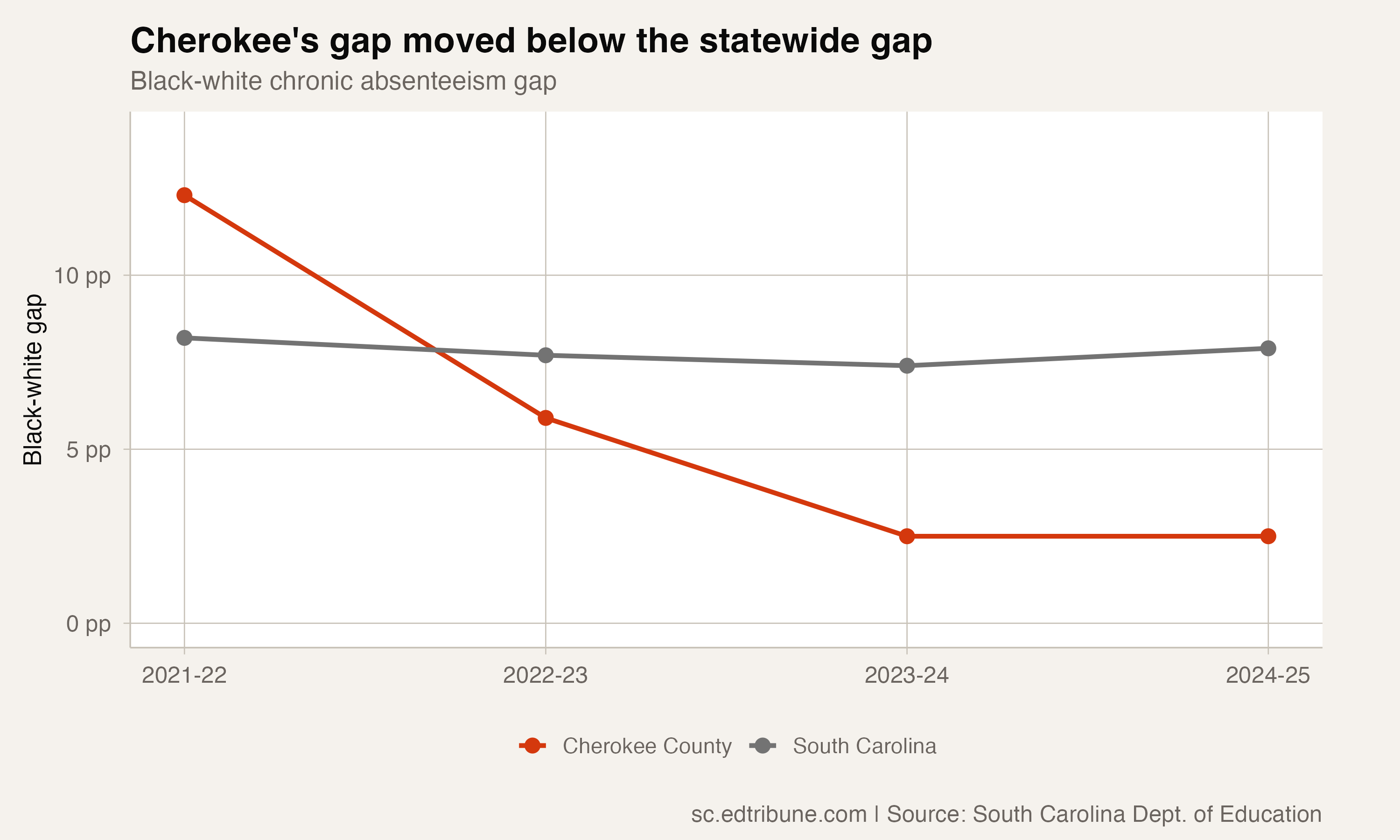
South Carolina's statewide gap has been remarkably stable across all four years of data, fluctuating between 7.4 and 8.2 points. That stability makes Cherokee County's trajectory (from 50% above the state gap to one-third of it) all the more unusual.
The District's Overall Trajectory
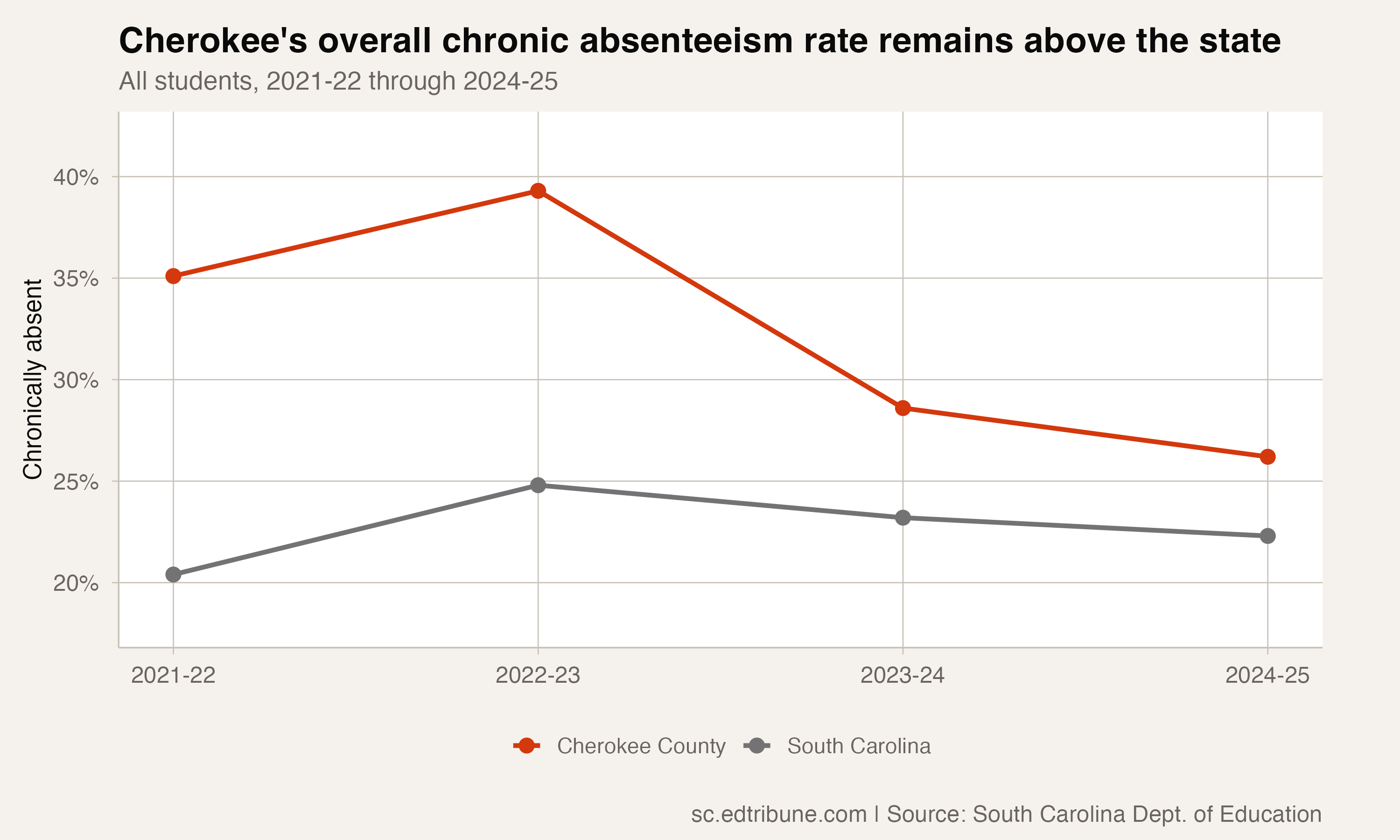
Cherokee County's overall chronic rate of 26.2% remains above the state average of 22.3%. The gap closure happened in the context of a district that still has significant attendance challenges. But the trajectory is encouraging: down from a peak of 39.3% in 2022-23, a 13.1 percentage point improvement.
The school-level data shows where the improvement was concentrated. Gaffney Middle School dropped from 43.2% to 23.0%, a 20.2 percentage point improvement. Luther Vaughan Elementary fell from 47.4% to 26.2%. Draytonville Elementary went from 49.8% to 31.3%. These were schools where nearly half the student body was chronically absent; they are now closer to one in four or one in three.
Not every school improved. Blacksburg Primary went from 19.1% to 29.9%, and Grassy Pond Elementary rose from 9.6% to 18.8%. The district-level improvement came despite these increases, driven by large improvements at the schools that had been worst off.
What the data does not explain
The data verifies the outcome, not the mechanism. Direct evidence: Cherokee County's Black-white chronic absenteeism gap closed from 12.3 points to 2.5 points while both groups improved. Unresourced: whether the improvement came from a deliberate equity-focused strategy, districtwide attendance interventions, school-level practice, changes in student composition, or some combination.
What the data shows definitively is that the outcome many education systems say they want -- closing racial attendance gaps through mutual improvement, not through leveling down -- happened in Cherokee County. At 2.5 points, the district's Black-white gap is close to parity by the standards of attendance data. The next test is whether that gap stays narrow while the district's overall chronic absenteeism rate moves closer to the state average.
Detailed code that reproduces the analysis and figures in this article is available exclusively to EdTribune subscribers.
Discussion
Sign in to join the discussion.
Loading comments...